
2025 In Review – Different But Overall Positive
My clients and I headed east as the early morning sun broke the horizon to bless us with yet another flawless watercolor painting made up of purple, blue and orange hues to start our morning. I had a plan and knew exactly where we needed to go to get on some solid trout. One of my customers said, “Man! We’re gonna hammer them today!” I normally don’t want to hear things like that when we haven’t even made a cast yet, but fishing had been so good that I didn’t worry about it. I’m somewhat of a superstitious fella, but fishing was so incredible during this stretch that I could’ve walked under a ladder with a black cat crossing my path and I would have been just fine.
We pulled up to the middle of Deep Reef in East Galveston Bay. There were four or five slicks about the size of my Whaler popped up on the west side of the reef where a local oyster dealer had recently been transplanting oysters. A blue plastic jug marked the spot. I used my trolling motor to get into position, then—like a duck hunting guide instructing his hunters—“Okay guys! Take ’em! Go ahead, cast!” We caught more than 60 trout up to 6 pounds in less than two hours. That giant school lived on that stretch of live reef for the entire summer and fall. Several other guides and I caught so many trout from that spot that I joked with one of them that I was going to have some t-shirts made…Team Blue Jug. There were plenty of areas throughout our bay system producing results like this during that period. This was about 15 years ago.
I talk about those days more often than some folks probably care to hear, but these days are quite different. We still have plenty of fish to catch, but they aren’t necessarily in the areas they used to be. We’ve had to make adjustments and relearn where the new hot spots are in the Galveston Bay Complex. Reefs like Deep Reef, Middle Reef, Whitehead, and the spoil reefs along the Houston Ship Channel don’t produce like they did over the past decade. Trinity Bay areas like C Lease, F Lease, Jack’s Pocket and Anahuac Pocket have their moments, but those moments are fewer, farther between, and mostly produce smaller trout. All of that being said, we’re still catching plenty of decent trout—just not where we used to catch them.
I take this time and space in the magazine each year to look back over the previous twelve months and evaluate the state of our fishery based on all of my experiences from January through December. My evaluation won’t change the way things are, but hopefully it paints a picture of where we currently stand so those who read this can visualize where we’re headed. Planning our fishing trips is much easier when we have a good idea of what to expect.
January of 2025 was characterized by big cold fronts, northwest winds, high barometric pressure and low tides. Fishing was very good on the days we could go, but those days were few and far between. We caught some really solid trout on Saltwater Assassins and twitchbaits such as Double Ds, Leles and MirrOdines. There were lots of fish in the deeper guts, bayous and back lakes—if you could get to them. Salinity was high, so fishing up the rivers was good. Soft plastics like Saltwater Assassins and MirrOlure Provokers worked well on 1/8-ounce jigheads when cast into the deeper troughs, especially after the big fronts.
February was a decent month considering the high winds associated with the fronts. Low tides continued to be an issue, and some days I couldn’t find a ramp with enough water to launch. Fishing was good when we could get out because trout were stacked in certain areas. February basically mirrored January.
March of 2025 ended up being typical March fishing—windy and inconsistent. My Galveston Bay trips averaged 12 to 16 trout with some redfish mixed in, but sizes were solid with some 3- to 4-pound trout. Wading coves was more productive than drifting. My East Matagorda trips produced better results than Galveston for the most part—but that’s usually the case for me this time of year. The spring transition just doesn’t affect those trout like it does up here.
April is always a coin toss. Trout are in a serious transitional state because of temperature fluctuations and microscopic bait concentrations. High winds add to the early-spring challenges. But April 2025 offered a pleasant surprise. East and West Galveston Bay shorelines produced well for us, especially while wading. When I didn’t have wading clients, the bayou drains and back lakes got the job done drifting over shallow reefs with bulled-up tides. Not the 30- to 50-trout days we had wading, but good enough to keep everyone smiling. Tails and twitchbaits, with a few topwaters mixed in, produced solid results.
May is always a month where fishing busts wide open, and 2025 was no different. We experienced an incredible shad hatch and brown shrimp migration. Everything lined up for an awesome late-spring/early-summer trout run as resident trout formed tighter schools while tide-runner specks moved in from the Gulf. We had several 30- to 40-fish mornings and could’ve caught more if we wanted to lean on them. Fishing over live oyster reefs was the ticket. Soft plastics were our main choice, but just about anything worked most days.
June and July were steady fishing months as trout settled into summertime locations on deeper reefs, near wells and along man-made rock barriers. We also continued catching mid-slot trout wading south shorelines of both East and West Bays. Fishing structure was key on days without visible signs like slicks.
We found plenty of solid trout during August and September by focusing on old wells and unmarked well pads in deep water with nearby live reef. Most of our fish were caught on Assassins and Lil’ Johns on 1/4-ounce jig heads, but some days we did very well throwing soft plastics on lighter heads and even topwaters in 10 to 13 feet of water!
The first three weeks of October kept us fishing deep, but I could tell some fall areas were close to popping because of new bait concentrations near softer-bottomed guts and ledges. We just needed a front or two. Sure enough, the first real front blew through near the end of the month and trout fishing busted wide open in those areas.
As I type this on November 20th, we’ve had only two legitimate cold fronts. The first was October 29th; the second pushed through November 9th, dropping air temps into the mid-thirties and briefly bringing surface temps to 58.5 degrees. Both fronts triggered week-long feeding frenzies for trout, redfish and flounder. Speaking of flounder—fishing has been exceptional again this fall, and I’m not even targeting them! Redfishing has been hit or miss for slots, but oversized reds seem to become more plentiful each year.
By the time this publication reaches your mailbox, inbox, or store shelf, December will be winding down. Based on how things are shaping up, I predict we’ll experience a pretty darn good month to close out the year, especially with more frequent cold fronts. For December, we’ll continue focusing on ledges when water temps are in the fifties and low sixties, then spend more time on adjacent shallow flats during warm-ups. Softer bottoms with mud and shell are prime this time of year.
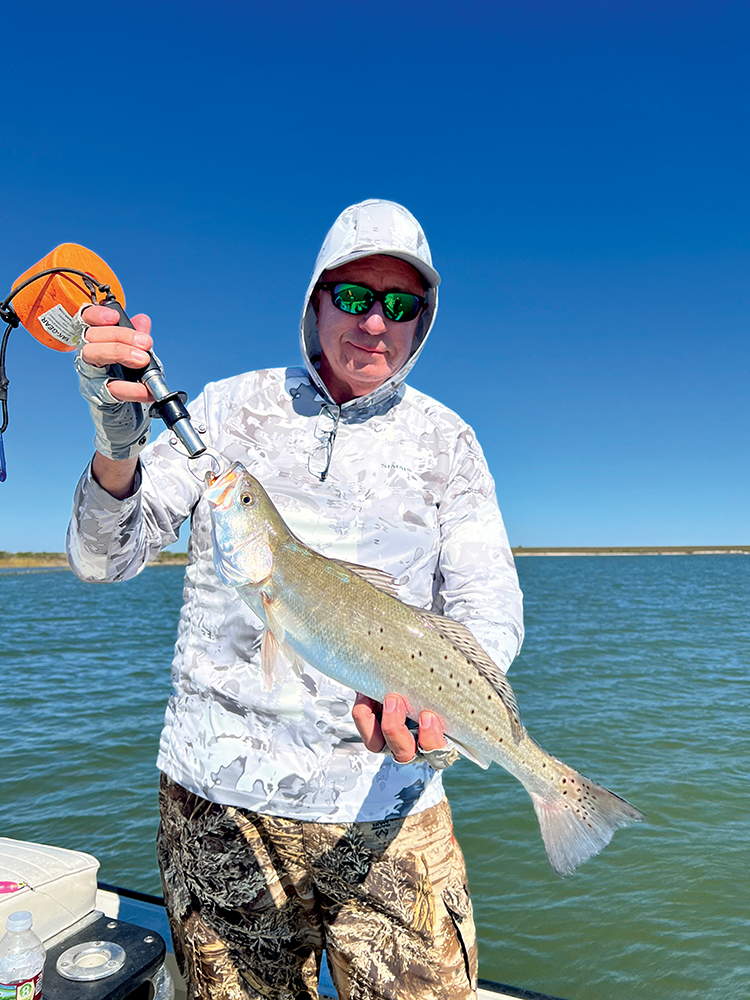
Here are the key takeaways for 2025, based on my experiences: Overall fishing was steady most of the year, with plenty of exceptional days. I observed older age classes of trout (more 3- to 4-year-olds) than I have in the last eight years (since the Harvey floods of 2017). Salinity remained suitable for trout throughout the entire Galveston Bay Complex—the best it’s been in about 11 years. Out of necessity, we continued doing more spot and structure fishing versus relying solely on slicks and rafting mullet like years ago. Schools of slot reds aren’t as easy to find as they once were, but oversized reds seem to be year-round residents. Flounder numbers—and size—appear strong. Limestone rocks planted for new oyster reef growth are working; we just need more. Seagrass beds are slowly returning in parts of West Galveston Bay, but we have a long way to go. Focusing on areas with some form of live habitat will greatly improve success.
And last but not least—time on the water gives anglers a bigger advantage than almost anything else when it comes to catching speckled trout these days. Always be willing to try something new, because things are different now. I hope everyone has a very Happy New Year with their families and loved ones! God Bless!