
35 Years in the Making - The Texas Artificial Reef Program
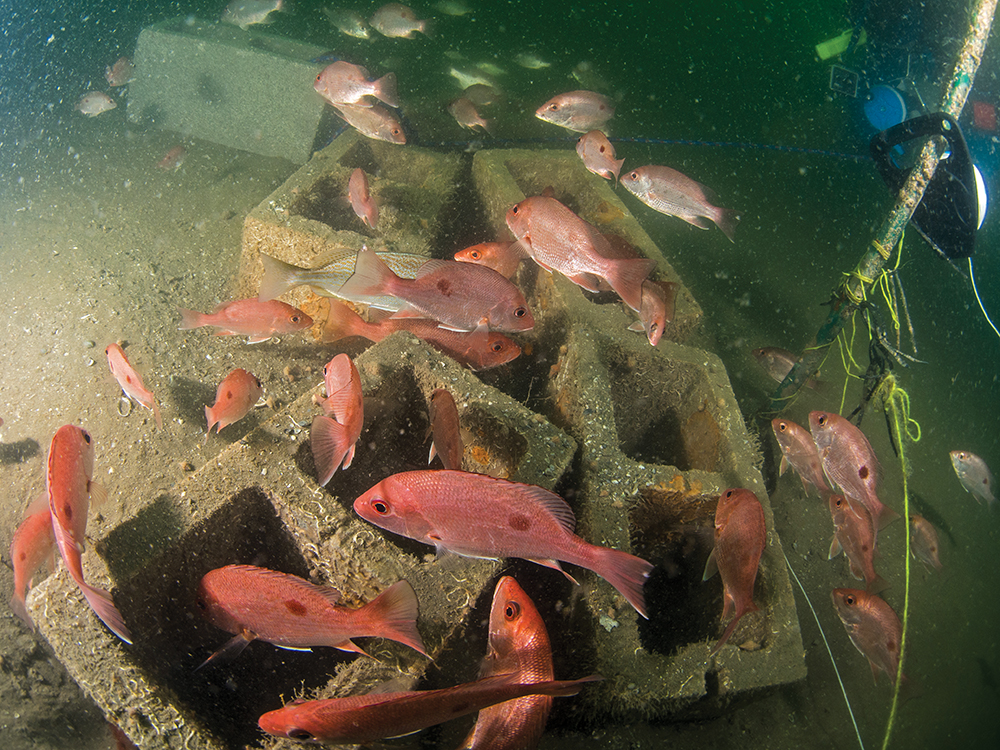
For 35 years, artificial reefing has become a cornerstone of Gulf restoration and recreational fishing off the Texas coast, filling a vital ecological and recreational gap where natural hard-bottom habitat is scarce. Managed by Texas Parks and Wildlife Department (TPWD), the Texas Artificial Reef Program was established by state law in 1990, and since its inception, has coordinated placement of ships, concrete modules, bridge sections, and portions of decommissioned oil and gas platforms to create durable, complex habitat on an otherwise flat continental shelf. These structures give barnacles, oysters, corals, and other sessile organisms a place to attach; those communities in turn attract juvenile and adult fish and concentrate food for predators—creating hotspots for anglers and divers alike. Simply put, build the habitat, and the fish (and the fishing opportunities) will follow.
The program has permitted about 7,450 acres since inception, with a total of 94 reef sites (16 nearshore reefs, 66 rigs-to-reef, and 12 ships-to-reef), more than 10,000 concrete structures deployed and over $36 million funded. Currently, TPWD is working with CCA Texas, CCA’s national habitat program, the Building Conservation Trust, and friends’ groups (Texas Parks and Wildlife Foundation, Friends of Sabine Reef, Friends of RGV Reef) on deployments at sites including Sabine, Port O’Connor, the Rio Grande Valley, and the Queen Isabella Causeway. Some of these deployments are funded by a $2.4 million RESTORE grant originally secured by CCA’s Building Conservation Trust.
Why artificial reefs matter to fisheries
The Texas Gulf is largely a flat, sandy shelf with few naturally occurring “hard” habitats; where hard structure exists, natural ridges or man-made structures, fish and invertebrate life congregate. Artificial reefs provide the substrate needed for invertebrates and algae to grow, creating food and shelter for juvenile fish and forage grounds for larger gamefish such as red snapper, grouper, king mackerel, cobia, and amberjack. TPWD monitoring finds red snapper commonly at artificial reef sites, and nearly 200 marine fish species have been recorded on reef-associated structures in Texas waters. These reefs increase local productivity and enhance fishing and diving opportunities.
Angler access is a central benefit of nearshore reefing. Texas manages fisheries out to 9 nautical miles from shore; inside that boundary, anglers are subject to state regulations and, in the case of red snapper, enjoy a near year‑round recreational opportunity with a more liberal bag limit than federal waters. Because much of our state waters lack depth and structure attractive to reef fish, nearshore reefs sited at appropriate depths are especially valuable for creating new, accessible red snapper and reef fish fishing grounds for anglers. TPWD explicitly designs some reef sites to be reachable by smaller boats and to support local ecotourism and diving economies. One such example is the 20-acre HI-54 Shallow site 1.7 miles from the coastline in front of Sea Rim State Park, which received its first deployment of concrete culverts, granite blocks, and old oil rig structure pieces in June 2024. This reef site serves as a template for future reef locations since it is easily accessible and provides ample opportunities to target speckled trout, red drum, mackerel, jackfish, and sharks.
Site selection: opportunities and conflicts
Selecting reef locations requires balancing ecological gain, public access, and other marine uses. The Texas artificial reef plan and program guidance emphasize minimizing conflicts with shrimping grounds, navigation routes, endangered species habitats, and culturally sensitive sites while maximizing benefits for recreational and commercial fishers. State law and the Texas artificial reef plan direct TPWD to use best available science, coordinate permitting, and avoid unreasonable obstruction to navigation, hence the careful permitting, marking and monitoring that accompany reef projects. These competing uses and regulatory constraints explain why siting and permitting can be lengthy and why nearshore sites are carefully prioritized.
Funding and the rigs‑to‑reefs model
Although TPWD has a legislative mandate to run the artificial reef program, funding has been a limiting factor. A significant source of funding and material has come from rigs‑to‑reefs partnerships: when oil and gas platform owners donate decommissioned platforms (or share realized removal-cost savings), TPWD can pursue permits and deployment. TPWD and partners have repurposed more than a hundred platforms into reef habitat. Conservation organizations (notably CCA Texas and the Building Conservation Trust), grant programs such as RESTORE, donations from private companies (such as Port Arthur LNG, Cheniere, Golden Pass LNG, Phillips 66, Motiva, Valero, BNSF Railway, and others), and support from friends’ groups have provided important financial support for nearshore projects. Still, sustained funding is needed to scale reef construction and monitoring.
Looking ahead
Nearshore reefing offers a pragmatic, cost‑effective tool to restore lost habitat, improve fisheries, and expand public access to quality fishing and diving. Some permitting woes may soon be alleviated as TPWD is working closely with the Army Corps of Engineers to create a programmatic permit and agreement to streamline the permitting process for constructing artificial reefs. Projects such as the Queen Isabella Causeway conversion and recent deployments at Sabine and Port O’Connor illustrate what coordinated public‑private efforts can achieve: new habitat, stronger local fishing economies, and more places for anglers and divers to enjoy the Gulf. Continued partnerships, stable funding, and careful, science‑based site selection will be key to expanding these benefits and carrying the artificial reef program forward for the next 35 years.