
Better Data for Better Management: Anglers Can Help Improve the Red Snapper Fishery
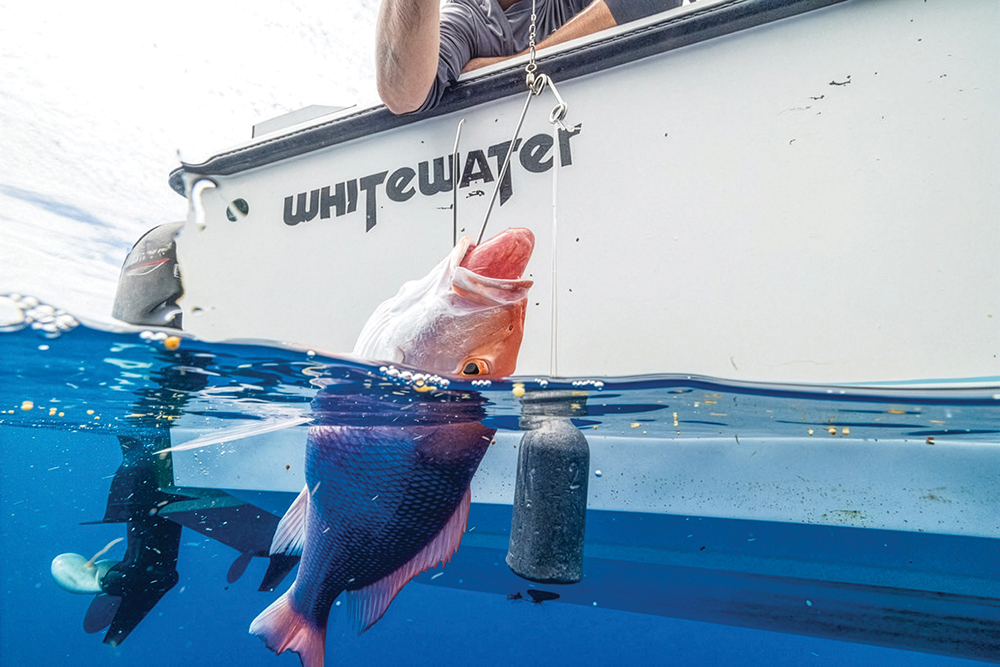
Figure 1: A Red Snapper showing visible signs of barotrauma after being brought up from depth. Before release, a descending device is attached to help return the fish to deeper waters. Photo Credit: Return 'Em Right
If you’re a recreational angler in Texas, you probably know the thrill of hooking a Red Snapper offshore, or the careful calculation that goes into deciding whether to keep it or throw it back. While most anglers are focused on what will eventually end up in their cooler, few give much thought to the fish that are caught and then released. But did you know that the fish you release, the ones you “discard,” are just as important to fisheries managers as the ones you keep? These discards are an important data point to assess the health of the population and are often extremely difficult to quantify in recreational fisheries.
Why Your Released Fish Matter
Even released fish aren’t guaranteed to survive. If you’ve ever caught a Red Snapper offshore, you’ve likely witnessed some of the effects that catching can have on the fish you’ve landed. Sometimes fish sustain injuries from the fishing gear itself (e.g., line entanglement, hook injuries), or experience increased stress from the “fight” or handling. If you’ve been out in the Gulf, you’ve also probably seen Red Snapper floating at the surface of the water—an effect of something called barotrauma. When fish are reeled up rapidly from deep water, the sudden drop in pressure causes gases in their body to expand, resulting in bloating, bulging eyes, and stomach protrusion, all of which prevent them from swimming back down to the bottom after release and leave them particularly vulnerable to predators.
Gear-related injuries, stress, and barotrauma all increase the likelihood that a discarded fish will die. This information is of particular interest to scientists and managers throughout the Gulf, because whether or not a discarded fish makes it back into the population can impact how many fish can be sustainably harvested by anglers.
Introducing the disCARD Study
To address the data gap regarding recreationally discarded reef fish in the Gulf, Texas Parks and Wildlife Department (TPWD) has teamed up with Mississippi State University (MSU) and the four other Gulf states to launch the “disCARD” Project. The goal is simple: to collect discard information from you, the angler!
Each Gulf state, from Texas to Florida, will distribute physical cards (disCARDs) to anglers before they leave the boat ramp for a Gulf fishing trip. Anglers will be asked to record the fish they release on the disCARD itself, noting things like:
- Species of fish discarded (Red Snapper, Greater Amberjack, or Cobia)
- Depth of water where a fish was released
- Released in state or federal waters
- Reason for discarding (undersized, reached bag limit, etc.)
- Fish fate upon release (alive or dead)
Each of these data points provides crucial information for managers. For example, the depth of the water where a fish was caught and released can affect its likelihood of survival. Additionally, understanding the difference between discard rates in state and federal waters can help guide season openings and closures. Even things like an angler’s reason for releasing a fish can help managers to understand a lot about the fishery—we might glean information on the effort required to reach the bag limit, the rate at which you are encountering undersized fish, or even preferences for keeping certain sizes of fish. Each of these data points give managers the information needed to better assess the status of populations and understand what you, as an angler, value.
Once anglers are finished with their trip, they can simply text a photo of the card to submit it—no app is needed thanks to the work put in by MSU and Bluefin Data. It’s that easy!
What Might Texa[DS1] s Anglers See at the Ramp?
In Texas, disCARDs will be distributed at ramps in three areas along the Texas coast: Galveston Bay, San Antonio Bay, and the Lower Laguna Madre. These locations were selected to represent any potential regional differences in offshore fishing behavior. To account for any seasonal variation in offshore fishing, this project will run for a total of 18 months (May 2026 through November 2027).
So, if you’re leaving for an offshore fishing trip from a ramp in one of these three bays over the next year and a half, keep an eye out for TPWD staff, grab a disCARD, and be a part of gathering stronger science and supporting a healthier fishery for everyone. Your fish matter—every single one!
Be Part of the Science
The disCARD Project is a huge step towards addressing an important gap in offshore reef fish management in the Gulf. Information about the fish you throw back might seem small, but it’s critical for managers to maintain healthy fisheries. When we have data on how many fish are released and in what condition, we can replace assumptions with actual numbers in Gulf-wide stock assessment models. This can improve decisions on things like catch limits and season lengths, ensuring that fish populations stay healthy while anglers continue to enjoy great fishing.
However, getting this information depends on anglers like you participating. By filling out a disCARD and sharing what happens on your trip, you can help scientists and managers collect real data to replace current assumptions. In short, stronger science means better fishing. Your participation directly helps managers make decisions that benefit both the fish and the people who love to catch them, ensuring better and healthier Gulf fisheries for years and generations to come!
[DS1]This might be nit-picky but I feel like saying "Texas Anglers" will encompass all anglers that will fish along the Texas coast throughout this study whereas "Texan Anglers" comes off a bit more like only referring to native Texans.