


Black Drum Fishing On The Rise: Are There Enough To Go Around?

Saltwater anglers of Texas are no strangers to the joy of catching spotted seatrout, red drum and flounder in our coastal waters. These fish are quintessential for the Texas fishing experience so much so that catching these three fishes in one day is commonly called “The Texas Slam.” Afterall, these three saltwater sportfish are the most common within our bays. In recent years, there has been a growing number of anglers adding to the notorious trifecta and raising the bar by including one more species on the list – black drum.
Black drum belong to the croaker family, making them cousins to the treasured red drum and spotted seatrout. Unlike those fish, however, black drum remain a commercially harvested species along our coast. It was only 46 years ago that red drum and spotted seatrout transitioned from commercial to recreational harvest only. Around that time, there was growing concern over the notable decline in red drum and spotted seatrout. Bag and size limits were implemented for the first time as commercial and recreational pressure was growing. To relieve additional commercial pressure, some commercial harvesting methods such as gillnets and drag seines were eventually prohibited. By October 1980, the state legislature made the pivotal decision to prohibit the sale of red drum and spotted seatrout. This marked the end of commercial harvest for these two species in Texas. Throughout the years, we have seen the fishery recover despite the ever-increasing number of anglers coming from far and wide.
A couple questions arise today with the growing attention on black drum. Is the increase in recreational interest in black drum localized to certain bays along the Texas coast? If so, can those bays support this growing recreational harvest in conjunction with commercial harvest? Let’s dive into some of the data collected by TPWD to see if we can find some answers!
Is the Growing Interest in Black Drum Localized to Specific Bays?
The percentage of recreational anglers coastwide seeking black drum to place on their dinner table has steadily grown and is now six times higher than in the early 90s. When we narrow the scope from coastwide to individual bays, the hotspots of growing angler interest in black drum appear to be the Upper Laguna Madre and Aransas Bay.
We can also see that these two bays account for 20% and 17% of the coastwide recreational harvest of black drum, respectively. Though the Upper Laguna Madre and Aransas Bay are similar in their contribution to recreational harvest, the overall population of black drum within each bay is not so similar.
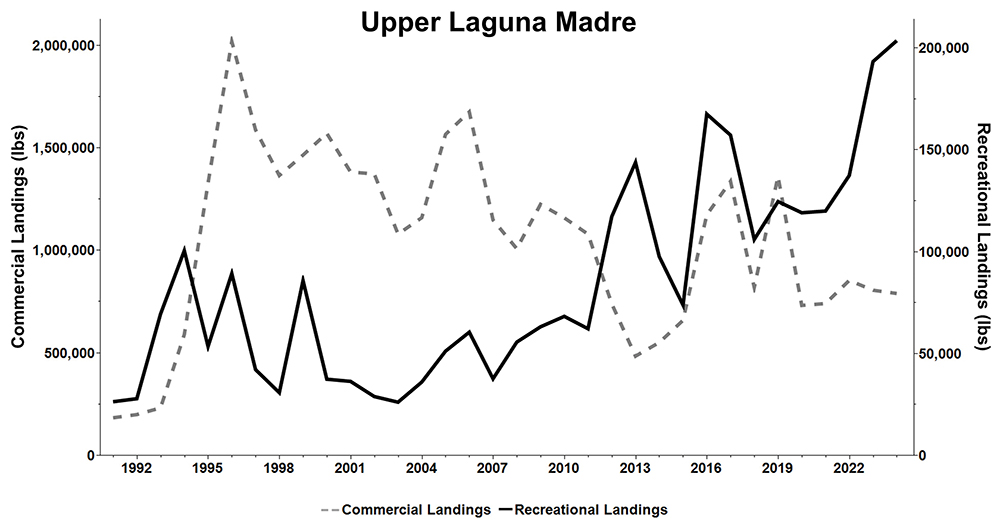
Moseying around in the hypersaline Upper Laguna Madre is a plethora of black drum. This is not said in exaggeration. Fisheries monitoring data have shown that there are, on average, four times more black drum in the Upper Laguna Madre compared to all the other bays along the Texas coast. The vast difference is also revealed when looking at the total commercial harvest over the past 30 years. Approximately 64 million pounds of black drum were harvested along the Texas coast from 1991 to 2024. The Upper Laguna Madre accounted for over 55% of the commercial harvest.
Although the number of anglers fishing for black drum in the Upper Laguna Madre and Aransas Bay continues to grow, the commercial harvest in these bays is on a whole different trajectory.
Can These Bays Support the Commercial and Growing Recreational Harvest of Black Drum?
Back in 1996, the Upper Laguna Madre hit peak commercial harvest with two million pounds in one year. Around that same time, Aransas Bay also peaked at 245,000 pounds (an order of magnitude lower, but still important in this context). What did the recreational harvest look like in comparison? The ratio of commercial to recreational harvest of black drum in the late 90s was 48:1 in the Upper Laguna Madre, and 8:1 in Aransas Bay. That is, for every black drum a recreational fisherman caught in the Upper Laguna Madre, 48 were commercially harvested. However, data from the past decade reveals a sharp decline. The average ratio of commercial to recreational harvest now is 7:1 in the Upper Laguna Madre, and less than one in Aransas Bay (meaning recreational harvest has exceeded commercial harvest).
Put simply, both bays have experienced a decrease in the black drum commercial fishery while simultaneously seeing an increase in the recreational fishery. This is certainly a fundamental shift in the way black drum are harvested along our coast. As each of our bays differ in black drum population and fishing pressure, close monitoring by fisheries managers is vital to ensure that the balance of harvest is sustainable. The good news is, with the sheer number of black drum in the Upper Laguna Madre, there are plenty of fish to spare for everyone’s dinner table!