
Catching Them the Way They Want…Not the Way We Want
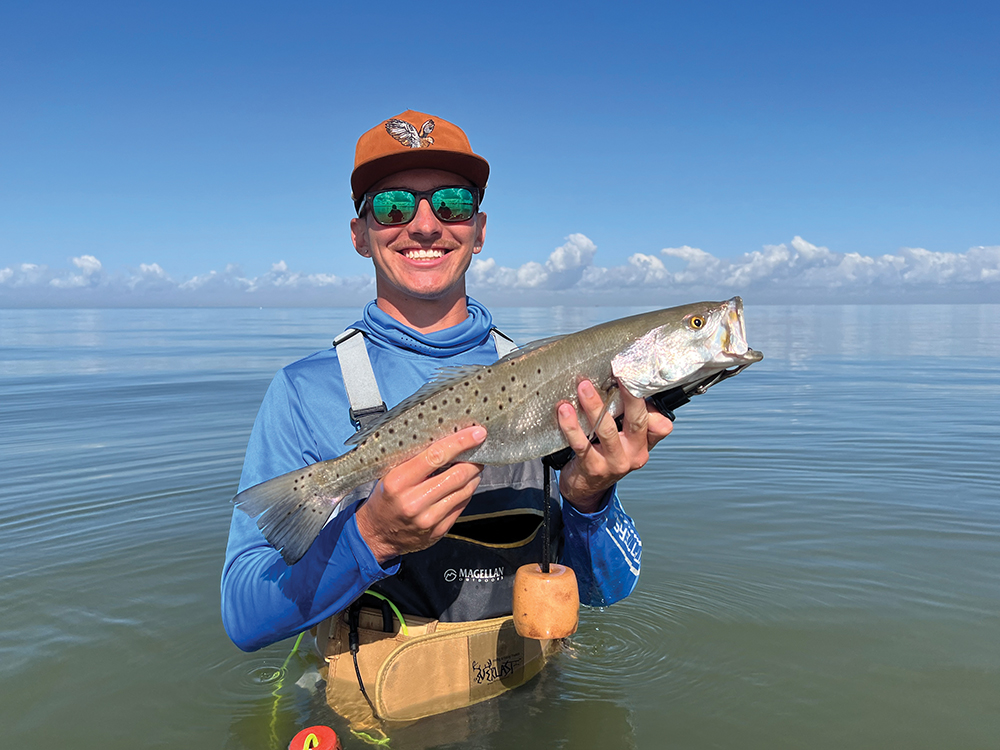
We just fished our way through what’s usually the toughest stretch of the year (March and April) here on the Upper Texas Coast. There were some days when the fish just didn’t want to cooperate, but we were able to make adjustments. We tried old tricks and different methods and most of the time were able to get commitments from stubborn fish. While May is one of the most consistent months for catching trout here in Galveston Bay we will still occasionally have those stubborn trout days where we have to catch them the way THEY want to be caught instead of the way WE want to catch them.
My favorite way to catch trout, or any fish for that matter, is on topwater lures. Many of the strikes on surface plugs are massive explosions but some of my largest trout consisted of subtle slurps as my plug simply disappeared from the surface. I’m fine either way, I guess, but the former is certainly preferred. In calm surface conditions I prefer Heddon Super Spook Jr’s, One Knockers, and Rapala’s Baby-size Skitter Walks. MirrOlure Top Dogs and full-sized Skitter Walks are my two favorites in moderate chop conditions while She Dogs and Super Spooks work better for me in seriously choppy water. My top color choices are Pink/Chrome, Blue/Chrome, Chartreuse and solid black. The speckled trout pattern Skitter Walk is deadly in clear to trout green water also.
A close second choice of lures to trick them on for me would fall into the category of twitchbaits. Texas Customs Double D, the Borboleta LeLe, and MirrOlure’s family of twitchbaits which include (but are not limited to) Paul Brown Original Corkys, Soft-Dines, MirrOdines, Catch 2000s and Catch 5s are all at the top of my list. Some of the most violent strikes I’ve ever experienced are when a trout or a redfish crashed into my twitchbait like a freight train, sending a shockwave through my 30-pound braid that is absolutely unmatched. Twitchbaits work year-round but are especially effective when trout are suspended and feeding on recently hatched shad. Such is usually the case throughout the month of May.
We throw soft plastics (I often just refer to them as tails or worms) the majority of the time and I have to say that not only trout but reds, flounder, black drum, sand trout, gafftop and just about every other carnivorous species we can think of will eat a tail. Tails come in a wide variety of shapes, sizes and colors designed to mimic just about any type of prey you can think of, from a shrimp to a mouse and literally everything in between. Their versatility allows us to rig them on different styles and weights of jig heads to perform specific tasks. We can also fan our casts and cover lots of water when chunking them. Because of the attributes I’ve mentioned (and too many others to list) soft plastics are the most effective category of lures for tricking our target species on a year-round basis. I love to throw worms and they are in my top three choices. The strikes can vary from soft and subtle to very aggressive. Tails can be worked in a multitude of ways. My preferred retrieval method is jigging but there are days when just a simple cast and reel (straight retrieve) method works the best. The majority of the time, soft plastics will get the job done but there will be times when they won’t.
When none of my top three choices of baits will work I have to open my mind a little more than I like and start giving in to using methods that aren’t necessarily my favorites – so that I can achieve the best results for my clients. I was faced with this scenario on a recent trip with some new clients. Worms didn’t work and I couldn’t even get those agitation blow-ups on topwaters than I can normally produce. Twitchbaits weren’t doing any better because all of the fish seemed to be lying near bottom – already fat and happy.
I always say that finding the fish is the easy part but making them eat can be a different story. I took my three new guys straight to where we had caught good numbers of nice trout the day before. The water was a little muddy from the high winds we experienced the night before and the tide was a little lower, but small slicks confirmed that we were in the right location. Unfortunately, slicks popping up doesn’t always mean that the trout are actually feeding. I can’t tell you how many times I’ve heard someone say, “Well, they have to eat!” My answer is always the same. “Yes. They do in fact have to eat, but not necessarily while we’re here.” As a matter of fact, there are many times when the trout start slicking that the bite is actually over. These “throw up slicks” are some of the best looking and best smelling slicks you’ll ever see. They can also be the most frustrating.
Since I don’t have the luxury of waiting for the fish to feed again I have to do my best to manufacture ways to entice these full-bellied fish during a negative feed, such as the one we were currently dealing with. One of the most reliable methods I’ve used through the years is certainly not my favorite but it works and that is rigging a soft plastic or Berkley Gulp! under a rattle cork. I had recently gone red fishing with a buddy of mine and we’d caught some reds using this method. This style of fishing certainly isn’t anything new. Folks have been using this technique for years (see Mansfield Mauler) but it’s just never been my favorite way to fish. Regardless of my personal preferences, I had to try something to get these guys bit. I rigged two rods with a 3.5” Watermelon/Red Glitter Saltwater Assassin Lil P&V’s and one with a 4” Pearl White/Chartreuse Gulp! Paddleshad. I personally continued to throw a regular Bass Assassin on an 1/8th ounce jig head. Over the next two hours or so we caught 12 trout and one 17-inch black drum. I caught 2 of the 12. We obviously didn’t set the world on fire but the cork and jig method clearly worked the best at enticing stubborn fish in the off-colored water.
May is shaping up to be an awesome month here on Galveston Bay, based upon everything I’m seeing now with bay wide salinity levels, bait hatches, and numbers of trout throughout the entire complex. There will be many mornings when we’ll be able to slip over the side, wade towards our favorite little shoreline reef and get our adrenaline flowing with those violent topwater blow-ups. Watching them eat a surface plug is exhilarating then watching these energetic trout shake their heads and go airborne out of the shallow water during the fight is next level stuff. Then there will be days when we’ll have to stay in the fiberglass and drift mid-bay reefs while casting to slicks. Sometimes drift fishing is the better option, especially here on the Upper Coast as water temperatures rise throughout the summer.
We all have our favorite ways to fish but at the end of the day it’s about catching. Being in touch with the line and lure while actually feeling the bite adds another level of excitement. There’s a sense of accomplishment that comes with being able to finesse a trout, feel the strike, and then knowing when to set the hook. Fighting the fish properly and bringing it to hand at the right time brings everything full circle. The entire process is very gratifying. All of this being said, there will be times when the bite gets tough and it becomes time to pull out the ole rattle cork to get the job done. Sometimes we have to catch ‘em the way THEY want…not the way we want.