
December Expectations

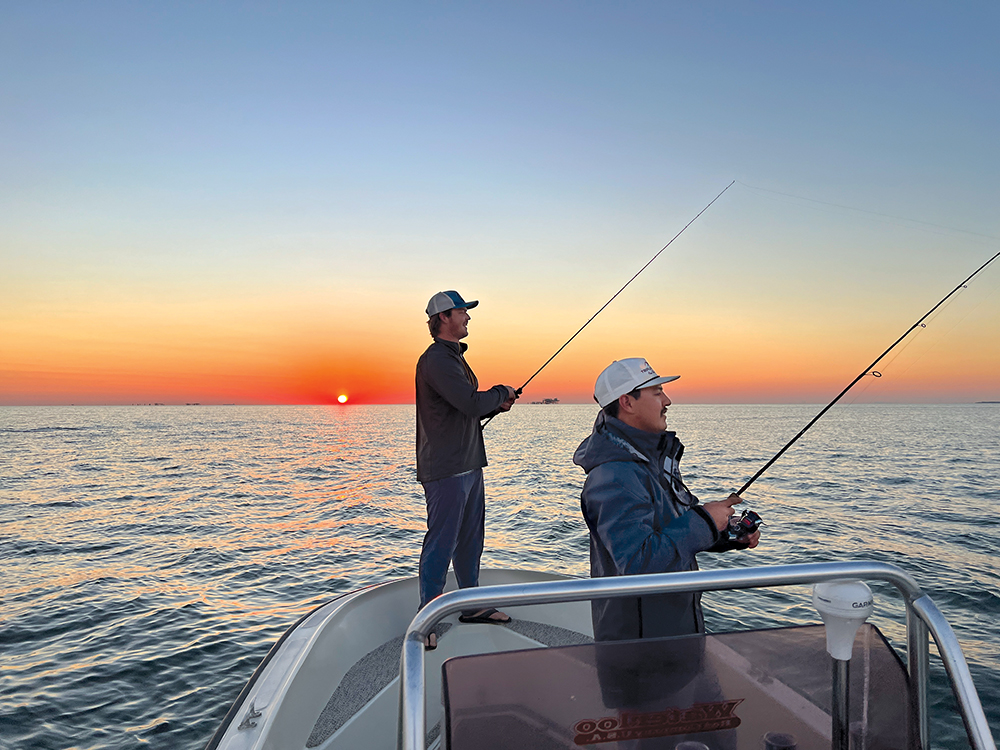
It has been another good year here on Galveston Bay. Salinities have been stable throughout the full bay complex, so fish have been able to establish themselves in many locations, unlike years past when we experienced freshwater stack-ups. This also resulted in another good trout spawn for the year which obviously bodes well for our future. Reduced trout limits back in 2019, and then further reductions and slot restrictions since March 2024 have definitely attributed to an increase in age classes but I think the main reason is that it’s been a little more than nine years since the floods from Harvey. Regardless the reasons, 2026 was another good year that showed vast improvements in our speckled trout fishery.
Water temperatures were running in the high 70s to low 80s and our summertime trout pattern was still in play, despite the fact that it was fall on the calendar. Deep water structure, open bay reefs, and drifting slicks were producing above average results. Almost daily I would check on some of my true “fall spots” only to find mostly small trout and a few redfish. The one thing I did notice was that these areas were beginning to load up with tons of shad, shrimp, and mullet. Seeing this told me that the stage was set. We just needed a decent cool front. Then, on October 16th one finally arrived and things began to fall into place.
Water temperatures dropped down into the low to mid-60s causing our trout and redfish to move into those staging areas. Our trout bite got really good immediately following the front as they fed for longer periods and with more aggression. Hordes of white shrimp in the marshes, back lakes and bayous began to make a move, but this front didn’t really drop the tides much, so they didn’t completely flush. Birds started working, especially in smaller satellite bays. Some had a few legal trout mixed in with the dinks while some of the groups way back in the marsh were holding good numbers of slot reds. The higher the tides, the further back in the flooded Spartina grass they would go. Speaking of tides, we’ve had some crazy high tides due to not only the fall equinox but persistent easterly winds and low barometric pressure.
Who knows what Mother Nature has in store for us at the time of this writing but NOAA (National Oceanic and Atmospheric Administration) has predicted a wetter-than-normal fall/winter season with average seasonal temperatures. I can only hope we get just enough rainfall to keep our estuaries healthy but not so much that major parts of our bays get too fresh. It is critical for our long-term outlook that we continue to re-establish resident populations of trout in areas that have been hit hard by freshwater inundation in years past. Trinity and East Galveston Bays are prime examples. Let’s discuss some seasonal scenarios we will be faced with during the month so we can devise the best strategies for success.
Mild Weather Warmer Periods -
During warmer stretches our fish will typically spread out and feed less frequently. Bait will be more scattered across vast areas. Tides are typically higher during these warm periods, so bayou drains along grassy shorelines and adjacent flats are great areas to target. Don’t overlook shoreline oyster reefs either. Trout and redfish will tend to stay near drop-offs and guts but they won’t necessarily be in the deep stuff. We tend to move around more during these warm-up periods while picking up a few fish at each stop as opposed to being able to lean on one area of concentrated fish. I have found that our best bite is typically early in the morning and late in the evening during the warm weather periods.
I like to chunk topwaters to start my day during these stretches because I can fan my casts and cover a lot of water. In addition, they can be great locator baits. In other words, if I’m getting blow-ups but not many hook-ups then I can switch over to something else like a soft plastic because they showed me that they’re there. My top three choices are MirrOlure She Dogs, Rapala Skitter Walks and Heddon Spook One Knockers. Twitchbaits such as Borboleta’s LeLe and Texas Customs Double Ds are excellent choices too, especially for those hard to trick trout that are just suspended on a flat with no sense of urgency to feed. Of course, you can never go wrong with a Bass Assassin or a Lil John, especially when you’re trying to cover a lot of water.
When a Cold Front Hits -
A lot of folks think that the day or two before a front hits is the prime time to absolutely hammer the trout. I’ve found this to be true when fronts are close together, but when there are longer stretches between fronts I’ve found that the best bite can be experienced as the front actually hits. Some of the most aggressive feeding I’ve ever witnessed has been when waves from a 20-mph north wind were slapping into the back of my wading jacket as a front pushed through. Such was the case on a trip years ago when my clients and I were lined up on a set of south shoreline bayou drains as a strong front hit. The wind had just switched to a hard northwest. We watched as the water poured out of the back lake through the drains carrying tons of button shad. Slicks were popping and brown pelicans were diving and gorging on the shad and the big trout were gorging on our MirrOlure Corky Fat Boys! The trip back to the dock wasn’t anything nice but I’m still here to tell about it, so I suppose it was worth it.
Such fronts cause our trout schools to tighten up and feed aggressively as they instinctively sense their food supply diminishing as water temperatures drop. I like to focus on breaks along shallow reefs and near bayou drains. I prefer windward shorelines but if that’s not doable then I like to set up behind points or even stand just inside a marsh drain on the leeward side while casting out into the streaky more turbulent water on the bay side.
Just about anything in our box will work when the bite is good but because we’re typically dealing with higher winds, soft plastics are what I use most of the time. MirrOlure Lil Johns, Provokers, and Saltwater Assassins rigged on 1/8-ounce Pro Elite jig heads work great. Not only can we cover more water throwing jigs but releasing fish is faster and easier than dealing with multiple treble hooks. Crimping the barbs down on our jig heads adds to the ease of unhooking even further and does minimal damage to the fish. As always, I use darker colors such as Red Shad, Texas Roach and Morning Glory in low visibility water and colors like Chartreuse/Silver Glitter and Laguna Shrimp in higher visibility water.
Fishing the Backside of the Front (Post-Front) -
Sudden water temperature drops and higher barometric pressure can cause a tough bite especially since the fish fed heavily during the passage of the front. That’s the bad news. The good news is that stiff north or northwest winds will drop tide levels and tend to concentrate fish in deeper guts, bayous and channels. So even though they may not be feeding aggressively there are usually enough of them there to enable us to hit a few of the dumb ones on the head. We just have to figure out a way to trick them. I actually enjoy the challenge.
Post front fishing is pretty much the only time I’ll even mention the phrase, “low and slow.” This being said, my particular “low and slow” retrieval style is usually accompanied by a couple of quick twitches followed by a “Three-Mississippi” pause (dead sticking). I can remember a mid-winter post-front trip last year when I was standing up shallow while casting toward deep shell ledge. I’d cast my Saltwater Assassin Lit'l P&V out deep and then let it settle near the bottom before employing that retrieval technique as I methodically worked it through the water column up the ledge. I remember Opening Night worked the best in that wintertime gin-clear water. Speaking of clear water, our water will continue to clear as we get further into winter. When it’s calm and clear I like to head out extra early as often times our fish become more difficult to trick once the sun gets above the horizon.
I typically use a similar retrieve when chunking MirrOlure Corkys, Catch 2000s and MirrOdines. By the latter part of the month and beyond most small forage species such as shrimp and shad have left the bays. Mullet and pinfish will remain, so the slow sinking plugs hovering in a trout's face will get smoked with the right twitch of the wrist in many cases when nothing else will.
December is not only a fantastic month for numbers, but we’ll start seeing some of our largest trout of the year. The weather will be back and forth because it’s Texas and that’s what it does. We just have to take whatever Mother Nature gives us and use it to our advantage. Here’s hoping you catch your personal best for Christmas! See y'all next year!