
Factors Influencing Winter Trout Patterns
Our summer pattern is over, and I must say we had a pretty solid run in certain areas of the Galveston Bay Complex this year. Now, seasonal changes and all of the new variables that come with them will alter speckled trout patterns. This means that those of us who chase trout must alter our patterns as well. To do this successfully, we must first take a look at the current dynamic of our bay system by analyzing things like salinity levels, water temperatures, bait migrations, and habitat. We need to understand where most of the trout are now and the factors that will cause them to relocate. Additionally, how will their feeding patterns be affected?
Lake Livingston is currently about a foot below pool, and the dam is discharging at 1,792 cubic feet per second. Our other main freshwater tributary, the San Jacinto River, is at a mere trickle. We haven’t had much recent rainfall in local watersheds, so salinities are holding at a comfortable range for trout throughout the entire complex, including back lakes and up most bayous and rivers. Bay-wide, moderate to high salinity levels help fish stay spread out in more areas. It’s especially helpful for East Bay, Trinity Bay, and the upper reaches of the complex for another reason.
While it’s true we always need some rain, recent years have yielded more than we’d like in certain parts of the bay—from a fishery perspective, anyway. We obviously need low-salinity brackish estuaries to breathe new life into our bays, but in recent years Trinity Bay (mainly because of river flow from upstream) and the back of East Bay (especially since the closing of Rollover Pass) have both seen salinity levels drop too low to allow for a significant re-establishment of base populations of speckled trout.
So what does this mean? It means that when you can’t re-establish a significant biomass, it will take longer to rebuild what we refer to as a resident population of trout. Without a resident population in parts of our complex like Trinity Bay, it’s next to impossible to proliferate older age classes of trout year after year, because the first generations of fish get flushed out by freshwater every winter and spring.
Trout can tolerate a wide range of salinities, but excessive amounts of freshwater can greatly affect their movements. The initial phase of moderate to heavy freshwater inflow occurs when there’s just enough rain to cause the surface to become fresh, pushing trout closer to the bottom where suitable salinity remains. When we’re faced with this scenario, we usually fish the same general area but switch to heavier (eighth- to quarter-ounce) lead heads to work beneath the freshwater layer. Water clarity is typically murky in this situation, so we use darker-colored soft plastics for added contrast.
If rain and runoff persist, we may be faced with a situation where the entire water column becomes too fresh, forcing trout to relocate altogether. Having knowledge of the bay’s hydrology helps us determine where to go when such an event occurs. Much of it is common sense—for instance, the southern areas of our bay are farther from the rivers and closer to the Gulf, so trout are often forced in that direction during flood events. Other times, they may simply stack up in deeper areas or just outside the fresh zone within the bays. Spending time on the water and physically following them through trial and error is usually the best way to determine their new locations.
When everything is salty, as it is now while I write this article, fish can spread into many different locations—and anglers will too. Concentrations of fish won’t get beaten up by multiple boats stacking on top of them. Trout will stay in the areas they’ve been in until other influencing factors come into play.
Water temperature changes are one of the key triggering mechanisms influencing trout movements. As temperatures drop, trout will find their way toward areas with deeper pockets and guts, often lined with mud and shell. Many of our back lakes, bayous, and rivers possess these characteristics. These same areas also happen to funnel forage species such as shrimp, shad, and mullet.
Some folks automatically assume that trout go deep in the winter. Blanket statements like that can cause an angler to have some very nonproductive days on the water. In most cases, trout will reside near deeper water, but not necessarily in the deepest areas. We usually have one or two arctic cold fronts each winter that force our fish into truly deep water. This occurs because of a combination of factors—the obvious one being a temperature drop into the mid- to upper-40s. Other contributing factors include low tides and high barometric pressure. The timing of the cold event has to be considered as well. Gradual cool-downs allow trout to become more acclimated, resulting in less drastic movements.
Speaking of cold fronts, yesterday we had a decent little one blow through the area. I had one of my long-time clients and his daughter in from Delaware, and we witnessed the textbook version of pre-front and post-front fishing in a span of about four hours. The wind was dead calm as we rolled into our first spot of the morning. Shad and mullet were active on the surface over live oyster reef in about five feet of water. It was too slick to see slicks, but we could smell trout in the air. Geoff and Hayden put on an absolute clinic chunking Slammin’ Chicken Assassins! The bites were very aggressive, and though we didn’t throw any topwaters, I’m sure that bite would’ve been insane.
By 9 o’clock, the clouds had cleared and the wind was pumping out of the north at 20 knots. It had already been a fine morning, with them catching and releasing 20 solid trout, a couple of redfish, and a black drum. However, anyone who’s ever fished with me knows I’m not a short timer. There was a wind-protected area I wanted to try, hoping for some big flounder and maybe another red or two.
We made drift after drift along a shell-covered ledge, but the lack of surface activity and the bluebird post-front sky might as well have been a giant neon sign reading, “The Bite Is Over, Dummy!” I caught one more nice trout and lost a huge flounder at the boat, but other than that it was just more casting practice for the three of us. The wind became unbearable by 10:30, so we headed to the marina.
High winds following the front caused us to cancel the next day’s trip, but let’s talk about what the pattern would’ve been like had we been able to go. There are three things typically associated with post-front conditions: high barometric pressure, lower tides, and clearer water.
Trout will usually drop and suspend along ledges in extreme post-frontal conditions, even near the bottom of deeper guts. Bites will be more subtle. In most cases, we’ll downsize our lures due to the negative feeding behavior associated with such circumstances. The 3.75" MirrOlure Lil John and 4" Bass Assassin Sea Shad are go-to soft plastics for me. When plugging, I love not only the size of the MirrOlure MirrOdine, but its suspending action can draw strikes from a full-bellied post-front speck when nothing else can. I like brighter colors like Opening Night and pink in clear water; chartreuse with silver glitter is also one of my favorites.
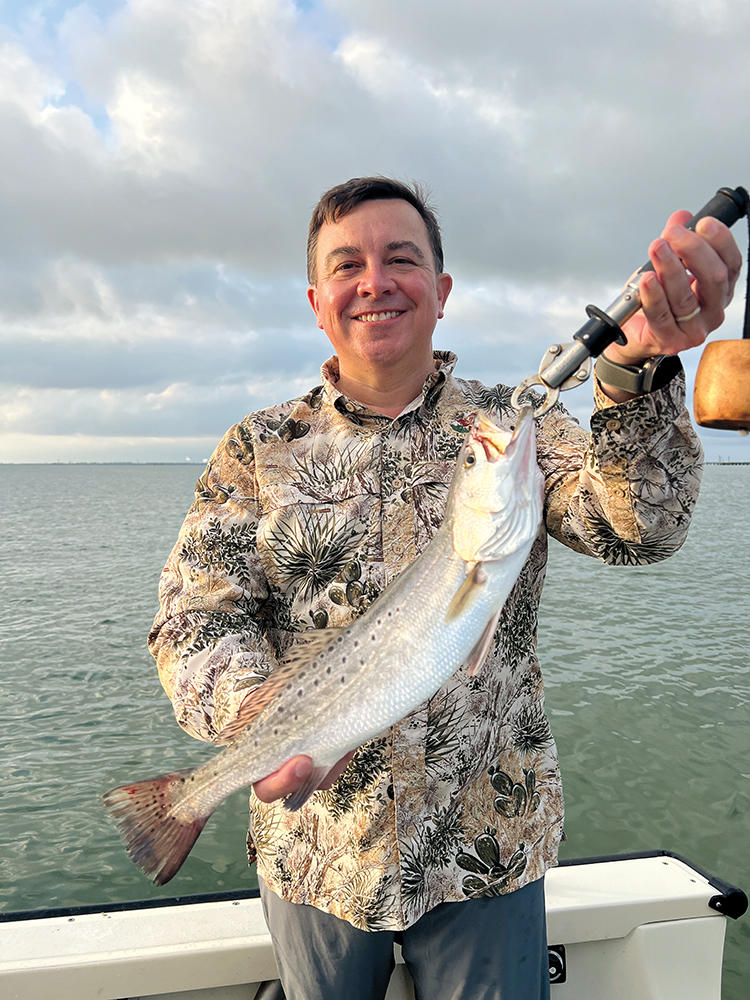
There will still be plenty of white shrimp in our bays early in December. I’ve even seen trout and reds feeding under birds as late as Christmas, especially during milder winters. As winter progresses, shrimp become increasingly scarce, and trout rely more on shad, pinfish, and mullet. This brings us to one of my favorite times to fish—when we can wade and drift along mud and shell ledges for some of the best-quality trout of the entire year. We’ll still catch plenty on Bass Assassins, but many days will be spent chunking mullet-imitating plugs such as MirrOlure Paul Brown Corkys and MirrOdines.
In summary, bay-wide salinity levels are stable, so freshwater inflow isn’t currently a major factor influencing trout movement. Cold fronts will be the primary force driving trout locations and feeding habits. Trout are currently holding in a variety of areas due to mild water temperatures and the abundance of shrimp, shad, and mullet in the bays. As we move deeper into winter, trout will congregate in tighter areas near live habitat (shell reefs) and deeper water as temperatures decline and forage species become less abundant. We’ll then lean more heavily on plugs in our daily arsenals.
Oh, I almost forgot—here’s wishing everyone a Merry and Blessed Christmas!