
Fish Highways
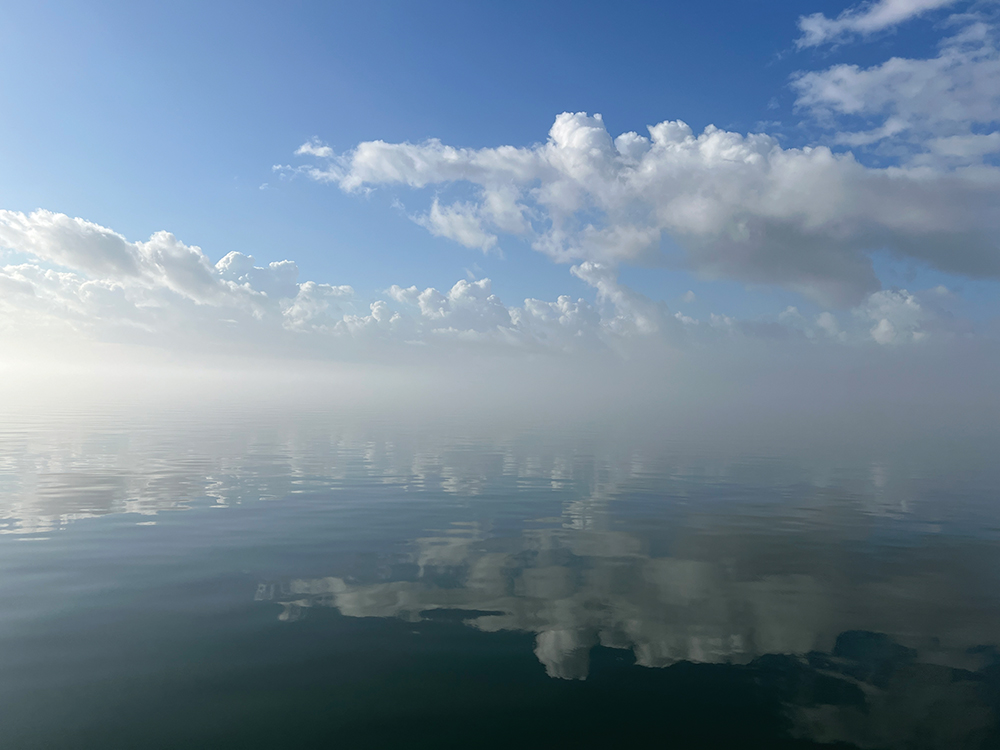
Our ride across the bay that morning was picturesque. There wasn’t a ripple on the water and a thin layer of fog made everything appear much larger than reality. V-shaped squadrons of brown pelicans gliding just above the water’s surface looked more like Boeing 747s. The reflection of the sky in the water was as perfect as I’d ever seen it. If I were a painter or photographer, I would have been in hog heaven, but as a fisherman I already knew the challenges we would face given those conditions—especially at this time of year.
I killed my outboard about 100 yards from my intended anchoring spot and used my trolling motor, at very low speed, to ease into the area. I knew the fish were going to be ultra spooky with no wind, clear water and very little tide movement. I paused for a minute or two to survey the area before slipping the anchor over. I was hoping to see at least a few mullet flipping but hadn’t seen any.
“Okay guys, the tide is supposed to start going out within the hour. Let’s jump out and give it a shot,” I said.
The three of us spread out along a toenail-shaped stretch of cordgrass-lined shoreline divided by three bayou drains leading into the bay. Out in front of the drains, on the bay side, there was a trough that wrapped around parallel to the shoreline. Beyond that was a shallow flat stretching toward the middle of the bay.
About twenty minutes into our wade the tide began to trickle out, but I still hadn’t seen a single mullet or any other bait for that matter. The tide slowly pulling water out of a back lake through a bayou drain is usually a textbook scenario for success, but for some reason everything still appeared lifeless.
After probing every square inch of all three drains—inside and out—I told the guys to keep plugging while I went to get the boat. A little wind began to blow just as I started my two-hundred-yard trek. Then it blew a little more.
I thought I saw a mullet jump out on the flat toward the middle of the bay, so I just stood there staring until I witnessed another flip. I made my way through the wraparound gut and positioned myself where I could land my Bass Assassin Lit’l P&V right along the edge of the flat where the mullet were flipping.
Bam! The first trout of the day came to hand.
I fired off another cast and caught another one. Not knowing how long it would last, I yelled at the guys, “Y’all get over here!”
The three of us stood there for probably thirty minutes catching dozens of trout before the bite finally waned.
The key factors for our success at this particular spot were:
• The beginning of an outgoing tide
• Wind clouding the water, making it easier to trick trout
• Location (edge of a gut leading to a flat created an ambush point)
• The presence of bait
There are a few other things to note about that first wading spot. We were coming off a couple of late cold fronts, so water temperatures had dropped along with tide levels. I believe this was one of the reasons those trout were pulled away from the shoreline drains they typically gravitate to this time of year when tides are higher and water is warmer.
I also noticed they were more willing to eat smaller baits like Bass Assassin P&V’s and 4-inch Sea Shads as opposed to larger soft plastics. My theory is that this was likely a result of them having gorged themselves ahead of the cold fronts.
Our second stop found us about five miles down the shoreline in another area where I’d had recent success. By now the wind was gusting to almost 20 mph. If the water temperature had been warm like it is during the summer, this particular area likely wouldn’t have been fishable due to poor water clarity. Luckily for us that day, it was just cool enough (69°) that we had yet to see the full effects of suspended algae growth and organic matter.
The water had a sandy-green color but featured some well-defined color changes compared to our first stop. Anyone who has fished with me knows how much I like fishing color streaks. I just love having something to focus on. Nothing is worse than blind casting.
This area was somewhat similar to our first stop but had much more eccentric drop-offs along the edges of the guts. The bottom characteristics were slightly different as well, with this area having a softer, silty bottom—especially in the deeper guts. These slight differences, along with the wind, helped produce more obvious muddy streaks.
Once again, the beginning of our wade was somewhat uneventful with only a couple of trout caught during the first forty-five minutes or so. The later it got, the more westerly the wind became. I’ve never been a big fan of a west wind, but this time it actually helped us.
This time of year (early spring) we have a multitude of juvenile forage species like shad and glass minnows. They are still tiny, so they get carried along by wind and current. The wind speed and direction, along with the outgoing tide, pushed them up against the edge of a sandbar leading up from a deep gut.
This created the perfect scenario right before our eyes.
It didn’t hurt that we were heading into a moonset minor feeding period either. Terns were dive-bombing the tiny forage species along the edge of the gut. The icing on the cake was a well-defined color change with a few small mullet flipping.
The cherry on top were the small slicks emerging from the drop-off.
It was officially showtime.
We never caught any trout over 22 inches, but we caught a lot of them.
Our main takeaways at this stop were:
• Well-defined sandy mud streaks
• A series of deep guts through sandbars creating “fish highways”
• Wind and current-driven bait concentrations creating a buffet scenario for trout
• Underwater shelves and drop-offs creating ambush points
• Slicks, terns and bait activity = dead giveaway
• A minor solunar feeding period helping the bite
We proceeded to fish several other areas over the course of the day, replicating what we had learned at our first couple of stops. Most of what we experienced early in the day definitely played a role in our continued success, but the two most common themes at every stop were bait concentrations and some type of gut structure.
Just about everywhere we went there were noticeable depth changes surrounded by shallower areas holding concentrations of bait. As simple as it sounds—where there was bait, there were fish.
April here on the Upper Texas Coast can present some challenges at times. There will be days—or at least periods during the day—when the fish just won’t seem interested in anything we have to offer. But if we spend more time focusing on these “fish highways” while watching for other key signs around them, we will end up having many successful days on the water.
Best of luck and Happy Easter!