


Fishing Pressure and the Centuries

I’m sitting here in Sicily thinking celebratory thoughts after becoming a grandfather a few days ago. Just outside our window a couple of “Jimmy Crouch doves” are cooing incessantly, starting about 6:00 a.m. each day. Also known as Eurasian collared doves, they appear to be the same species we heard every day when we lived next door to Jimmy, the unofficial mayor of Port O’Connor, who kept a few in an outdoor cage off his back steps. Jimmy was something of a legend there, and quite the neighbor; quick with a scattergun on local wildlife, even on moles burrowing under his lawn.
Hearing these doves outside makes me pine for the fishing action in POC, after trying our hand at the jetties and beaches on the Med, downhill from Agrigento, a hillside city built by Greeks centuries before Rome was built. For the geographically-challenged, that’s the Mediterranean Sea, where different civilizations thrived for thousands of years, catching fish without limits, even using explosives after WWII. And then spearguns aided with scuba tanks. The result is that fish here are rather scarce. There are still no size or bag limits that I can find. We’ve seen a few cautious mullet in clear water at the beach, but at the jetties there are few signs of life, not even barnacles on the rocks. I saw two sea urchins out there yesterday, but even these are eaten raw, caught and for sale daily by the harbor’s bottom trawler, much like our Gulf shrimpboats.
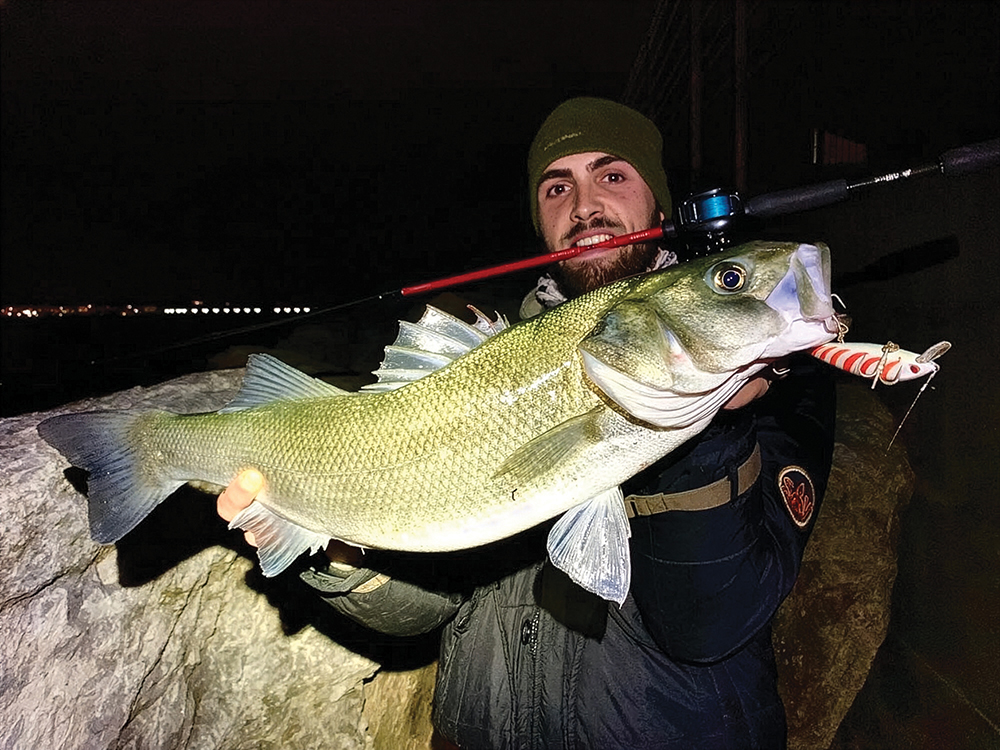
The real prize here is Spigola, nicknamed seabass, mostly caught in subdued light or even at night. Catch one, and you become the talk of the neighborhood. Each discussion being long and loud with vigorous hand gestures, the custom here even over the most trivial matters. Their seabass resemble our striped bass but without the stripes, and grow to 12-16 pounds. We shared a 30-inch baked seabass in the restaurant and it was delicious, though likely raised by aquaculture.
Yesterday, we explored the mouth of the Akragas River, one of two rivers that used to surround Agrigento. Amy and were tossing shallow-diving plugs and spoons exactly where Greek and Roman shallow-draft triremes rowed out of the Med into protected river water, using slave labor like in the movie Ben Hur. Their triremes mostly followed coastlines and were built to be dragged ashore during rough weather or invasions, as shown by the Greek assault on Troy.
For some reason the action is slow today after 3,000 years of local fishing. I did catch one bluefish, but not the prized spigola, pictures of which show successful anglers wearing a lot of winter clothes. Maybe this 95-degree heat is keeping the fish further offshore. This all makes me wonder what the fishing and bag limits will be like in Port O’Connor 2,800 years from now. Maybe not so good. The small boat ramp at the harbor looks tough for launching a boat, with a 90-degree bend for backing down into the water, which involves jackknifing the trailer on purpose, something we try to avoid in America. (POC’s boat ramp weekend peanut gallery would have a field day here, offering catcalls or unsolicited advice.) The harbor here in mid-summer is completely full with a fleet of mostly 20-foot center console, fiberglass boats, where there were virtually none last winter.
Compared to Sicily, Port O’Connor and the Texas coast are newly discovered fish havens. It’s true that stocks of seatrout have fallen over the years but the daily bag limit keeps adjusting downward to keep pace with growing fishing pressure. Flounder headed for offshore spawning have their autumn closure now, safe from gigging and they also have a tight bag limit. Redfish are cranked out by the hundreds of millions at the hatcheries, so they’ve held their own for decades. Black drum and sheepshead were protected at least 30 years ago with five-fish limits and the bigger drum are safe from harvest. Even roe-filled mullet each autumn carry protection. I haven’t seen the latest regs on those all-important menhaden schools off upper coast beaches from Sabine Pass to Galveston, but they should have been protected from the big Louisiana net boats decades ago.
Offshore is a different story. While it's true that, after 20 years of aggressive management, red snapper have recovered nicely, other migratory species are not doing well. Ling and kingfish numbers have pretty much collapsed Gulf-wide. I sometimes wonder how they'd be doing if they'd been protected with gamefish status 20 years ago. Amberjack are in trouble, too. Nobody seems to know why, not even scientists or Gulf Council members. Tedious studies have to be made while fish numbers keep dropping; there are now hardly enough left to tag and study except for targeting a few hundred fish—very different from years ago. I can't help but think the Gulf Council should declare an immediate moratorium on king mackerel and ling harvest, but they have to be careful these days before making that commitment. Recently, I’ve spoken with two marine biologists who are pessimistic about the future of both fisheries. One of them even said it keeps him up at night. They worry that Gulf water temps are now so warm, that floating fish eggs and larvae from king, ling and amberjack (and other species) are suffering poor survival rates. They don’t want to go on record and say so, for fear their federal funding might be cut. It’s already happening to scientists I know.
According to the latest harvest reports, the last stronghold of kingfish in the Gulf are being netted each winter with the aid of spotter planes off Key West, just 17 boats taking hundreds of thousands of pounds. These net boats are hitting spots where eastern Gulf king mackerel historically have spent each winter. Years ago they could net millions of pounds and certainly did; the schools seemed endless. Those fish were ground up for fish chum or shipped off to New York City. What has happened to western Gulf kingfish off Texas is more of a mystery, though some migrate each winter to Mexico where there are no bag limits and plenty of hungry mouths to feed.
Meanwhile, the average size of ling continues to shrink. On Florida’s Gulf Coastal Bend, friends in an offshore fishing club now average one barely-keeper ling per year for the entire club. These are guys who have been running offshore for 20-40 years; they aren’t rookies. Almost all ling in that region are now undersized, the classic red flag for overfishing anywhere in the world. And yet, ling can still be caught and sold down in the Keys, where these fish migrate each winter. Ling tournaments have been shut down in Florida and outspoken anglers there are starting to demand a 5-year closure.
Things are so dire for amberjack that the same club recently dropped them from their target list of tournament species; AJs are no longer viable in that part of the Gulf. And it happened fairly quickly, too. Maybe those fish are out in 600 feet of water trying to stay cool where few people fish, but no one knows for sure.
Also in Florida, other inshore fish struggle under the weight of fishing pressure. (With lots of boats and nice weather, many consider it a rough day with 3-foot seas.) Even sheepshead are hurting with a bag limit at 15 per day for 30 years too long. Where there are no bridges and jetties, there are now virtually zero sheepshead caught each year except in February-March at spawning aggregations offshore in 20-30 feet of water. It’s never a good idea targeting spawning sites where any saltwater fish are busy trying to procreate. It’s like gigging egg-filled flounder every November on their spawning run to the Gulf, a practice wisely outlawed in Texas. Some 25 years ago, Texas set a daily bag limit of 5 sheepshead with a 12-inch minimum size limit and later increased the minimum size limit to 15 inches through a phased three-year adjustment starting in 2007.
There is also concern on Florida’s Gulf Coast that few Spanish mackerel showed up this year, something inconceivable even the year before. And Florida hasn’t bothered much with redfish hatcheries, with all that great coastal habitat of islands, salt creeks and mangrove shorelines. They raise a few thousand redfish fingerlings annually to a size that survives well, versus the smaller fry released by the hundreds of millions in Texas, where the bag limit for reds has remained stable at three per day for more than 30 years. (Perhaps Florida has qualms about genetic diversity of their redfish).
Back in Sicily they have no big reservoirs, real rivers or fish hatcheries. The Med is very salty and any freshwater runoff is appreciated by fish. But that happens only after a major rain. The island’s forests were cut down long ago and not replanted, so the land is more arid now. Its wildlife were hunted for sport by royalty and now both are gone. There is lots of history here, including slave uprisings fighting to the last against Roman legions on mountaintops, like they did with Spartacus over on the mainland. (His followers hoped to escape to Sicily.)
They still burn the grass fields here each summer, mostly by sheep herders, and the fires easily spread onto adjacent properties. This summer, we had fun on our son's farm fighting a wall of flames, barely saving the olive and almond trees with the last of our drinking water. It was warm work on a 95 degree day, but we had a strong north wind to keep us going. For six days leading up to that, we holed up in our apartment with 105-plus degrees outside.
Thousands of miles from the Texas coast, it’s a different ballgame here, and I look forward to returning to a quiet morning on the Port O’Connor jetty, which positively swarms with fish by comparison.