
From the Playbook
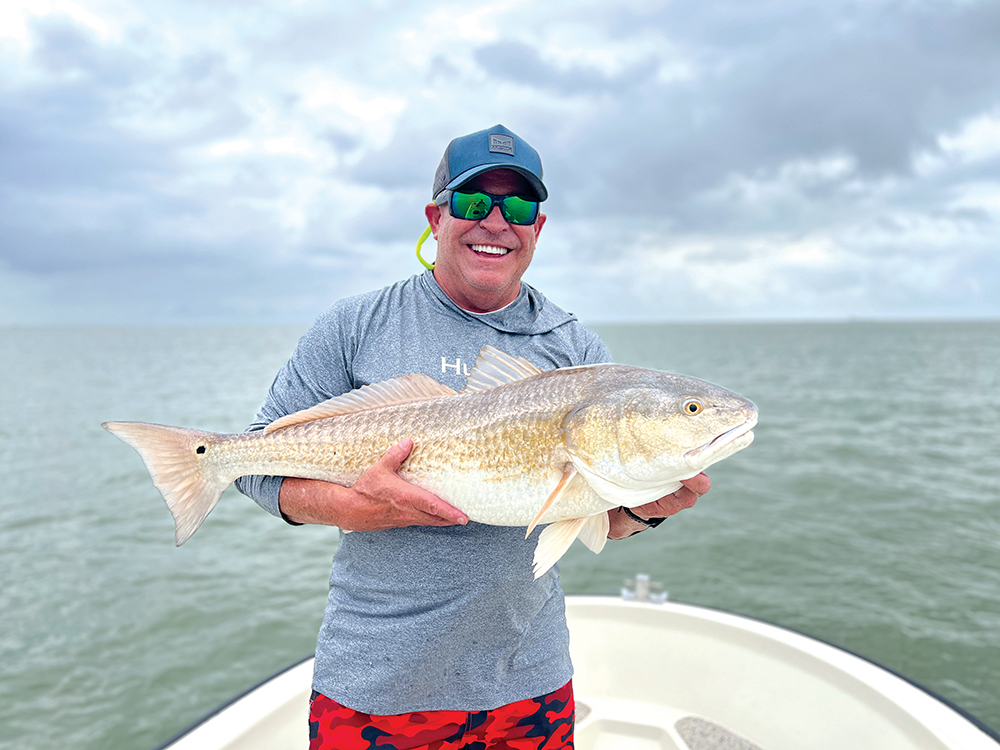
We eased out of the ramp on the Texas City Dike in the dark. It was a picture-perfect morning, with light winds and good tide predictions leading up to a full moon. What more could we ask for on tournament day? The mid-bay oyster reefs in East Galveston Bay were teeming with solid trout. Salinities were above average, and giant pods of small shad were everywhere. The game plan was simple. Find the slicks and shad concentrations over live reefs and get after it. It was “Field of Dreams” type stuff.
The tournament that my clients had booked me for was for the largest fish in each species. In other words, there was no creel weigh-in. We just needed one big fish, and trout was our focus. We started on a south shore reef that I had nicknamed “The Mailbox” because a buddy of mine seemed to go there every time he fished. I finally told him one day, “Damn, Robby, you ought to just put a mailbox on that reef because you go there every day.” There was a reef just east of “The Mailbox” that I actually used to basically live on that he nicknamed for me, but I can’t say the name in this article because I’m trying to keep it as G-rated as possible.
Chuck Walsh, David “Woody” Woods, Marcus Schnur, and Marcus’ son, Nick, were the guys I had on my boat that day. They had been fishing with me for a long time, and they were all good fishermen. All I had to do was put them on the right fish and let them go to work. There were literally dozens of small slicks popping up on the western edge of the reef. The wind was blowing about 10 mph out of the east-southeast, and all of the trout were, of course, facing into the current. This enabled me to position the boat with the wind at our backs, making it very easy for us to cast up-current while presenting our soft plastics in a natural fashion as the tide brought our baits into the trout’s face. We caught lots of solid specks ranging from 2 to 3 pounds, but nothing that would even think about being worthy of bringing to the weigh-in.
Every reef in East Bay was at our disposal, given the ice-cream conditions, so we took full advantage, hopscotching all of the ones I’d had success on leading up to tourney day. We caught plenty of fish, and it was lots of fun. There was only one problem. Time was running out, and we didn’t have a trout that weighed more than four pounds, and that certainly wasn’t going to cut it, especially with some of the live-bait guys I knew who had been catching some monster trout at the jetties. When conditions are as perfect as they were on that June day, virtually no water is eliminated.
We only had enough time for one more stop. There was an area on the south end of Deep Reef that was part of an oyster reef restoration site where river rock had been planted for substrate. This particular site had been planted about two years prior, so it had a substantial amount of new live oyster growth. As with almost every “spot” I fish, there is usually a sweet spot within the spot, and this area was no different. There was a significant hump near the edge of the site where I’m guessing more rocks were dumped compared to the rest of the area. The tide had slowed considerably, and by now there was almost zero wind.
As I trolled us into position, I noticed a dark shadow on the surface in about seven feet of water. It was about the size of my boat, and it was slowly moving in a circular fashion over this hump. As I got closer, I realized it was a giant pod of button (small) shad. Then, all of a sudden, what appeared to be a pretty big trout blew a hole right in the middle of the pod, scattering tiny shad everywhere into the air. Woody fired off a cast where the blow-up had taken place and immediately hooked up! When this trout went airborne, shaking its giant bucket mouth, I think all of our knees started buckling. I know mine did. I told him that if he landed that fish, then he would probably win the tourney. This fish took him all around the boat. Then, as he was getting her closer to the landing net, she decided to make a deep dive straight under the boat. Woody did a phenomenal job controlling the fight without letting this trout have her way with him. It was such a beautiful sight as he finally guided her into the net. After a few quick high-fives, we headed toward the weigh-in. You had to be in line by 2 PM, and it was 1:40. I estimated our distance at around 15 minutes, and I was dead on. We made it to weigh-in with five minutes to spare, and Woody’s seven-and-a-half-pounder took first place. I still remember the lure he caught it on—a Sabine Machine Texas Trout Killer II made by Texas Tackle Factory.
That story is basically a microcosm of what fishing in Galveston Bay in June was back then. June is definitely one of the most consistent months for fishing here in Galveston Bay, quite typically the first month of the year when everything comes together after months of back-and-forth weather and mixed results. Winds usually settle, which works out great because this allows us to get out to the fish, as many of our trout will begin to frequent mid-bay oyster reefs and other types of structure. They will also begin to form legitimate schools, making them easier to target. As if that wasn’t enough, they will usually show us where they are by slicking and offering many other signs, such as bait concentrations. If there was ever a month where we could follow a set of proven strategies, June is it. Let’s go over a few of them.
Obviously, open-bay oyster reefs will be holding fish. We don’t have as many to choose from as in years past, but there are still quite a few. I typically focus more on reefs closer to the shorelines early in the month, then drift the ones out in the middle a little later in the month as water temperatures climb. Finding high spots and ledges while focusing on slicks is my main modus operandi, but I don’t necessarily shy away from terns and gulls working over shrimp either. Reef edges where they transition from shell to mud are good areas to target as well. Saltwater Assassins are usually my first choice, and I typically rig them on 1/8-ounce lead heads for this time of year.
We are still wading quite a bit this time of year, especially around sandbars and guts. We typically experience early morning bites up shallow, then work our way out deep by midday. Rafting mullet, shad, and glass minnow concentrations are our focal points. Don’t be afraid to cast in the skinny water on top of the sandbar very early in the morning. We’ve caught some very large trout on topwaters through the years doing this. As a general rule, I’ll throw a high-pitched surface plug like a MirrOlure She Dog when it’s choppy and downsize to a smaller-profile, softer-pitched topwater like a She Pup or Baby Skitter Walk when it’s calm. Texas Custom Lure Double Ds, along with Borboleta Hot Rods and Leles, are smart choices when we’re getting more blow-ups than hook-ups.
When we’re not wading shorelines or drifting reefs, I’ll spend time trolling along the edge of the many man-made revetment walls we have here in our bay system. Most of them are constructed of crushed concrete or some form of rock, such as granite or limestone. Algae, barnacles, and oysters grow on the rocks, which attracts all kinds of marine life, which in turn pulls in trout, reds, and flounder. I like to troll along rock edges looking for bait and slicks. Corners, bends, and openings tend to produce the best. Soft plastics, such as MirrOlure Lil Johns and Saltwater Assassin Litl P&Vs, are deadly when casting along rock ledges for trout and flounder. One of my favorite things to do is reel crankbaits along the edges for redfish. My favorite one right now is the Strike King KVD Squarebill 1.5. It runs at a 3–5' depth. Its side-to-side wobble and rattle induce some of the most violent strikes I’ve ever had on a lure. It’s not uncommon to pop an above-average-sized trout on a crankbait either. I recently caught a 24 ½-inch trout on one while we were fishing for reds.
On a side note, make sure you’re using a rod that can winch those strong-shouldered reds away from the rocks. My rod of choice is my Waterloo 7’ Power Mag. It’s ultra-sensitive and lightweight but has a helluva backbone.
I have to say this has definitely been one of my better starts to the year here in Galveston Bay since the floods from Hurricane Harvey in 2017. In addition, it’s now been five years since our last fish-killing freeze. There are many similarities between what I’m currently seeing in our bay compared to what I experienced years ago. I’m not saying that it’s the same, but I am seeing improvements in our fishery and, more specifically, with our speckled trout fishery.
June is not complicated. As a matter of fact, it’s pretty straightforward. Our eyes don’t lie. Don’t be afraid to try new spots. If it looks “fishy,” then more often than not, it is. We’re catching fish in places that we haven’t in years, mainly due to higher bay-wide salinities. The tide-runner trout are filling our bays. Every style of lure we own will catch fish in June. Each day, we assess the conditions, then develop a plan of action based upon what has been successful for us through the years. We’re basically just working from the playbook. I’m looking forward to a great summer! Good luck, my friends!