
Got Sharks?
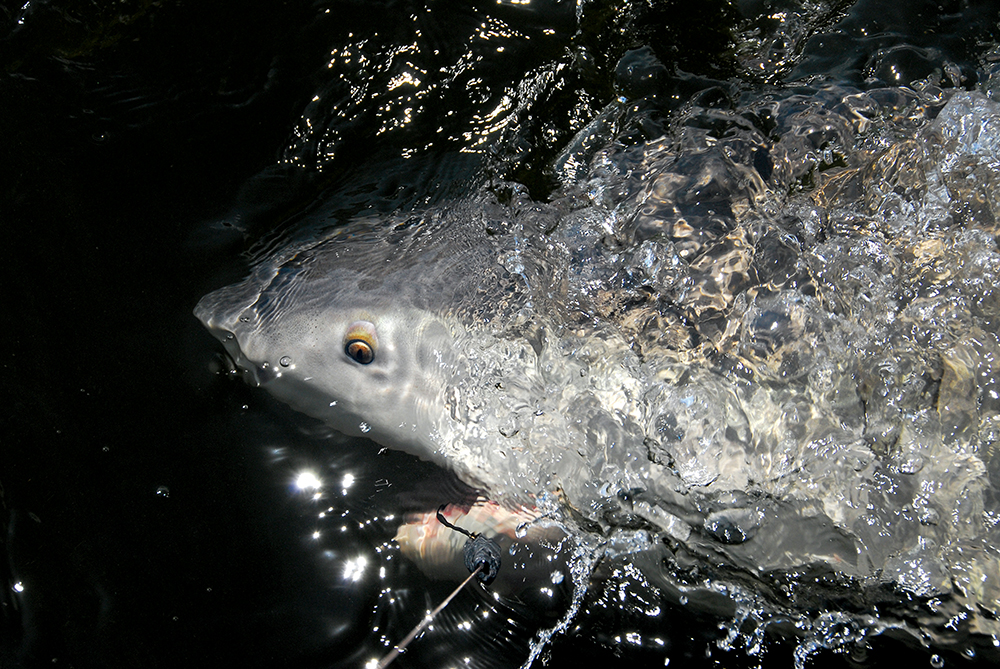
I’ve had this pair of shark jaws on the wall so long that I seldom notice it—until recently. It came from a shell shop in Mazatlán, where countless ocean treasures from around the world are gathered for tourists, mostly shells stripped from Pacific coral reefs. Shark fins are sold for soup in parts of Asia for a pretty penny, their meat kept for consumption in Mexico, but the shark jaws are sold for souvenirs.
I didn’t actually pay for the jaws, which appear to be from a bull shark. An Elvis impersonator named Jessie, on his first visit to Mexico to fish for sharks, paid for them. His group caught nothing, so before heading for the airport he offered me a few Benjamins to buy several shark jaws. But that’s another story.
Except for rare and occasional fish fries decades ago, my policy has been to leave sharks alone. They ignored me (mostly) for many years when I dove the Gulf’s oil rigs, so I don’t target them—much less bring one home. Most fishermen avoid them as well.
As a result, shark numbers have greatly increased, even with heavy fishing pressure. Strict bag limits have certainly helped, and an entire generation of anglers now fishes without any thought of bringing a shark home for dinner. Even with a very low birth rate, sharks have now become a problem, chewing up prized gamefish before they can be landed. They’ve even been known to chase hooked snook onto beaches in South Florida multiple times in a day.
One young angler fishing near Flamingo was snatched from his boat because he rinsed his hands overboard—apparently forgetting his fish towel that day. His hand was chewed on, and the helicopter flight to the hospital must have cost a fortune.
So lately I’ve been thinking maybe it’s time to eat more shark—especially now that kingfish, ling and amberjack numbers are at historic lows in the Gulf.
After guiding my first and only shark-fishing charter, I never wanted another. Three young guys showed up in Port O’Connor with two buckets of beef lung and a .357 Magnum—which will shoot through a car engine, a bit much for dispatching sharks.
It was April with a north wind blowing, a little early for sharks compared to summer action. Those chunks of beef lung used for chum floated away like Styrofoam and attracted hundreds of seagulls. My 4/0 Senator reels would have been too small for a big shark anyway, and ultimately we had no bites.
That’s not to say we haven’t had our share of shark encounters. We’ve had plenty with blacktips, the smaller coastal sharks that visit the Texas coast by the thousands each summer.
Every May and October there was a regular run of them through Pass Cavallo, providing fast action on 40–50 pounders that jumped and generally went crazy on the line. We used big circle hooks—meant for tarpon—and somehow I unhooked ten of those blacktips in one trip while they were still in the water.
I talked to them and they actually calmed down while I jiggled the hooks loose, which weren’t buried too deep. A regular shark whisperer, that was me.
I didn’t want to leave hooks in the sharks if it could be helped—but it’s not advised. Blacktips have wicked teeth and a friend of mine, Capt. Howard Horton in Galveston, wound up in the hospital after they gaffed a three-footer into the boat and tried to unhook it. The shark, like most animals, went nuts and grabbed Howard’s hand. Off he went to the emergency room.
His fingers were saved and morphine eased the pain during a week-long hospital stay. As he later lamented, he went through all that trying to save a forty-cent hook.
On another occasion, our unofficial mayor of Port O’Connor, next-door neighbor Jimmy Crouch, volunteered to catch blacktip sharks when a group of outdoor writers were scheduled to visit for a fish fry.
It was typical June weather—windy every day with muddy whitecaps even eight miles offshore. No problem. Smaller blacktips love warm, muddy water.
We ran offshore, tied up to the first Gulf platform, and began catching three-foot blacktips until the cooler was full. The ammonia build-up inside that cooler was stunning. Once they were filleted back at Doc’s Dock, the smell disappeared and we told everyone they were trout.
Everyone was impressed with our deep-fried sow trout fillets.
Keeping that trip in mind, Amy and I decided to try a blacktip for our own fish fry. At sunset we caught an impressive five-footer in Pass Cavallo and, lacking a pistol, tried to tail-rope it and drag it backwards with the boat to drown it—knowing better than to drag a live shark into the boat, where bad things can happen.
When Amy tried to get a rope around its tail alongside the boat, it whipped around like a snake and came within inches of grabbing her elbow. Snap! Bad idea.
So I grabbed my seven-foot pole spear with three ice-pick points on the end, aimed for the shark’s middle gill—remembering a diagram showing where the heart is—and let fly. That shark never moved again. Stone dead. Ready for a picture.
Those five-foot blacktips might as well be called the “poor man’s tarpon” because they are jumping fools and very sporty on the end of a line.
A friend from my high school days in Port Arthur, Mike Spencer, still targets summer blacktips off Sabine Pass, taking younger relatives offshore until they reach green water. They then locate the big shrimp boats, which can be tracked online.
They use quality equipment—Shimano TLD reels with smooth drags—not Mickey Mouse tackle. During summer there are serious blacktips out there following the shrimp fleet, not the little ankle-snappers found in the surf.
Action is fast and furious with crazy jumps and blistering runs. When the sharks tire, Mike simply cuts the leader close to the hook. This is no sport for rookies. Mike has been fishing a long time and knows when to grab a leader—and when not to. He might even have a guardian angel to have survived this long on the Gulf.
As I do—except mine must be working in shifts.
Further south in Port O’Connor, Capt. Curtiss Cash says sharks are becoming a serious problem.
“Offshore, red snapper and sharks are the only game in town these days,” he says. “You can’t fish behind the shrimpboats because the sharks are thick. We’re overrun with sharks now. Every area I fish in shallow water has a shark there regularly—bull sharks, blacktips and two hammerheads. They just live there and eat everything.
“They stay in the channels and then move onto the flats; you can see them from more than a hundred yards away waving their tails. Way more than we used to see. They eat maybe one out of every 30 bull redfish we catch in deeper water.
“We even had a rare oceanic whitetip shark show up while we were snapper fishing—eight or nine feet long. A couple of hundred-pound sharks hanging around the boat suddenly scattered just before that whitetip appeared. It was awesome watching him cruise around. We quit fishing for twenty minutes just to watch. I was impressed.”
Fishery Management
Curious about the trend of increased shark encounters while fishing—something also reported in Florida—I contacted Dr. Kelsey Banks, who studies sharks at Texas A&M’s Harte Research Institute.
She’s familiar with the issue of sharks impacting gamefish catches.
“Sharks are important to our marine ecosystem and help keep the food web in balance,” Banks explains. “The decline in king mackerel and cobia, specifically, is frustrating. While overfishing is something we can address through policy—bag limits, size limits, etc.—changes to the marine environment such as shifts in currents and water temperature are much harder to manage and may be compounding the issue.”
“These species often require very specific temperature ranges during their larval stages to survive and grow. So when anglers catch one of these coastal migratory pelagics and see a shark depredate the catch, it’s understandably frustrating.
“Increased negative encounters—such as depredated catches—with sharks are a concern for managers, anglers and scientists alike. Both research and policy discussions are underway exploring solutions such as deterrents or changes in fishing practices to reduce these encounters.
“However, there is currently no scientific evidence showing that increasing shark populations are responsible for declining fish populations.”