
Gulf Crossings – Both Happy and Cruel
Texas fishermen know the Gulf is wide, but how long of a boat ride from Galveston to Cozumel? It’s something like 700 miles from Galveston to popular islands like Cozumel and Isla Mujeres. The long boat run across open water was first accomplished by a few brave souls back in the early ’70s, where the spring run of sailfish offered fast action. (Texas is fairly deprived of sailfish except for accidental catches made late each summer). Then and now, there have been a host of adventures during those crossings, where a weather window was predicted and boats could scoot across the Gulf, hopefully without running into choppy seas. Which could be exhausting, while also consuming more fuel. Boats crossing back then were usually only 31 to 42 feet, smaller than today’s big, modern boats.
For those who succeeded, a real prize awaited: always-clear water, pelagic fish a mile offshore, and generally calm water, especially between Cozumel and Playa del Carmen on the mainland. It’s a real paradise and offers easy fishing, even in shallow water for bonefish. World-class diving, too. The Galveston crews sometimes rescued floating divers in the morning, who’d been out there all night in deep water and currents where the mako sharks prowl. It seems the dive boats sometimes failed to pick them up the previous day. At one point, my buddies were told by an official that the island was losing 75 divers annually from various accidents.
Even smaller boats have crossed the Gulf. If memory serves, John Meeks, who owned Meek’s Marine in Clear Lake, decided to cross the Gulf in a 25-foot Boston Whaler. Not sure if he was alone, but weight and space were crucial. It must have been a real tradeoff whether to bring a buddy along, or more fuel. Carrying barrels of gasoline, he first ran the boat with a load propeller, then stopped in mid-Gulf and changed props for better efficiency. Whoops! Don’t drop that prop. Not sure what size fuel barrels he carried, though probably no bigger than 30 gallons. At any rate, he planned it well. It takes some serious stones to cross the Gulf in a small boat with outboards all by yourself.
Galveston’s Capt. Howard Horton’s yellow 23-foot SeaCraft with a single outboard was
perhaps the smallest boat that made the crossing. When they weren’t trailering that boat across the Sierra Madre to the Pacific coast, they would scoot across the Gulf down to Cozumel. His friend Billy described returning the boat back to Galveston after the spring sailfish run, and he definitely did it by himself. Because the boat wouldn’t carry enough fuel to cross the Gulf, he timed it when some of the bigger boats were returning home. They met in the middle of the Gulf and transferred barrels of gasoline into the SeaCraft, and kept going. Billy said it was so calm, he went up near the bow, leaned over the side and could see his own reflection. When he stopped by Customs in Galveston, officials there had a hard time believing his story. Again, it was a well-planned trip perfectly timed.
Other crossings lacked one or both of those factors. An acquaintance bought a 31-foot Bertram and installed brand new Cummins diesel engines. No time to worry about boat insurance, they took off on the 700-mile run. In mid-Gulf they decided they might not have enough fuel for the full run, and changed course for Progresso, the closest commercial port in Mexico with fuel. A rookie helper drove the boat during the “dog watch” and at 5 a.m. crashed into shallow coral on Alacran Reef, the only deepwater island in the Gulf. Its reef stretches 15 miles and it has a lighthouse with a small Navy detachment on the dry part of the island. Daylight arrived soon after impact. The boat, with its bottom mostly ripped out, now sat in 3 feet of water. They were picked up by Mexican fishermen, who delivered them to the Navy, who eventually delivered them to the Federales in Progresso. At every turn, their equipment and fishing rods kept disappearing. They took a bus to Cozumel, but one-way air tickets home were hard to find, and that took a few more days, which they spent in the bars. Eventually they flew back to Houston with “only the shirts on their backs,” as the saying goes.
So they bought another Bertram and tried again. This time, they ran the ICW to New Orleans, to fuel up there and shorten the Gulf crossing. Running the ICW has its own hazards with barges, sandbars and drawbridges. Hit the shallows and bend a propeller shaft and the trip was over. At one point the owner needed a cigarette so badly, they eased up into a dead-end canal after spotting a gas station sign in the distance. The owner jumped into tall cane and disappeared. Later he reappeared with a triumphant carton of cigarettes held high. But he was muddy, wet and scratched up from pushing through tall cane to reach that farm road. On they went, finally docking near Bourbon Street, seeking serious refreshment. Fueled up, they headed straight south across the Gulf, the route now shortened to 500 miles. And made good time until halfway across, where they encountered rough seas that slowed their speed. The going got rough and their fuel efficiency plummeted, but after rounding the Yucatan peninsula, the seas calmed a bit. They actually ran out of fuel just short of the gas dock in Isla Mujeres. But this time they’d made it. Mostly.
Out there in the Gulf your luck can run out fast and it’s quite the opposite of Disney World. Still, one would think crossing the Gulf in a big sailboat would be a cinch; there’s always wind and diesel power. Our neighbors in Port O’Connor set out in a 50-foot sailboat they’d salvaged in the surf around Freeport, cleaned out the sand and fixed it up. It was June and the Gulf was hot and smoky from fires in Mexico, the smoke drifting north to Texas. The sailboat plowed into waves with its diesel engine until something disabled it. Raising the sails, they beat into big waves for at least a week, I forget the number of days, but it was miserable. And smoky. They finally rounded the Yucatan and when they reached Cozumel, the return flight home for some of the crew was due to take off in something like one hour; there was no time to see the sights. Some of the neighbors on that trip weren’t really boaters; visiting Pass Cavallo was their idea of a boat trip. It must have taken them a week to recover. Maybe longer.
Mostly, it’s fuel that is the main concern. During our long three-day tournaments in the Gulf, we had to carry a fuel drum or two. A 50-gallon drum is too difficult to move, but the 30-gallon drums were great and once emptied, could be tied to the bow rail. We always transferred fuel with a clear hose, once near our destination if the Gulf was calm. Thinking it might get choppy later, making fuel transfer more difficult. We never had an electric pump and had to siphon, sometimes spilling fuel, once down somebody’s shorts, who ran howling overboard to wash off.
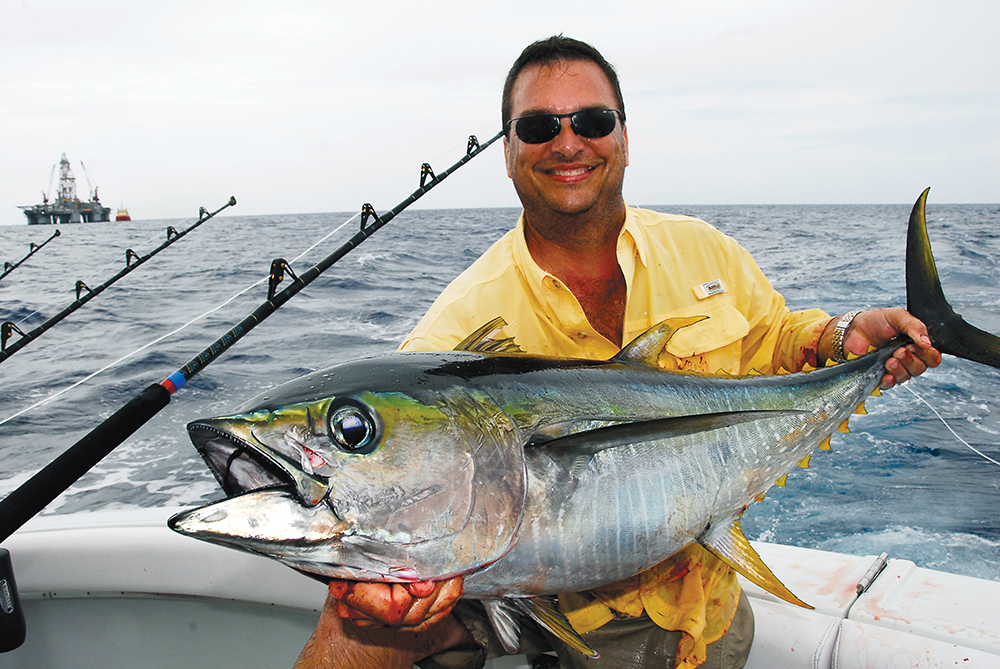
I have crossed the Gulf myself, as related in an earlier article, but it was aboard a 53-foot Bertram in rare, calm June conditions, nothing but ripples on the water for 3-4 days. From Playa del Carmen we trolled due north to the deepwater oil rigs off Louisiana, then turned west, sampling more rigs all the way to Port Aransas. Had those rigs all to ourselves, too. We caught blue and then white marlin, wahoo, plenty of yellowfin tuna at night, and big mahi. It was a bucket list of a trip.