
Guy Time
According to the book Bowling Alone by Robert Putnam, there is far less socializing in our local communities today. People are more isolated; there are fewer Rotary Clubs, and church attendance is down. The same goes for Lions Clubs and Elks Lodges. Cell phones have replaced much of our human contact. Social media is rampant with folks constantly staring at their phones in restaurants and traffic. Storytelling around campfires—a tradition thousands of years old—now struggles to survive.
We still keep that tradition alive while visiting friends in Port O’Connor, however. It’s one of our favorite pastimes on the coast each summer evening, because there are many stories to tell about locals and various misadventures on the water.
It’s true that hunting provides a storytelling respite for guys, but the season doesn’t last all year. When I’d been married only a year, I was invited on a deer lease near Lockhart where a few Beaumont lawyers and a judge sat around the campfire. When it was pointed out that few deer had been seen on the lease, one guy said, “I don’t care; I just need a break from my old lady.” That was my first introduction to the idea of guys actually needing guy time.
His statement seemed odd to me, because Amy and I fished together—even won tournaments—and still do. I was going to say that our situation is probably a rarity among married couples, but we may as well delete the word probably. With that said, over the years I’ve come to appreciate guy time—not so much as a break from a wife, but as a chance to enjoy camaraderie with others who share a passion for the outdoors.
One form of socializing I enjoy is year-round fishing clubs. I’m currently a member of two: one saltwater and one freshwater. The saltwater club holds various tournaments, a Christmas auction with lots of used equipment, a winter clam roast, and an annual awards banquet honoring the year’s top male and female anglers. We also host monthly lectures from area guides and scientists working with saltwater species. Teenagers are part of the club and are learning the ropes.
The club runs a year-long contest featuring ten species—four offshore and six inshore. Using registered digital hand scales, each fish’s weight is converted into points, with the largest fish of each species worth 25 pounds. Whoever finishes with the highest score at year’s end wins a $500 Bass Pro Shops gift certificate. Amy is currently leading the women’s division for 2025, so we’ll be going on a shopping spree in January—just like we did back in 1981 with a gift certificate from Port Arthur’s SALT Club, though that one was to Gibson’s, which carried only a few outdoor items and fishing tackle. Then and now, we didn’t—and don’t—own an offshore boat, though there were decades when we did.
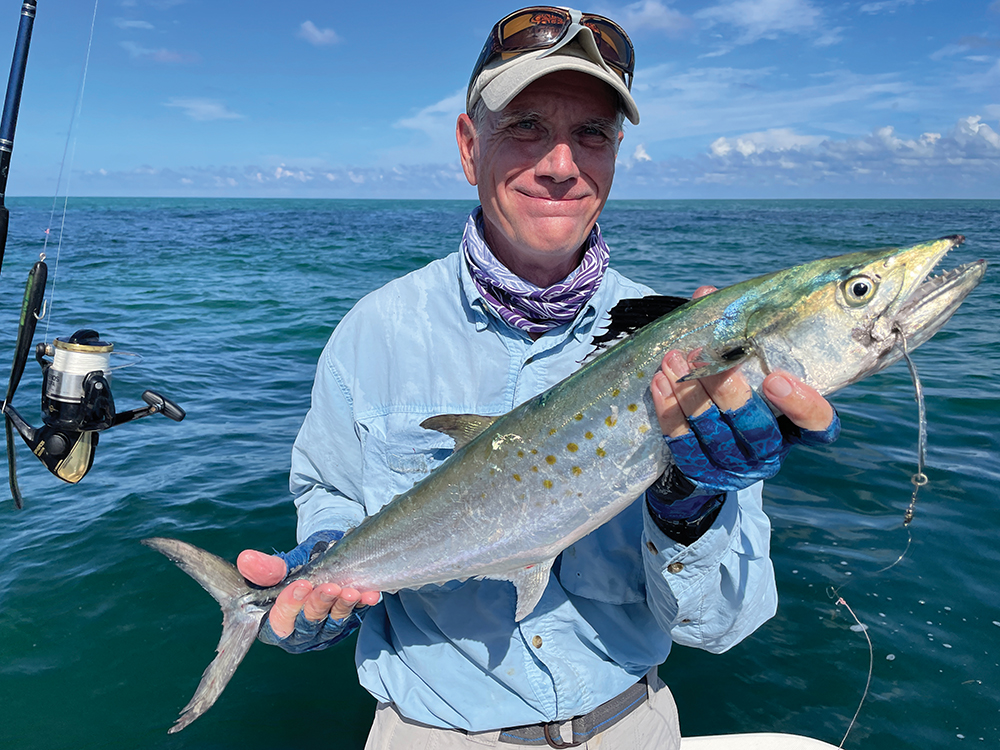
As a board member on the tournament committee, several of us will be pushing hard to drop several offshore species for 2026 and replace them with inshore fish. Ling, kingfish, and amberjack are not doing well offshore. Gulf Coast biologists I’ve spoken with are plainly worried but hesitant to go on record without deeper research into cause and effect. It seems logical to replace these troubled species with others that are doing better. The club was founded in 1969, when fish stocks were very different from today. Species like tripletail, black drum, and pompano—reachable with smaller boats—could be viable substitutes.
Our serious offshore members with big boats have sometimes returned to port without a single keeper, after burning more fuel than I use in a year. The entire club caught only four or five kingfish and ling this past year. I still fish offshore occasionally aboard club members’ boats, knowing there’s no need to own one when you have friends looking for passengers.
My other fishing club is made up of what I affectionately call “grumpy old men,” where the average age was at least 70 when I joined. They stick with freshwater, which isn’t nearly as tiring. Since 2020, we’ve lost 14 members to various causes—several were World War II veterans. The club dates back to 1950 and was named after Four Roses, a popular beverage at the time. Back then, the members were much younger, fished hard, and held fish fries every Thursday. Some no doubt carried lingering war trauma.
Today, they’ve largely been replaced by Vietnam veterans who still fish, and we even had two game wardens among our ranks, though one recently passed. About half the members are now too old or stove-up to fish, but they still show up every month for meetings at the clubhouse, enjoying fried crappie, hush puppies, and cheese grits while eagerly hearing the latest fishing reports. We regularly hold crappie tournaments on area lakes, plus a redfish, trout, and mackerel tournament every October.
These older guys have shown me techniques on five different lakes. Younger members in their 40s are gradually replacing them. Above our covered picnic table hang plaques bearing the names and birth-and-passing years of at least 80 deceased members. Most of the group still uses jonboats, so I fit right in. This is a guys-only club, allowing plenty of good-natured guy talk. A few of the younger members still sip beer, but nothing like back in the day. I was coaxed into becoming club treasurer, managing $40 membership fees, raffle proceeds, $5 lunches, tournament entries, and payouts. I’ve learned a lot fishing with these guys.
Cast your mind back to around 1969, when Toledo Bend Reservoir first opened to fishing. Most local high school kids didn’t know shinola about the new lake. The YMCA had started a boys’ fishing club in Port Arthur, and with great enthusiasm, we boarded a bus with camping gear for a warm spring weekend. They hauled us north, eventually turning down a (thankfully dry) dirt road to Green Acres campground, which had boat rentals.
The next day we paddled into the nearest cove. Back then, crappie were stacked around every tree and brush top, with no limits in place. We caught heavy stringers using small hair jigs. On the dock was a contraption like a clothes dryer that spun fish clean, blasting scales back into the water.
That first trip turned into many more adventures. With new driver’s licenses, we drove back on our own and filled stringers again. We never would’ve known about that place without club membership. On one trip, we slid off the muddy road in a massive station wagon and waited hours for a tow. On another, returning after dark and distracted by a rabbit—we used to road-hunt rabbits on Pleasure Island—we hit a sharp curve near Burkeville on wet pavement and slid into the woods, slamming Marvin Cichowski’s dad’s red Thunderbird into a big tree. Our Styrofoam coolers didn’t survive, and crappie flew everywhere, even onto the dashboard. We hiked into town to make a call, and Marvin’s schoolteacher father—who had plenty to say—drove 92 miles on a Sunday night to retrieve us. We were hard on family cars for several years.
We need more fishing clubs. How else are you going to learn new areas, techniques, and recent catches—by talking to tight-lipped strangers at the dock? Lurking on Facebook? Good luck with that.
Just today, two buddies from my club called to report catching 20 trout from 16 to 22 inches, giving the exact location. They’re going back tomorrow—and want me to go.