
Hook Drama
Hook barbings are a constant, low-key menace while out there fishing, and they don’t always happen in the boat. I was reminded of this last week at the dinner table when I stood up after lunch. Or tried to. There was a sharp pain in my right foot, and I couldn’t move it without tripling the pain. I work on tackle at the dinner table and the 100-year old rug we inherited. A hook had somehow slid off the table weeks before, and the eye was imbedded in the carpet. The sharp end was now deep in the side of my bare foot close to the big toe. To move an inch hurt something fearful. We couldn’t even see it without climbing under the dinner table. Fortunately, Amy was right there and found tin snips in record time, crawling under the table and snipping the hook. Finally free to move my leg, I set it on the corner of the table and found the culprit, a small hook buried to the max. Amy tugged on it a few times with pliers, provoking a few howls. And that’s when I remembered the loop-and-pull method. Limping to the tackle room, I grabbed a spool of 30-pound line, fed a loop inside the hook’s bend, and gave a mighty yank. The hook came out easily, right back into the carpet, but it first bounced off Amy’s leg and she spotted it right away. I’d forgotten to depress the far end of the hook (it was a long-shank) against the skin before pulling, but the technique still worked. It had been 15 years since I’d used that technique. Such unexpected drama at the dinner table.
The hook was small enough to hurt. Major trauma from a bigger hook can temporarily numb a wound, which happened the only time I’ve had a hook removed by a doctor. The wound stayed numb on the drive to the hospital. I’d been tying on a big saltwater jig at Pleasure Island in Port Arthur. Ready to wade out, I gave the jig a careless yank to tighten the knot. The big jig slipped from my hand and the 6/0 hook went deep into my trigger finger. Not sure why I was using a jig fit for offshore amberjack while about to wade for bay redfish, but we were in the 12th grade and had much to learn. We were likely out of Tout Tails, which we used extensively. I do remember the hospital doctor used a serious bolt cutter on that hook. (Coastal doctors rightfully keep a pair handy.) In the intervening 50 years, I shudder to think of the hooks I’ve dodged without ER removals. All those thrashing offshore fish unhooked and released, often with tags. I did get stuck with big treble hooks in my hands (twice) by big trolling plugs, thanks to thrashing fish, but not past the barbs.
Trotline fishermen probably get it the worst, often baiting up and checking a hundred hooks while fishing alone, often with the wind blowing the boat. Saltwater trotlines aimed at redfish and trout are thankfully gone now, along with their hazardous stakes, but our reservoirs see plenty of trotlines. A friend of mine named Ron Chandler played football at SFA in Nacogdoches and related how he was impaled while running his lines at nearby Sam Rayburn. He didn’t own a boat, but there was a big car hood with a welded plate on the back end that was left ashore with a paddle, which he often borrowed. He was using bigger J-hooks, and one day his hand was impaled with a steady wind blowing. It was a bad situation; that car hood might have sunk like a stone, and him with no knife. He wrapped the main trotline around his leg to stop drifting, and pushed the hook through his hand to cut if off, and said they probably heard him bellowing on the far shore. This was before circle hooks became common and urgent care centers didn’t yet exist. I have mostly avoided trotlines and catfish because I had to deal with the saltwater kinds with their poison fins. My early trotlining on the lakes with store-bought 20-hook rigs either caught turtles, gar, or had their hooks straightened. I never liked skinning catfish, anyway.
Many guides prefer using single hooks on their boats, to avoid a boatload of strangers with unknown casting abilities slinging treble-hooked plugs. Or they spread everyone out by wading open water. I carry two anglers on my boat and have been lucky with no serious snags in many years. Back in the 90s at Bird Island off Port O’Connor, one guy was snagged in the forearm while throwing live croakers. No problem; I popped the hook loose with 40-pound line and he went back to casting. Another guy snagged himself with a MirrOlure when we spotted tarpon. Popped that hook free, as well. This handy loop-and-yank technique has cost the ER’s many lost customers and revenue.
Last time I used the technique, Blair Wickstrom snagged the heel of his hand with a Yo-Zuri plug while our boat drifted in calm surf. I found a spool of 40-pound line and right away snatched the front treble from his hand. But then the rear hook caught him good! Our TV cameraman, a big guy from Boston, almost fainted and lay down in the bow. Blair never even winced. That back hook was snatched out more carefully, this time. By then I was so put out with the offending plug, I tossed it overboard. Should have kept it.
Those early MirrOlures with their three sturdy treble hooks have been hard on people. What if a redfish inhaled one? Or while wading, a trout thrashed at close quarters, or ran between the legs? I remember one guy getting snagged while wading the third bar at Galveston, with a trout on one treble and another treble stuck in his chest. He had to swim to the beach with one hand while in pain. My great uncle Wib mostly fished alone and carried a rusty butcher knife for any job on the boat, including hook removal. On every trip we would sling his silver-sided, clear-back MirrOlures for trout. His boat was small, not much elbow room, but neither of us got a snagging. He was my fishing mentor and I would not want to remember him advancing towards me with that big old knife…
My only regrettable hook-snagging incident involved snagging someone else. It happened at the Matagorda jetties when tarpon were rolling close to the rocks, a thrilling sight at 20 yards. We drifted quietly and I tied on a MirrOlure while reminding everyone to keep quiet. My eldest son, in the fifth grade, accordingly tip-toed behind me while I flailed away. Whap! That serious plug struck him in the head, and a hook was buried north of his ear in his scalp. There was no pulling it out; we didn’t even try. Instead we motored four miles back to the dock, put the boat on the trailer, drove home and collected our younger son. To cheer everyone up on the way to Port Lavaca’s hospital, we told them we’d make an evening of it and buy a large pepperoni at Pizza Hut. It was our only access to pizza and the boys were thrilled to varying degrees. Ian said the hook hurt more from the weight of the lure, so he constantly held it in the air during the 30-mile drive.
In the hospital’s emergency room there was a wait and the kids were hungry, so we called in for pizza delivery. A half-hour later, while Ian was in the back room having the hook cut out, the pizza arrived. Meanwhile an old woman in a pink bathrobe shuffled in with some sort of terrible skin condition. She’d also fallen and hit her head on the fireplace and her hair was a mess, a really grim sight. We looked at her, then the pizza, then back to her, and promptly closed the box; realizing then that the emergency room is no place for pizza. Ian came out of the back room looking relieved and the MirrOlure was gone. We then drove back to POC while chowing down. Some of the fun you can have, living on the Texas coast.
Bottom line: it’s a good idea to carry tools for removing hooks in the boat. Diagonal cutters seem like a better choice for snipping hooks than the all-purpose needlenose pliers most fishermen carry. Boat owners that commonly chase billfish wisely carry 2- or even 3-foot bolt cutters for serious hook removal. My friend, the late Howard Horton, who always fished barefoot, was in a big tournament out of POC when a 30-pound mahi was gaffed into the boat and went crazy on deck. The double-hook plastic trolling bait designed for marlin was whipped back and forth at lightning speed, catching Howard’s leg where it met the top of his foot, digging deeper every time the mahi flipped in the air. Howard must have danced right along with it. Bolt cutters soon cut that thick stainless steel hook, which was pulled free, and they went back to trolling. Next day his ankle was so stiff he could barely hobble up three wooden steps into Josie’s Mexican Food for his breakfast taco. I advised him to at least put some antibiotic cream into the two wounds. Howie took some bad injuries during his storied career offshore.
In our kingfish tournament days, back when those fish were plentiful, we fished two or sometimes three-day tournaments that allowed anglers to stay offshore the entire time and far from the dock. We’d spend an entire day prepping the boat, and one of my duties was to file down the hook barb on each kingfish leader. We didn’t use treble hooks and considered them dangerous around kingfish. My theory was those single, barbless 6/-0 or 7/0 hooks would penetrate jaw bone if need be and would stay in the kingfish if we kept a tight line. And it worked; we were often in the winner’s circle using barbless hooks. Without barbs it was far easier to unhook and release each thrashing fish under 30 pounds, which we frequently did (with dozens of 14-25 pounders), and never suffered a hook injury. We also tagged and released many kingfish and ling with some recaptured in faraway lands. You had to be quick around those thrashing fish; their teeth were worse than any hook. We never considered how the trip might have been altered if a hook went deep into someone. Tagging was thankless, dangerous work and we didn’t use a gaff.
Besides protecting fish, hook safety may be the reason barbless hooks are required in Canada’s huge Quetico Provincial Park, with its thousand lakes of every size, starting at the top of Minnesota. Canadians manage their park fishing well with two fish allowed per angler each day for the fry pan (at least for the cheaper fishing licenses we bought). This is canoe-only country with no outboard motors, and you don’t want to spend three days paddling out with a treble-hook in your hand or other body part. We fished and camped there for eight days, fishing 19 lakes, further and further north before turning back. Somehow I was the only one wearing fishing gloves, which was a good idea in retrospect: I caught a lot of fish, close to 200, mostly on topwater plugs. When I missed a shoreline strike the plug often came zipping back at us much quicker than I could yell, “Incoming!” One plug would have struck me in the face, except I raised a glove and a treble stuck in the tendons of my wrist. But not entirely; the glove stopped it. Good thing, because we were six lakes away from the border and five canoe portages through thick woods with the longest trail, at 3,200 feet, locally called Big Agony. My buddy was older, and had to get an injection for his bad shoulder before the trip, so I carried that 17-foot Kevlar canoe down ancient trails through boreal forest in the land of the Chippewa.
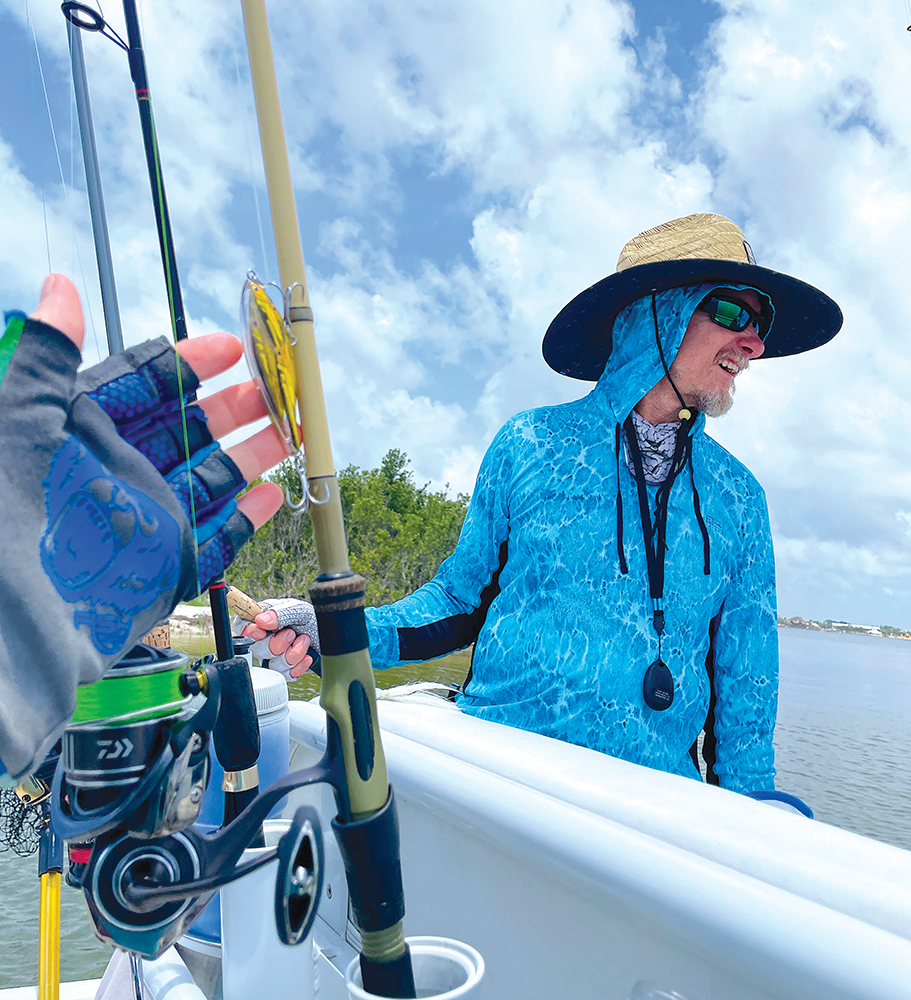
Overall I’ve been fortunate with hooks. These days, we wear long slacks and shirts and a Buff mask; everything is covered except the fingertips. I’ve had plugs thump off my hat and clothes and impale in my shoes. On one great offshore trip with lots of kingfish and a ling, hooks ripped my pants leg a foot and also the back of my shirt. After wearing shorts and t-shirt for a decade on the jetties back in the ’70s, I’ve worn long clothes ever since, often disappointing my skin doctor today, who has still awarded me 40 stitches.
One more tip: Don’t forget those wrap-around sunglasses. I’ve heard two disquieting stories of people getting hit in the eye, one of them having just removed their shades. A trout plug then flying aboard. There are gruesome pictures of eye injuries and hooks online that will curl your hair. Heck, fish out there with nothing but a swim suit if you want to, but at least cover those eyes. Even cheap sunglasses sported by ZZ-Top will stop a flying hook.