
Hooked on Conservation: How Texas Shark Anglers Are Helping Scientists Protect the Future of Shark Fishing
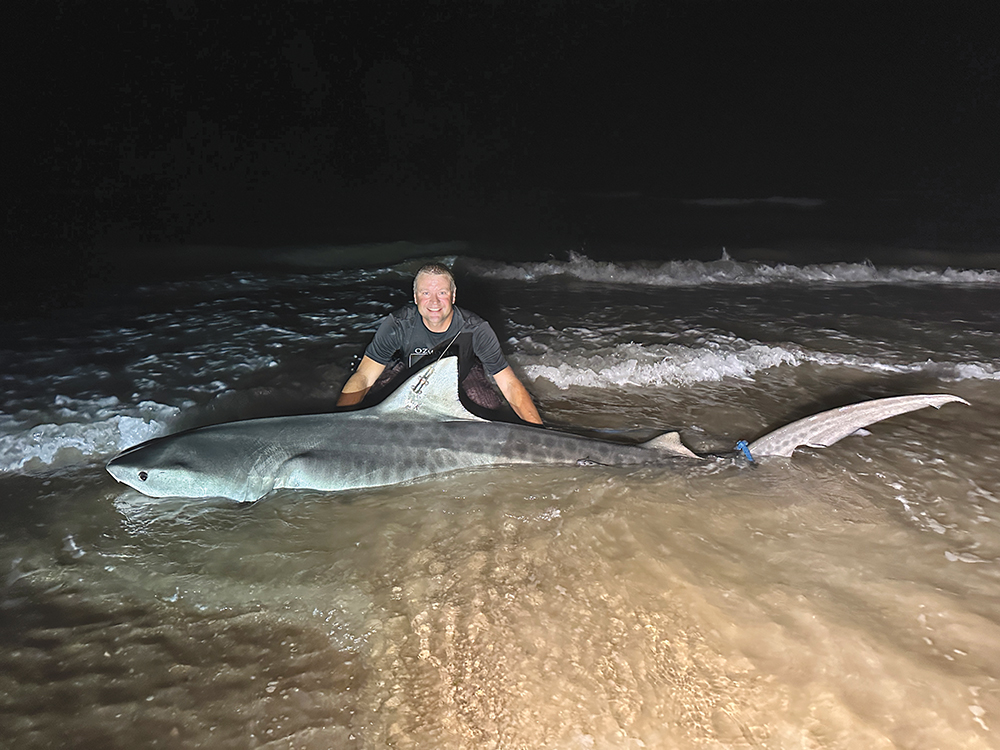
Fig 3. Shore-based angler Eric Ozolins with a satellite-tagged Tiger Shark being kept in the water, practicing safe and proper handling techniques.
If you’ve ever set a bait past the third gut and waited patiently for that heavy pull at the end of your line, you already know—shark fishing from Texas beaches isn’t just a hobby. It’s a tradition. It’s part of who we are as coastal anglers. But what you might not realize is that your passion for chasing apex predators might be one of the most valuable tools scientists have to help protect the future of these fish and the fishery.
That’s the idea behind the collaboration between scientists at the Center for Sportfish Science and Conservation (CSSC) at the Harte Research Institute at Texas A&M University-Corpus Christi and recreational shark anglers. Our partnership with recreational anglers allows for better understanding and transparency in data collection for the shore-based shark fishery along the Texas coast. If you’ve ever participated in the Texas Shark Rodeo, Sharkathon, or tagged a shark through the CSSC Sportfish Tagging Initiative, then you’ve already been part of the solution.
Shark populations worldwide have exhibited serious declines over the last few decades. Between commercial fishing, habitat loss, and slow reproductive rates, many species are struggling to bounce back. In Texas alone, 33 of the 39 shark species tracked by the state are considered vulnerable or data deficient. Translation? We know we need to protect them, but we’re flying blind in some areas.
That’s where these “Rod Benders” come in.
Shore-based anglers catch thousands of sharks each year, most released after a quick photo and tag. That’s not just good conservation; it’s also incredibly useful data.
For example, what species are we seeing? How big are they? Are we catching more or less of certain species over time? Are sharks surviving the release? And most importantly, how can we make sure they do?
Instead of trying to collect all this information the hard way, through expensive surveys or offshore trips, our research team is tapping into a unique source: anglers like you. Through partnerships with the Texas Shark Rodeo and Sharkathon, we are gathering long-term, coastwide data submitted by hundreds of shore-based anglers. Since 2014, these programs have logged over 13,000 shark catches. That’s more than most researchers could ever dream of collecting on their own.
Using this data, our team is digging into questions like: What species and sizes are being caught most often? How often are anglers landing sharks with their gills still submerged (a key factor in post-release survival)? What motivates an angler to release a shark and under what circumstances influence the harvest of sharks? We are even rolling out surveys to get more insight into angler perspectives, from gear choice to conservation attitudes. One of the coolest parts of this work is how it’s already changing behavior. We tested a whiteboard video sharing results from a post-release mortality study (yes, keeping the gills wet really does help!). The video was shared before Sharkathon, included in the registration packet, and played at check-in. Afterward, 97% of surveyed anglers said they were more likely to adjust their handling practices based on the information that was shared. And when we reviewed photos from the tournament, we saw it wasn’t just talk; anglers actually changed how they landed sharks, improving the survivability of these magnificent animals. That’s the power of education when it’s shared the right way, with the right people.
The shore-based shark fishery in Texas is growing fast. And if we want to keep it sustainable, not just for us, but for future generations, then we’ve got to lead the way. That doesn’t mean shutting it down or turning it into red tape. It means fishing smarter, tagging more, and working with us scientists who respect the sport just as much as the science.
Projects like this don’t just help sharks. They give anglers a voice in the management process. They validate the skills and knowledge that seasoned shark anglers have spent decades building. And they prove that conservation and recreation don’t have to be at odds. So, the next time you’re out on the sand, paddling out bait under a setting sun, know this: every photo, every tag, every responsible release—it all adds up to something bigger. And thanks to your help, that “something bigger” might just be a healthier future for sharks and the fishery we love.