


Long-Term Shifts in Angler Preference for Spotted Seatrout and Red Drum in Texas

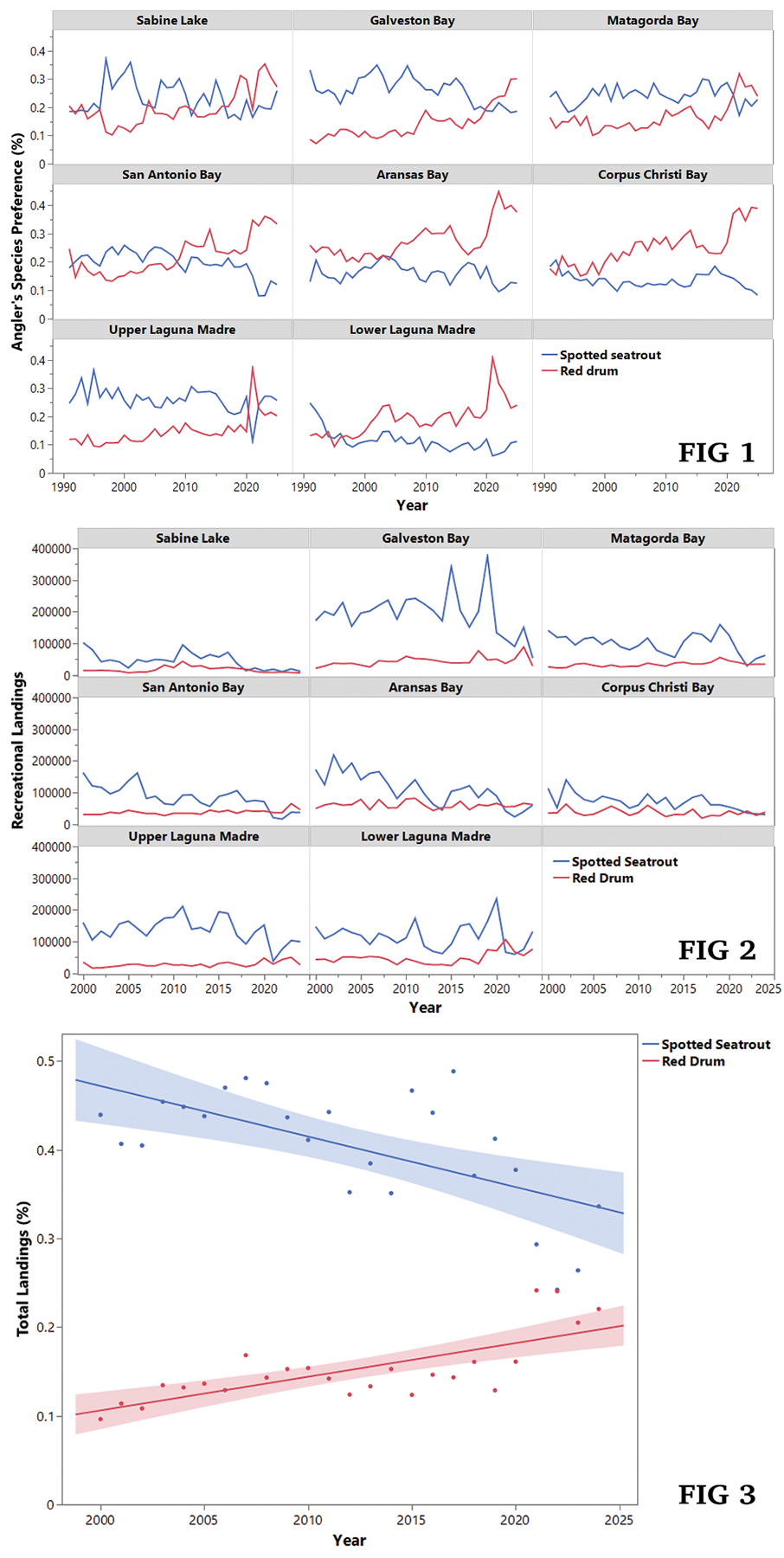
Figure 1. Angler’s species preference from 1991-2024 across the eight major Texas bays. Each line represents the proportion of surveyed anglers from TPWD creel interviews that were specifically targeting spotted seatrout or red drum.
Figure 2. Spotted seatrout and red drum recreational landings from 2000-2024 across the eight major Texas bays. Each line represents the total number of recreational landings of spotted seatrout or red drum recorded in TPWD creel interviews.
Figure 3. Coastwide recreational total landings for spotted seatrout and red drum from 2000-2024. Total landings are expressed as a proportion of the number of landings of spotted seatrout or red drum from the total number of landings across all sampled species recorded in TPWD creel interviews.
Spotted seatrout and red drum are two of the most highly coveted and widely encountered saltwater fish species found throughout Texas’ coastal waters. On any given day, rain or shine, you’ll find anglers out in the bay as the wind wisps across the water and the gulls call overhead, chatting to one another about what they’re hoping to catch. Back at the boat ramp, a Texas Parks and Wildlife Department (TPWD) creel clerk waits with a clipboard and a simple question: “Were you fishing for a particular type of fish today?” The responses to this question, gathered over decades, have revealed a subtle but significant cultural shift in what Texas anglers are actually after during their long hours out on the water.
Spotted seatrout have long been the signature inshore species in Texas Gulf waters. With their sleek, speckled look and ubiquitous presence across every bay system, they’ve remained a staple for generations of recreational anglers. However, their popularity has also made them vulnerable, with high fishing pressure, environmental disturbances, and decades of regulatory adjustments shaping how Texans view and pursue them today.
In contrast, red drum have surged from nearing overharvest to a conservation success story. Easily recognized by their copper color and signature black tail spot, red drum have steadily gained cultural momentum as their populations stabilized in the 1990s after years of overfishing. Since then, regulations for red drum have remained comparatively consistent.
Drawing on decades of TPWD’s creel surveys – dockside interviews that have tracked angler activity since the 1970s – a clear pattern has emerged in the species anglers prefer to target, with two species moving in opposite directions. Preference for catching red drum has steadily increased across every Texas bay system, while spotted seatrout has instead declined in nearly all bays aside from Matagorda Bay.
This shift is evidently not a short swing, but a long-term shift in angler preference. In the early 1990s, once the social question of “Were you fishing for a particular type of fish today?” was added to the creel surveys, spotted seatrout were the predominant species sought by recreational anglers, reflecting their abundance and cultural prominence. However, over time, the number of anglers fishing for seatrout has decreased and been replaced by a growing number of anglers pursuing red drum (Figure 1).
Creel-derived landings (the number of angler-caught fish observed by TPWD creels) also support this notion. Though spotted seatrout landings remain higher in some Texas bays, this is largely due to historical differences in regulations, as seatrout has had a much higher bag limit over time compared to red drum (Figure 2).
However, since 2021, following tightened regulations on spotted seatrout, there’s now an even three-fish bag limit for both species, which may provide a more reliable indicator of true preference in coming years. Regardless, the change in angler preference remains the same coastwide, suggesting there is a meaningful cultural shift in Texas inshore fishing with more anglers chasing red drum than spotted seatrout (Figure 3).
Now, the question is: Why the shift? The answer probably lies in the history and evolution of management rather than just changing catch rates.
Spotted seatrout regulations have changed repeatedly since the 1970’s, in response to population declines and major freeze events. Bag limits have dropped from 20 to only three fish, with size limits shifting multiple times, and emergency regulations enacted following freeze events in 1983, 1989, and most recently, Winter Storm Uri in 2021.
Unsurprisingly, these events not only changed management regulations, but also how anglers approach the species. As size limits, bag limits, and emergency rules evolved in response to freeze‑driven mortality, many anglers have become more cautious in how they target spotted seatrout. Some anglers choose to focus on other species simply because trout regulations have become more constrained over time, and they want to ensure they’re fishing well within the regulations. Others take a more conservation‑minded approach, intentionally reducing their seatrout effort or taking part in catch-and-release practices to support recovery and maintain long‑term stability in the fishery.
At the same time, red drum have risen in popularity, likely given their recovery from being historically overharvested in the 1970s, and their regulations have remained stable. These fish fight hard, are a reliable catch, and have become heavily promoted by fishing guides and tournaments, giving them an ever-growing presence in Texas fishing culture. The combination of changing regulations, environmental disturbances, and evolving angler culture has unmistakably reshaped what saltwater anglers now prefer to catch in Texas waters.
This long-term shift in angler preference from spotted seatrout to red drum carries meaningful consequences for the fishery at the biological, cultural, and management levels.
Biologically, reduced pressure on seatrout may have an unintended benefit of aiding population recovery through reduced fishing pressure – especially for large, older females that contribute heavily to the spawning stock biomass. Conversely, increased angler interest in red drum may now be concentrating effort toward a species with historically stable regulations and demonstrated resilience to population declines. In a cultural sense, when a species becomes harder to catch, harder to keep, and more regulated, especially due to declining abundance, angler preference naturally shifts towards species that aren’t under the same constraints.
From a management perspective, changes in angler preference are of utmost importance. These changes directly influence harvest patterns and regulatory decision-making. When one species becomes less targeted, managers gain more flexibility to support recovery, especially for a declining species. However, when another species becomes more heavily fished, future harvest pressure must be anticipated. The choices of anglers become an integral part of the ecological system, shaping not only what Texans catch now, but also what species are going to be available for the next generation.
The shift in preference from spotted seatrout to red drum has obvious implications for the future of these fisheries in Texas. The stewardship of these invaluable species will depend heavily on what anglers choose to chase and how their preferences might continue to evolve, which will in turn have a direct effect on how these fisheries grow, recover, and are redefined in the coming decades.