
Mansfield Report: August 2025
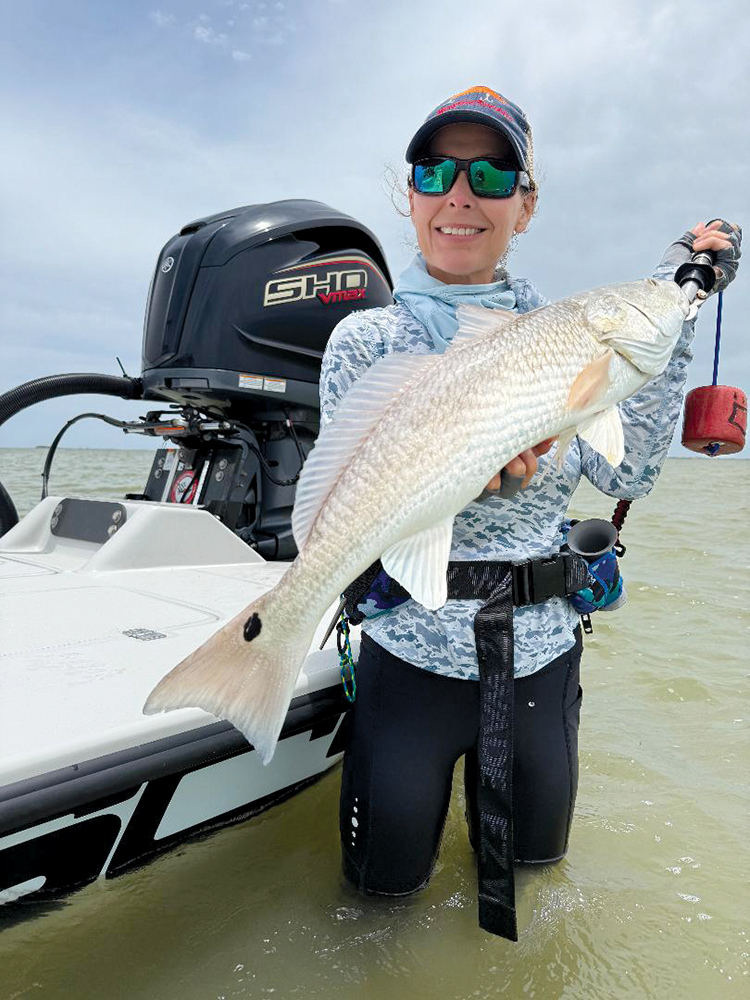
Catie was very happy to land her personal best redfish recently.
Greetings from Port Mansfield. I may have mentioned it last month, but this heat is really getting to be something else. The winds have started to back down somewhat, which can be both a blessing and a curse. No wind in August means you are fishing in a sauna and high wind in August feels like someone has a blow dryer aimed right in your face. Either way it’s August and we must make the most of it.
This last month or so I have been keeping busy chasing redfish, which has reminded me of certain key elements of their feeding and behavior patterns. When working reds in backwater flats that are connected to drains, its more about timing than anything else, and some of this also applies to reds staged in deep water elsewhere in the bay system. What I mean is it is best if you keep track of time in both of these areas.
For instance; there were several days when I would hit a “redfish hole” early in the morning and get one or two blowups, whereas the previous day we caught a lot in the same area at noon. Well, that difference in timing turned a slow day into a wonderful day of fishing, (although the exact time varies some and is usually a little later each day). We caught many reds for a few hours before the bite slowed and eventually stopped. The lightbulb went off and I started timing it accordingly as the days went on.
Next, I checked the tides and noticed the water was flowing out of the big drains associated with the small flat. Pretty neat to put this together although many anglers before me have likely done it as well. While playing the redfish game we also ran across a few good trout, one of which was longer than thirty-one inches (see photo). This pattern eventually shifts so take advantage of it while you can.
As we work through the next couple of months, and at the time of this writing, we have been starting our morning wades on “sloped” bottoms where there is immediate access to deeper water. What I mean is one wader in the group will be waist-deep and the others staged successively shallower toward the knee-deep. A recent wade produced four trout over twenty-six inches utilizing these tactics. Most came from off-colored water between mid-thigh and waist-deep. I like this approach simply because you can figure out pretty quickly where the fish are staged. Bait is also a good indicator and lately it has been thick in spots like I just described. White Wig-A-Los and 4-inch Paddletails on 1/8oz jigs have been our best baits. I have been stubborn with my Mansfield Knockers but the plastics have outperformed them these last few trips. Now, if I had landed every blow-up…
August will also have me looking for those elusive Texas snook, encounters with which usually become more numerous this month. The water is hot, (actually, the water has been hot enough more than two months now) but the winds have held me back quite a bit during June and July. I am really looking forward to this and I sure hope I get a few more shots at some tarpon. The last few years I have been chasing several small pods of tarpon around the bay while wading and I am hoping to dial in on that again. We shall see, but they certainly have a mind of their own and sure are hard to land when you get lucky enough to hook one.
You do not need heavy tackle to land bay tarpon and snook. I have pointed out in previous articles that you can catch them both on your everyday trout and redfish gear, such as I have done many times. A Fishing Tackle Unlimited G2 Green Rod, a Shimano Vanford or Chronarch reel, with 20-lb braid and 30-lb fluorocarbon leader can certainly get the job done. This set up will not break the bank and, more importantly, it will not fatigue you unnecessarily during a long day of casting.
In closing, remember to try and time those fish if you can, be patient and capitalize on the minor and major feeding times. Fish weekdays as much as possible to avoid boat traffic and fishing pressure. Please be courteous and kind to your fellow anglers if weekends are the only days you can be on the water.
Until next time; remember that fresh is better than frozen.