
Mid-Coast Bays: February 2026
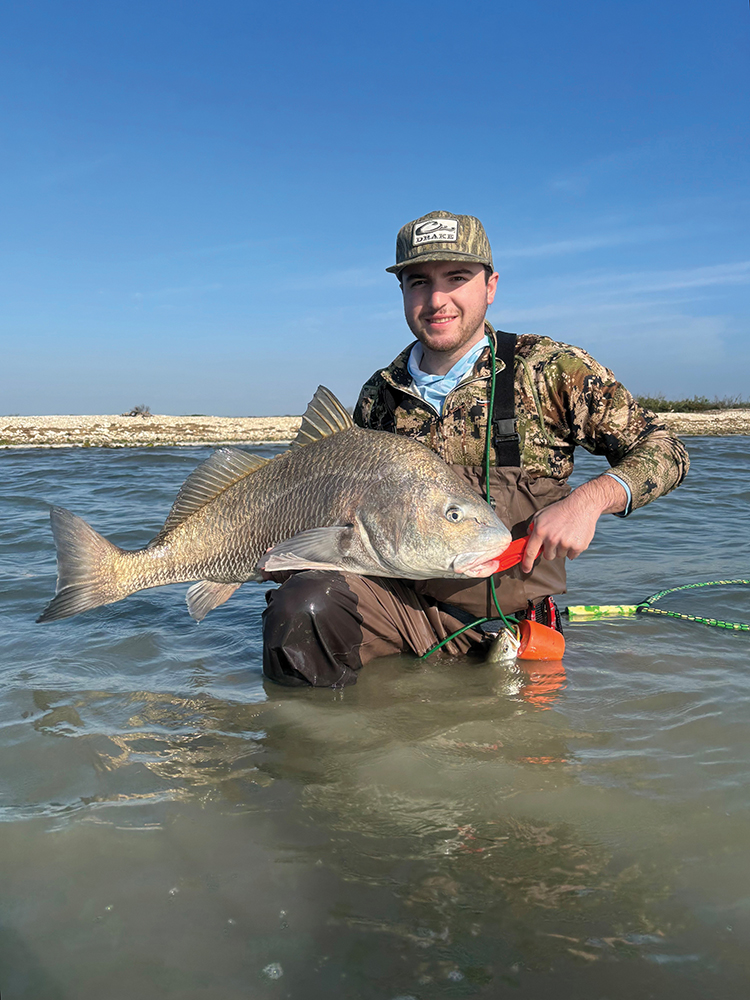
Hunter Maxwell enjoyed a lengthy tug-of-war with this bruiser of a black drum.
It looks as though Mother Nature is playing another one of her games here along the Texas Middle Coast—weather-wise, anyway. What I’m referring to is the steady 70- to 75-degree air temperatures we’ve been experiencing for the majority of December and thus far into January. A quick check of the long-range forecast seems to indicate this pattern could be with us for a while. While I’m not one who usually complains about warm temperatures, the higher-than-average temps made for a rather warm duck season and really hurt our wintertime big trout fishing. I can recall duck hunts during Christmas week when I never wore my Southerly Fishing Gear Coastal Waders—I just pulled on my Southerly wading pants and got after it. Hopefully, by me saying this, I haven’t jinxed us into getting another hard freeze before the end of February.
With the weather being milder and the Coastal Bend not receiving our regular blustery cold fronts in January and February, water temperatures in the open bays and back lakes have been surprisingly warm, staying mostly in the 65- to 70-degree range. These higher-than-normal water temperatures have kept the back lakes and main bay shorelines stocked with mullet and other forage species, simply because baitfish haven’t had to retreat to deeper water to survive.
One thing that has remained pretty much normal over the past several weeks, however, is the tide level—or lack thereof. The few fronts we’ve had arrived from a northwesterly direction, and the winds that followed remained southwesterly for the most part. Naturally, the tides stayed exceptionally low. What that means is the average boater would be wise to enroll in a tow service such as Sea Tow or TowBoatUS. That’s because there are two types of boaters running around the Seadrift/Port O’Connor area: those who are stuck, and those who are about to be stuck.
As far as the fishing goes, we’re really still doing the same things we were doing in November, December, and January. With the long intervals between fronts, winds subside quickly and stay down until the next one arrives. That makes it possible to fish pretty much wherever you’d like. I’d even say that with lighter-than-normal winds and milder temperatures, I—along with many other anglers—have been able to fish the mid-bay reefs of San Antonio Bay and Mesquite Bay more days this winter than I did during the summer months.
When fishing the reefs, the majority of our fish have come from the deeper ends—throwing out to where the shell tapers off and the bottom turns to mud. There were some days when the fish seemed stationed right on the edge of the shell, and you really needed to throw and work your lure parallel to the crown of the reef to get a strike. We’ve been throwing a lot of 4-inch Saltwater Assassins and 5-inch Sea Shads in Smoke Wagon and Purple Chicken, rigged on 1/16-ounce Assassin jigheads.
Along the main bay shorelines of West Matagorda, Espiritu Santo, and the Mesquite Bay systems, redfish are stacked heavily, with some larger trout mixed in. The drains off those same shorelines that connect the backwater areas are also teeming with baitfish and gamefish alike. I also feel compelled to mention the stupid number of quality redfish and larger trout I’m seeing in super-shallow backwater areas—yes, “stupid” is truly the best way I can explain it.
Now for the topic I’ve been avoiding. If we actually do get some true winter weather in the coming weeks, it will definitely change these extended fall-like patterns we’ve been enjoying. We’ll shift back to more traditional winter fishing areas such as deep-water drains and deeper back-lake spots like Pringle Lake, Army Hole, and the Victoria Barge Canal. At that point, we’ll downsize our lures and increase jighead weights to work the lower portions of the water column more effectively.
Whatever happens, we’re very fortunate to live and fish along this stretch of the Texas coast, with so many diverse habitat options to explore—no matter how big of a tantrum Mother Nature decides to throw.
Fish hard, fish smart!