
Mid-Summer Snapshot of Galveston Bay
I’ve written a lot about the changes Galveston Bay has seen through the years. We are not unique here on our part of the coast. Virtually every estuary, bay, sound, lake, river and any other body of water we can think of has experienced changes over time. Some have been caused by man while others have been Mother Nature induced. In most cases it has been both. We are simply a place marker on a timeline. We’re here for a finite amount of time, and we notice the changes during our stay while having the privilege of using the resource. Those who came before us did the same thing, but they observed different changes than us even though they probably said many of the same things that we say now. “Man! I sure miss the good ole days” or “Things just aren’t what they used to be.”
I feel like at this point it would be somewhat exhausting to give detailed explanations of all of the changes we’ve experienced here in the Galveston Bay Complex, but please feel free to peruse some of my past articles in this fine publication to listen to my take on said changes. My article titled “Assessing Thirteen Years of Trout Stack-Ups in Galveston Bay” from August 2021 does a good job of explaining many significant changes that have impacted our bay system. To give a quick summary, we’ve had thousands of acres of our primary habitat (oyster reefs) silted over with the biggest culprit being Hurricane Ike on September 13, 2008. Since then we’ve had droughts, floods, and channel dredging projects along with natural erosion and subsidence. We’ve lost virtually all of our seagrass beds. In my opinion, our toughest years for catching trout in the last twenty were the ones immediately following the floods of Hurricane Harvey in August 2017. Our bay system got almost completely purged (by fresh water) of trout, and we had to basically start from ground zero. The summers were especially tough. On a side note, 2018 and 2019 were two of the best years I’d had in East Matagorda Bay in years for numbers and big trout. Many others believe that many of the trout from Galveston Bay followed the freshwater wedge down the coast to Matty following the floods.
It’s not that we didn’t have any fish (mainly referring to speckled trout) during those lean years. We still had some 30-60 fish days, but we caught most of them in just a few spots, and the majority of the specks were younger age classes (1- to 3-year-old fish). Our bay reminded me of a guitar that was out of tune. If you were good enough and tried hard enough, you could still make it sound good, but it still needed tuning. And then the tune-up efforts began.
TPWD, CCA, Nature Conservancy, Galveston Bay Foundation, U.S. Army Corps of Engineers, Texas GLO, the oyster industry and countless volunteers have contributed more than 1,300 acres of oyster reef restoration projects since Hurricane Ike. River rock, limestone and oyster shell have been the main substrates (cultch) used. Cultch used to be planted in flat layers adjacent to existing live reefs, but in recent years the substrate is typically placed strategically in mounds with a more eccentric rise above the bay floor to help prevent siltation. Jetty-like revetment walls constructed of concrete chunks and granite along with shoreline Spartina (cord grass) planting projects have also provided habitat in many areas of our bays. There are even a few areas where I’m seeing a resurgence of seagrass. Speckled trout limit changes September 1, 2019 (10 trout to 5) and March 26, 2024 (5 to 3 with a 15–20-inch slot) have certainly played a role in improving overall numbers (biomass) and more mature age classes in the population.
So here we are in July of 2026. Despite everything that has happened along the way, things are doing pretty darn good. In years past my focus areas for trout this time of year would be predominantly open-bay oyster reefs, channel spoils and old well pads. Wading the Pig Pens, Fat Rat and the north shoreline of East Bay would also be in the mix, especially during the early hours of the day. While we do still catch some fish in those areas, I tend to focus more of my attention on man-made structures and oyster reef restoration sites these days during the hotter weather months. We still catch fish in those other areas I’ve mentioned, but we no longer see the giant rafts of mullet or the big schools of trout that we used to see there.
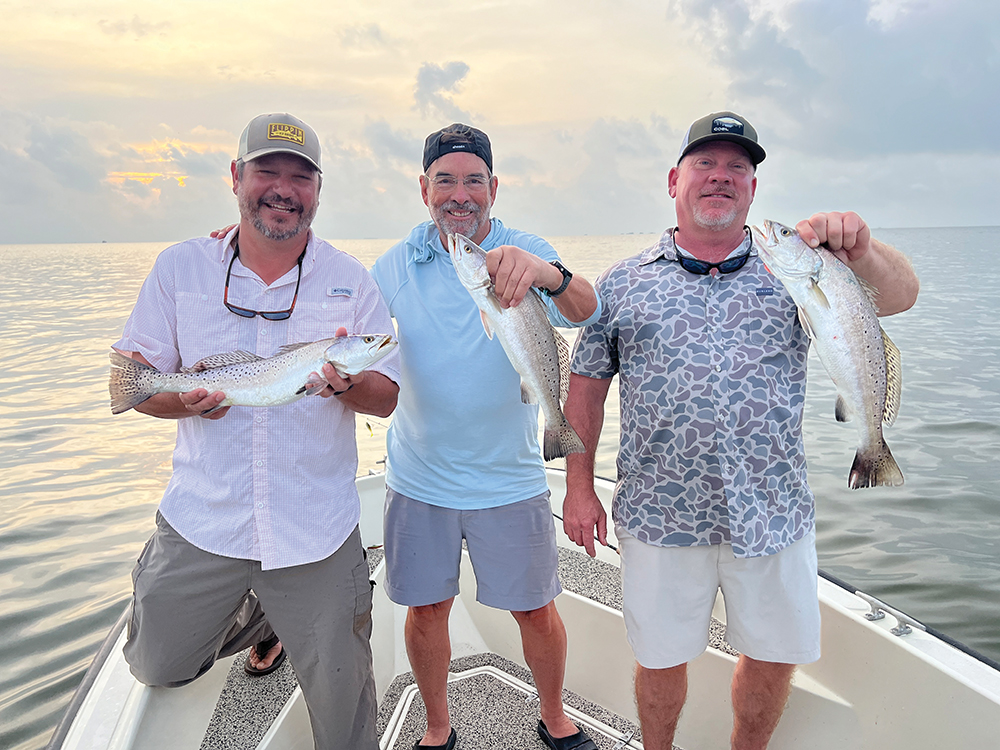
Slicks out over deeper reefs and rock structures and wells in 9- to 13-feet water are producing well for us. A lot of folks automatically think they need to rig their soft plastics on heavier jig heads (1/4 or 3/8 ounce) when fishing deep water. This is true for the most part, especially when there is a moderate to swift current, and/or some wind. There are other times when winds are light and tide movement is minimal, causing trout to just suspend somewhere in the water column. We witnessed this on yesterday’s trip.
We were in about 10 feet of water. I had three new clients. Vanessa, Victoria and I were rigged with Assassins on conventional 1/8-ounce heads, while Alec was using one of my rods still rigged with a Pro Elite 1/8-ounce head from a previous trip. He was absolutely wearing out nice trout while we were only able to trick a few. I finally switched the rest of us over to exactly how I had him set up (Laguna Shrimp Saltwater Assassin Sea Shad rigged on eighth ounce Saltwater Assassin Pro Elite lightweight jig head). Needless to say, I wish I would’ve done it sooner. Sometimes little changes like that change the entire outcome of your day.
We don’t always go deep this time of year. We’ll continue to catch plenty of fish along sandbars near San Luis Pass and along broken shorelines, especially early in the morning. Topwaters like MirrOlure She Pups and Rapala Skitter Walks can produce some excellent results. Sometimes, we’ll even catch them way up shallow in the middle of the day. We witnessed this just recently when rain showers cooled the surface water and increased the dissolved oxygen level. The trout pulled up much shallower than they would otherwise have for the particular spot we were fishing.
I’ve also witnessed dolphins and sharks pushing trout up shallow and making them easier to catch (when they don’t completely run them off). This has actually become a very common occurrence here in Galveston Bay in recent years. Dolphins used to hang out around shrimp boats which provided easy meals as they simply just gorged on the shrimpers’ bycatch. Nowadays, there are fewer shrimpers, so dolphins and sharks focus more on us (fishermen) and their inherent ability to hunt down prey. There are a few places here in Galveston Bay that I don’t even like to fish because dolphins anxiously wait at the side of my boat for us to release trout.
We are finally getting some significant rainfall amounts as I type this article. I’ve gotten almost 8 inches in the last two days here where I live, and the Lake Livingston dam is currently discharging at a rate of 7,500 CFS. That’s a far cry from the 85,000 CFS it was flowing at this time two years ago. It’s been so dry that most of it is getting soaked into the ground. I’m praying that our salinity levels stay balanced throughout the entire bay system so we can continue to increase our resident populations of trout.
It seems like we’re continuously having shad hatches and there are lots of shrimp in the bay. I’ve also noticed more blue crabs swimming past my boat as we drift. We’re catching quite a few black drum while we’re trout fishing. Water clarity has been incredible. There was recently a big tarpon hooked somewhere up the San Jacinto River and a small tarpon a friend / client of mine caught way up a bayou, not far from where I live. These are all very good signs.
I think about all of the places we caught trout and redfish back in the day. It was amazing. Then I think about the areas within our bay where we catch them now, and I think to myself, “Wow! So much has changed.” The good news is that I’m now seeing some fish show up in a few of those “back in the day” places! I’m even seeing occasional huge rafts of mullet now which is refreshing. All forms of marine life are important, but seeing our bays full of mullet is a tell-tale sign of a healthy fishery.
Things are most definitely different nowadays. Social media has changed fishing and just about everything else. Very few folks write checks anymore. “Hey captain, do you have Zelle?” “How about Apple Pay or Venmo?” Everything is done online and electronically now. Things have changed. It’s not bad. It’s just different. We can’t turn the clock back to the mid-eighties or whichever time period that we remember as being the best, but there is something we can do. We can enjoy what we have now and appreciate the changes that have been made by those who have cared enough about our resources to step up and make a difference. Good luck and happy fishing!