
Musings from the Fish Cleaning Table
Twenty years ago, a game warden advised me that fish carcasses, which he called “biomass,” really belonged back out there in the water where they came from to feed the fish, crabs, and critters, not in some dumpster or landfill. Ever since, I’ve tried to follow that by tossing scraps and fillet-less fish back, preferably in the ICW or deeper water with a slow current. I’ve also donated fish carcasses to neighbors from other countries who utilize more of the fish. More on that later.
It’s true that countless fish are cleaned at coastal docks where the remains are returned to the water. However, some places without access to good water circulation or deep water have posted “No Fish Dumping” signs, and for good reason. Sometimes there is a local ordinance banning fish disposal that tries to keep the water clean; no one wants to see floating redfish carcasses that can hang around for a week or more.
If you prefer to return your fish remains back to where they came from, here are a few tips: Anglers cleaning fish can help by puncturing the eyes and air bladders before tossing them. This makes it easier for them to sink, where benthic critters make them disappear fairly quickly, especially POC’s “piranhas” (hardhead catfish). They even have a local alligator that favors fish scraps.
With all that biomass going off the dock for decades, the crabs, dolphins, bull sharks, and even goliath grouper may show up for the dinner bell. Plenty of mangrove snappers, too. Back in the 1970s at Clarks shrimpboat dock (they opened the restaurant in 1994), Billy Ragusin caught a huge goliath grouper from under that dock. It had been seen inhaling buckets of shrimp heads dumped overboard. Today, it seems like someone with a sturdy handline might get some serious action around there, using a fish carcass for bait. Of course, this could be dangerous, getting wrapped in the line and yanked overboard by a powerful fish or gator. Around that cleaning table, it’s also “lions with the lambs,” so to speak, because even pinfish make a good living there, nibbling trout carcasses and getting some payback. One summer, I kept a pinfish trap next to that cleaning table for a couple of weeks that provided many of those baitfish.
As for dry land, forget burying cleaned fish carcasses in the backyard. I stopped doing that years ago, after several sandy sheepshead carcasses were dug up. (We have woods and a serious raccoon problem, no matter how many I trap.) Sometimes I’ve hauled a few fish carcasses to a local lake where people never swim because of the gators. Over in Florida, all of their lake marinas and boat ramps with fish cleaning tables post “No Swimming” and “Don’t Feed the Gators,” and for good reason, because they have thousands of big, hungry reptiles. The gators are predictable, but not people; you never know what the latter will do, or if they can even read, for that matter. It didn’t stop one inebriated teenager on a Saturday night from cursing nearby gators before fearlessly jumping off the dock to impress his friends. The water churned, and he didn’t last but a few moments. His girlfriend later told the sheriff, “It was the dang-dest thing I ever seen.”
Considerations when cleaning fish:
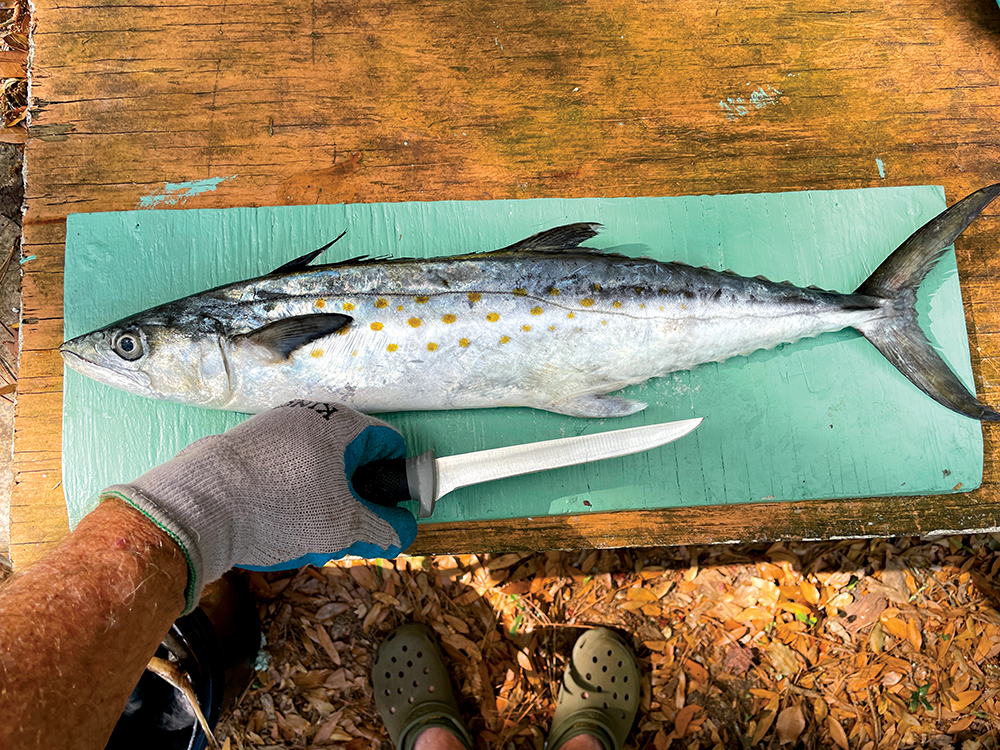
- Sharpen that knife to prevent wasting fillet meat. It’s depressing to see fish filleted with a thick layer of meat left on their skin and backbones. Watch how the guides clean fish and use the kind of knives they carry. I prefer the sturdy, white-handled Dexter blades after my wood-handled Rapala gave out years ago. Also, consider going electric. Each species is different to clean. That bony redfish is best cut from mid-section to head, while seatrout are the opposite; the usual head-to-tail cut works well. Spanish mackerel are the easiest of all, just one long boneless fillet on each side. Flounder and sheepshead are more tedious to clean. Consider baking whole fish such as flounder, snapper, and redfish, where every scrap of meat can be picked over with a hungry fork.
- Donate carcasses to those who will use them. Most people from other countries utilize the entire fish because they don’t have the fish populations we do. I have friends from Hungary and also the Netherlands who make a spicy fish soup or chowder using the whole carcass, minus the fillets, which I kept. In America, we toss tons of good fillet-less fish into marina waters, even big, fine red snapper with lots of white meat. Most people don’t even save the tasty throats of snapper and redfish. We now save some of those carcasses for ourselves for a tasty fish chowder that Amy makes each winter.
This idea first showed up on my radar decades ago when I was staying with a friend at Pirate’s Cove on Galveston Island. We’d spent the night offshore, back when the bag limit was five fish, and our catch added up to eight or nine sow snapper weighing 12–15 pounds. The next day, I set to work with the knife. Just across the narrow canal, I’d caught the attention of a roofing crew. When I tossed that first fillet-less big snapper off the dock, there came a howl of protest across the water. One of those guys spoke English and pleaded with me to save the carcasses, which I did, stacking them in the cooler with the remaining ice. When happy hour arrived, one of these dudes showed up with a big plastic bag and took the carcasses. I didn’t catch which recipe they had in mind for cooking all that saved meat.
- Current Texas law says you can’t use those carcasses in crab traps, which I did years ago in Saluria Bayou. Which is a shame, because a redfish head will last a few days in a trap full of hungry crabs.
- I’ve read that tossing fish carcasses to greedy pelicans at the dock is bad for them. It seems they’ve evolved by eating whole fish, not carcasses with lots of sharp bones exposed. There are stories of those big birds choking on discarded carcasses. And those puppies also bite, too; my uncle tried to hand a ladyfish to a pelican, and the greedy bird grabbed half his arm. Even dolphins show up at fish cleaning docks. Not sure how they deal with the bones, but they’ve found a way. It’s nice to help Flipper with a fish, but sharp bones might cause them problems.
- Blue crabs can always use a handout; they’re harvested widely with commercial traps, and their numbers are a joke from what I witnessed years ago in high school, when we could fill an old-fashioned steel trash can with big male “Jimmys” in a single morning in June (Pleasure Island Marina, Port Arthur). Some mornings, we had four big crabs clinging to a single chicken neck and also on a second line with a small red snapper head. Many more crabs were scooped up in the shallows with a six-foot crab net. We sold those crabs to Judice Grocery for a nickel each.
In Texas, it’s the chore of tired guides to clean fish at day’s end. I remember being too tired to push a knife through another redfish after taking out two trips each day for a drilling mud company in Port O’Connor (with a nap at mid-day back at the house, sleeping in my shoes), then cleaning fish after dark while the clients attended happy hour back at the lodge. We often had 8–9 redfish from the evening jetty trip, and if one was still flopping and breathing in the cooler after sunset, you can bet it was dropped off the dock. The rest wound up filleted in Ziplocs.
In Florida, as it is a long-standing tradition to pay “professional” fish cleaners, the marina calls in someone to weigh and clean the fish, and the fishing party pays them by the pound, giving the tired guide a break. The fish cleaner charges something like 80 cents a pound for uncleaned fish, weighing them by the bucket. When watching this at the marina, I assumed they’d be expert cleaners with a set of knives, but the last guy I saw hacked away like he only had a few minutes, and there was noticeable meat still left on each carcass. In POC, there was also a local teenager who could earn a few bucks by showing up at the right time with a fillet knife. That was years ago, and it may be impossible today to pry kids loose from their iPhones for more than a few minutes.
Down in the Florida Keys at Islamorada, offshore boats return to dock each day and fillet their mahi-mahi. They aren’t allowed to dump carcasses; their marina water is kept clean for tourists and diners. Instead, the carcasses are hauled a few hundred yards out and dumped in the channel, where they attract tarpon every evening that shamelessly gulp down the free groceries. Some guides take out evening tarpon trips and anchor there, bait up with a fillet-less mahi, and they’re soon hooked up to a fighting tarpon within sight of restaurant diners above the marina. Tarpon there have become a form of entertainment around the docks, especially across the island at Robbie’s (also called the Hungry Tarpon), where people are now charged for viewing and even more for feeding the tarpon, which will jump four feet out of the water for a handout. In 1989, we stopped there, nobody was around, so I waved a silver gum wrapper in the air near the dock’s end, where I was promptly bitten by a jumping 50-pounder, along with many other people in the years ahead.
There is video of one sturdy guy on YouTube who had a 100-pounder clamp down on his forearm and wouldn’t let go. He dragged that writhing tarpon onto the dock, where they both hit the planks together—ka-boom!—with considerable screams from a nearby tourist. Once free, his forearm shredded, he quickly left the scene. Tarpon first gathered around Robbie’s dock back in the late 1980s because commercial guys were cleaning fish there while wiping out the local amberjack population at a major spawning site 22 miles offshore called The Hump. It seems that Paul Prudhomme’s blackened fish recipe needed more product soon after big redfish in the Gulf were finally protected in 1986.
It’s fair to say that all sorts of things happen around fish cleaning docks, both good and bad. If you do save that trout, redfish, or snapper carcass, look up a good fish chowder recipe and give it a try.
Texas State Law
- No Public Dumping: It is illegal to discard dead fish, carcasses, or waste in public areas, including boat ramps, docks, and coastal parks.
- Fish Cleaning Stations
- Distance Restriction: Carcasses cannot be discarded within 500 feet of any public shoreline or in public trash receptacles.
- Puncture Air Bladders: Before returning to the water, ensure you "pop" the air bladder (belly) of the fish so it sinks immediately.
- Return to Water: The preferred method is returning fish parts ideally to deeper water, to act as fish food and nutrients.