
Non-Typical Approach to Sight-Fishing
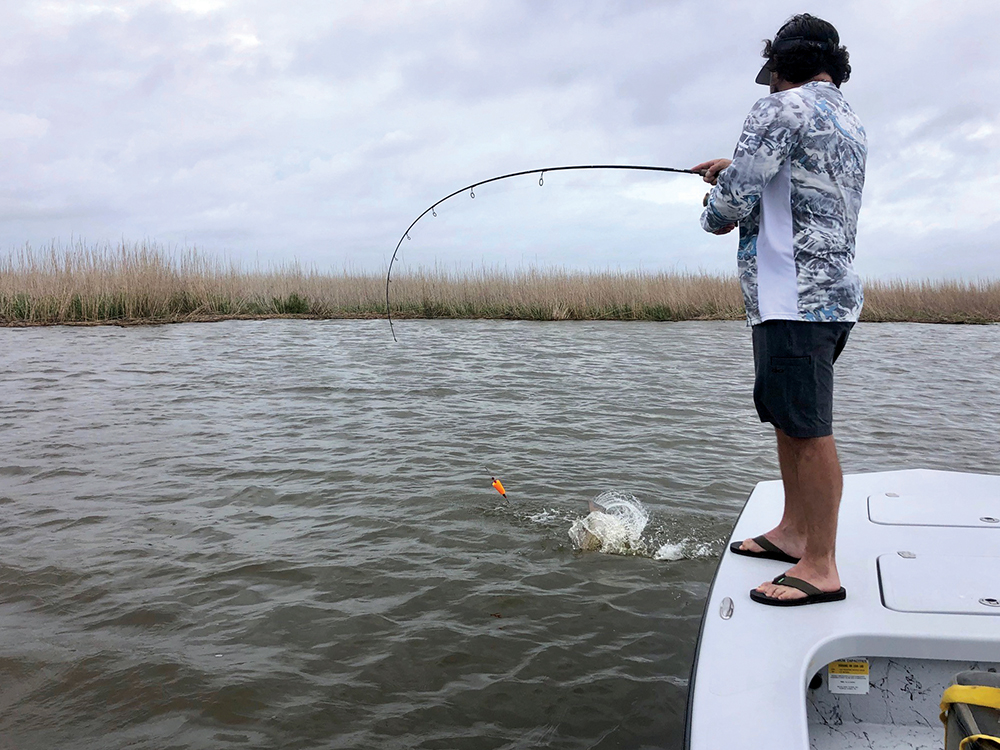
Typically, when we think about sight-casting redfish we automatically think about perfect weather conditions. Partly cloudy to sunny skies with winds less than 10 mph. Days like that are very possible in the month of June, but what about the other 15-20 days of the month? What about the days when the wind is right but the skies are overcast, or when the wind picks up to fifteen plus by 9:00 am?
Sometimes these not-so-perfect days happen and when I have clients scheduled, I must be on my toes at the dock and prepared to call an audible. We have several areas in the Seadrift/POC area that will still allow us to be successful. Not only are there areas to be successful under these conditions, but timing could get you a few more hook-ups before the wind gets bad. I have clients ask all the time, why are we leaving the dock in the dark to sight-cast? I explain to them that there is always a pre-dawn/sunrise bite, and it might just be the window we are looking for before the winds change.
Standing on the tower in the pre-dawn light shows us a ton of activity, and sometimes when the sun breaks the morning clouds, that activity ceases. Water clarity does not have to be perfect for this pre-dawn bite; what we see gets me excited even as I write about it. What I’m talking about are stretches of shoreline with reds crawling down the bank, half out of water, to small coves or protected areas where the slick water extends 5 to10 yards out from the bank, and redfish tails wagging above the surface.
I believe the first fish to quit in the mornings are the crawlers. Too many times, in my experience these fish seem to be the most bashful, not in terms of eating a lure or spoon thrown in front of them, but as far as condition changes. Sun rising above the morning clouds or ripples starting to lap up on the bank and they seem to vanish from the few inches of water they were just in. We still see these fish cruising the drop-off farther away from the shoreline where the water is a foot or two deep, but many are not interested and quickly spook when we cast to them.
The smaller groups seem to last a little longer, but when that wind starts to find another gear and those slick areas begin to disappear under surface chop, I agree they are much harder to see. Shorelines tend to go quiet when this happens; bait activity typically fades to almost non-existent. Thankfully, we were there at the right time and have already had considerable success by keeping this kind of sight-casting schedule.
Now, what about cloud cover. Well, that same early morning activity can be there, and under the scenario we described the winds can stay calm to light for a few hours longer. Under conditions like this we still cruise much of our favorite sight-casting grounds, but with the overcast conditions we must move much slower, sometimes simply sitting on the Power Pole in the middle of the flats and creeks or certain stretches of shorelines. One of the main reasons we do this is to avoid spooking fish that might be coming up to feed. We simply make the set to see if these fish will show themselves, close enough to cast to, or to where we can set up a true spot and stalk situation.
Yes, this approach can take more time, and each cast must be on the money. But, to be honest, I have never been about numbers. For my clients and me it’s the experience and being successful under as many conditions and situations as possible. Some of our most memorable trips have been under the tougher sight-casting conditions. And, on days like that I personally might learn a thing or two myself. Maybe it’s a new technique, or subtle area that I have overlooked on other days. But one thing is for sure, it always gets noted in my log and stored into memory.
I am very blessed to make a living fishing, and because I get to spend countless days on the water under varying conditions, my confidence holds steady in many different scenarios. Our newest adventure this year is to do some night trips off the tower for reds, trout and flounder under the right conditions.
If you are looking to explore more areas like this or need help navigating or improving your fishing game. We offer navigational trips from Port O’Connor to Rockport. These trips are designed to help anglers of all levels, whether you are new to an area or an experienced angler in a certain body of water. We offer tips and tricks for each. We emphasize safety and boating etiquette as well as teaching you how to run new waters safely, marking your GPS for any hazards along the way. We help you to read the water from a navigation and fishing standpoint and have fishing discussions in each area we travel to on the day of your trip. Some of these discussions are weather, tides, time of year, and what to look for and how to approach these particular areas. Whether you are new to fishing or an experienced angler, we try to customize each trip to fit your needs.
Captain Nathan Beabout – USCG/TPWD Licensed – Full time guide since 2007
Seadrift, Port O’Connor, Port Mansfield, TX
Facebook, Instagram, LinkedIn (N&M Sportsman’s Adventures)
Cell (210)452-9680 Email [email protected]
Website www.nmsportsmansadventures.com