

Our Bays Thrive on Freshwater Inflows
The same as every year, over the next several months we will need to be on watch for tropical weather developments. Hopefully, August will be a quiet month as far as major storm systems are concerned, but with adequate rainfall across the Coastal Bend region to ensure that our bays will continue to flourish. The late spring and early summer rains received recently saved us from the horrible drought pattern that had begun to settle over the region, and for this we are very thankful.
Many folks get scared when they hear our rivers have crested and are dumping into the bay, and yes, the initial push of fresh water may dampen fishing in certain areas, but our bays need this continual influx of freshwater. The way our local bay system is set up, even when the Guadalupe River floods, it’s like a time-release more than a sudden wall of water. That is because the predominant SSE winds keep most of it pushed to the northwest where it can mix gradually with the rest of the bay, thus preventing large scale freshwater inundation. Other contributors to the direction and flow of freshwater within the San Antonio and Mesquite Bay systems are Cedar Bayou, the Victoria Barge Canal, and the ICW. All three of these promote tidal flow in the general region. The Barge Canal and the ICW are the deepest waters in the vicinity of the Guadalupe and therefore have some of the largest water volumes moving through them.
When we have localized heavy rainfall, there are other smaller creeks and drainages that play a part in the volume of freshwater entering our bay. Several of these areas can be found up and down the banks of the ICW, which are small marsh habitats where tons of small grass shrimp get pushed out to the bays. I am not at all worried about fishing in times like this, in fact I welcome this change. This freshwater helps to lower our salinity levels and reduces the summertime bay water temperatures. Because of this, our fish are less likely to leave in search of more suitable habitat. Also, the major food sources – shrimp, crabs, and a host of other baits – get flushed out of the river delta and other freshwater tributaries, bringing an abundant source of forage into our bay.
From my experience on the mid-bay reefs of San Antonio Bay, it seems that trout will stay about a half mile to a mile out in front of the freshwater line, if the structure that is holding them Is relatively shallow. With other mid-bay reefs that have 5–6-foot drop-offs directly adjacent, fish can still be found hunkered down on the bottom. Meaning that we simply need to adjust our jighead weight to get down to them. As for trout on the grass flats or along the various shorelines, some of the fish will leave the area entirely while in other places they will just move out deeper.
Take for instance what happened to us back in early June, during the height of the most recent freshwater influx. When the rainfall occurred, we had an abnormally high tide, then overnight with the passing of a Coastal Low; the tide fell over a foot. This allowed much of the freshwater held up in our marsh lakes to start pouring out of the creeks and drains on the south shoreline. We thought for sure this would push trout away and to new areas. But what we found instead was that the adjacent shorelines were still salty and green, primarily on the south sides of the drains. This stacked bait and some very solid trout right near the edge of the drain, lying in wait for the abundance of bait being flushed out.
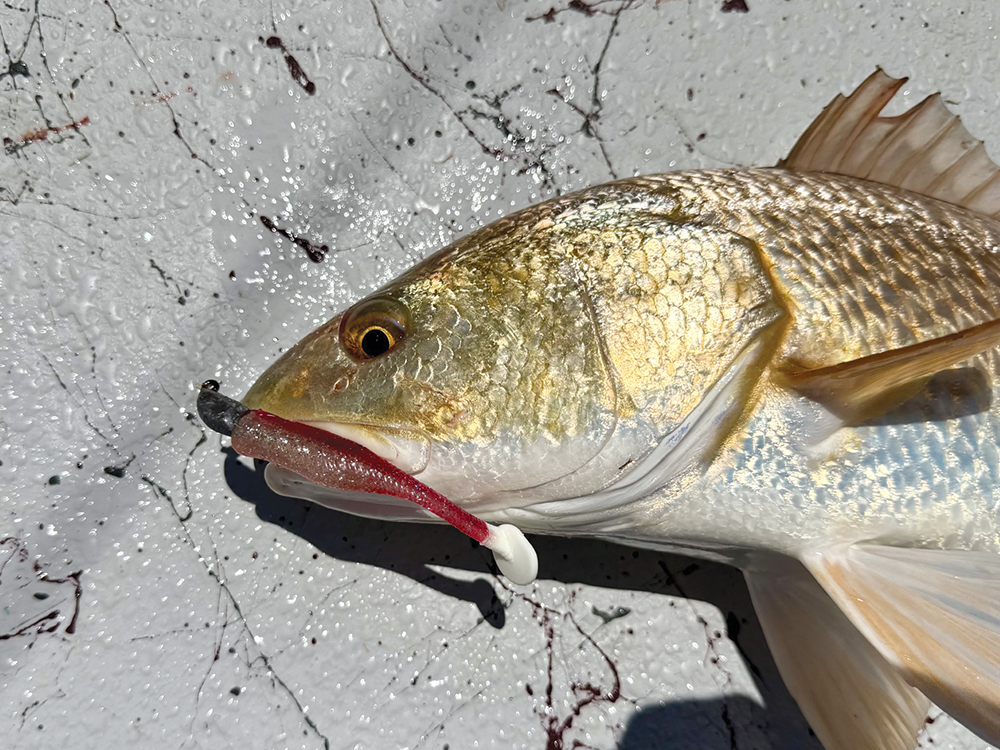
On the flip side, we all know that redfish can withstand much more freshwater than trout. Being on the tower during times like this is a lot of fun. I am no scientist and cannot explain why it happens, but when redfish stay in that tea-stained water they turn orange like a pumpkin. When this occurs, they stand out like a neon sign, doubling the distance at which we can normally see them, and they also seem to be more aggressive.
Every time a significant freshwater inflow comes our way, we begin receiving phone calls from customers who are on our books, concerned about water conditions for their trip, and also from out-of-town anglers planning to head our way soon. My reply is always the same – I am excited to see our bay receiving a good flushing for the present, and also for the longer-term benefits, such as how it will set us up for some phenomenal fall fishing. Sure, you might not be able to fish exactly where you had planned, or maybe not what you fished the last trip you made down, but our bay system is very unique in that under virtually any conditions there is always a place to fish and be successful. It pretty much boils down to how well do you know the bay?
If you are wanting to deepen your knowledge of the San Antonio Bay or Matagorda Bay complex, feel free to give me a call, as we offer a couple different ways to help you. One is with our navigational trips, or perhaps a 2-to 3-person classroom-style presentation where we dive into the unique characteristics of our bay system and what makes it thrive. In the classroom setting, we will spend the day going over Google Maps, looking at the changes that have occurred over the years in our bays, and the impact these changes have made in the fishing we enjoy today. Overall, I would say that both of these options provide exceptional knowledge that can be applied to your future fishing endeavors.