

Reeling in Reliable Results: TPWD’s Approach to Data Quality
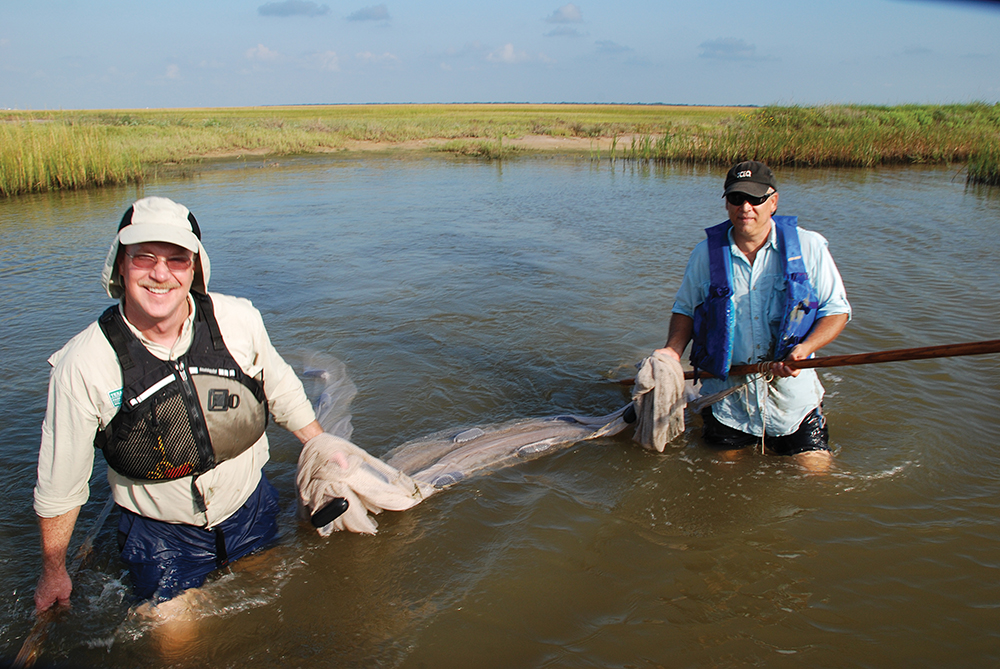
Two TPWD staff using a bag seine to collect juvenile fish and other organisms.
Every seasoned angler has put in long hours on the water, year after year, to figure out their favorite spots and best tactics. Their stories and memories on the water are hard earned. Time and time again, I hear the same question from fishermen around the Texas Coast– which is: “How can we trust Texas Parks and Wildlife Department’s fisheries data?”
As a former Fish and Wildlife Technician working in the Aransas Bay ecosystem, I get it. Our fishery is a shared resource, and our constituents want and deserve the assurance that the decisions impacting their livelihoods and weekend fishing trips are backed by solid science—not guesswork. So, let’s take a closer look at how the Texas Parks and Wildlife Department (TPWD) gathers, verifies, and uses fisheries data to manage our coastal waters—and why you can trust it.
A portion of TPWD’s coastwide monitoring program began in 1974. That means today’s decisions are anchored in over 50 years of reliable, protocol-driven observations. Very few fisheries agencies worldwide can claim that kind of long-term dataset. This historical depth and consistency allow TPWD staff to understand not just seasonal patterns, but temporal shifts, and the effects from major weather events. By following standardized procedures that were robustly designed decades ago, TPWD biologists can observe long-term trends in our marine ecosystems with greater certainty. This is something that TPWD is very proud of and hopefully you can be as well.
TPWD field biologists and technicians are out nearly every day, year-round, and in almost any weather condition, collecting critical information on fish populations, habitat conditions, water quality, and angler harvests. Using techniques like creel interviews, bay and gulf trawl surveys, bag seine samples, and oyster dredges, the team builds a living snapshot in time of Texas’s marine ecosystems. But data collection is just the first layer. What happens next is where TPWD truly sets itself apart.
In a state with more than 350 miles of coastline, the Coastal Fisheries sampling area includes more than 1.5 million acres, encompassing seven major bays, back bays, and portions of the Gulf. To handle the size and diversity of the coastline, TPWD divides data collection responsibilities among eight field stations—from Sabine Lake on the Louisiana border to the far southern tip of Brownsville. Each station covers a distinctive area of the coast, each with its own ecological uniqueness, habitats, salinity levels, and species profiles. This approach provides data at the ecosystem level while maintaining uniform data collection procedures across the state. For the anglers out there, this means your input matters.
Do you remember that creel survey you answered last summer at the boat ramp? It is part of a legacy that helps track fishing pressure, assess stock abundance, and shape next season’s regulations. When conservation decisions affect bag limits, slot sizes, or access to fisheries, it's natural to have questions. TPWD’s quality control procedures offer answers backed by high-quality data. They ensure that regulations aren't just arbitrary, but they are informed by one of the most comprehensive fisheries datasets on the planet that includes your input.
TPWD staff adhere to coastwide Standard Operating Procedures (SOPs) as specified in the Resource Operations Manual for collecting fisheries independent data. These scientific methods are detailed for each type of gear and are consistently applied across all bay systems. Similarly, our fisheries dependent data collection methods, such as creel surveys at boat ramps, are outlined in a separate manual. After the initial sampling efforts are completed, local TPWD staff pour over the raw data for any glaring data errors or omissions and correct the data immediately. In addition to staff checking for human-induced errors, the electronic database has been equipped with parameters to check for outliers and other types of field entry errors. Each dataset undergoes multiple layers of review by both humans and machines before moving on to the next set of eyes.
The behind-the-scenes efforts of TPWD may go unnoticed by many, but they are crucial to ensuring that the science supporting our collection methods, statistical analyses, and recommendations to decision makers is robust, transparent, and accurate. TPWD takes extensive measures to verify and monitor data collection from start to finish. This includes monthly quality control checks by team supervisors in real time, and periodic unannounced visits by Regional Directors. An annual rigorous review by an External Quality Control member, assesses each team’s field safety, staff knowledge, and adherence to protocols for each sampling gear. The final safeguard is the Regional Editor, who meticulously double-checks all data entered into the master database. Coastal Fisheries staff and scientists, many of whom are lifelong anglers, are not just performing their daily duties, they too are dedicated to preserving the legacy and health of our coastal resources for future generations.