
Reflections of the Way Life Used to Be
Marking its 40th anniversary this year, the movie Stand by Me has recently been recognized as an ode to the untamed childhood freedoms many of us enjoyed back in the day. Set in 1959 and telling the tale of four 12-year old boys striking out on a two-day adventure in the Oregon woods, much has changed since then, including a marked decline in kids allowed to be outdoors alone for any length of time. These days, many youth are practically air-tagged so their parents know exactly where they are. It’s been a revelation that today's teenagers can’t believe boys in the movie were allowed to just hike out of town. What, no cell phones or debit cards? How was that even possible?
In recent years, some parents have even been arrested after a “concerned citizen” reported kids walking to the grocery store or playing in the park mere blocks away. Nearly gone are the days of jumping on a bike with a fishing rod and heading for a favorite lake or coastal shoreline miles away. Or taking off in a jonboat across the bay, for that matter. It’s probably a good thing I was 15 by the time we moved to Port Arthur where fishing opportunities were unlimited. Even better that I didn’t fish the “high-energy” Sabine jetties until 18, an environment that even today older guides avoid—with all that wave action, ships, currents and granite rocks to deal with…
Before Port Arthur there was Lubbock, where I was all over town, riding the city bus and fishing every scrap of water all day without food or water. Happy to escape endless chores my stepdad dreamed up whenever a dust storm wasn’t blowing. Lubbock had a curfew for kids, but a friend and I rode bikes to Maxey Lake at 5 a.m. and once had to “hit the dirt,” to evade a patrol car’s spotlight, laying face-down in cedar bushes in someone’s front yard. It's possible he saw our fishing rods and bikes and shook his head before driving off.
At the end of my eighth-grade year, the family abruptly moved a long ways across the state to Port Arthur, a serious fishing paradise. After a grueling drive in early June, with three cats and no AC in the car, we arrived. Grabbing my Zebco rod, I walked across the street to the Intercoastal Waterway (ICW) and was catching croakers while the moving van was still in the driveway. Across the water was Pleasure Island and thick forest, which became my second home for the next three years.
That island offered more freedom than most kids can dream of. When the downtown drawbridge was hit by a barge that very October, construction began on the towering bridge to the island that still stands today, built to accommodate ocean-going ships. But it took three years to complete, during which time visitors were stuck with using a small ferry boat hauling mostly golfers. When I was stranded on the island after sunset that November, an elderly couple running the marina, the Smileys, took me in like a stray cat, allowing me a second home every weekend and a refuge when school let out. I tallied 20 (lower slot sized) redfish in a month just fishing around the marina, before expanding my range. On one memorable occasion, Mr. Smiley took me shrimping at night (not entirely legal). When his twin, hand-cranked red Johnson motors broke down on a full moon night, choppy easterly waves carried us right back to the seawall.
We also ran up scaup ducks (he called them blackjacks) on Sabine Lake, where the old man emptied a 12-gauge pump gun while I drove the boat. He and his wife were pure Cajun, saving every duck feather for pillows, and anything that flew became excellent gumbo. There were also trap lines to run. Within a year, I had my own 12-foot Gibson “v-bottom” jonboat with a 5-horse Evinrude, exploring and camping along Sabine Lake with new-found friends. Needless to say, that first boat suffered from a steep learning curve, mostly dragging it through rocks, onto a seawall and later even the Galveston jetty. There was no bait without using a castnet.
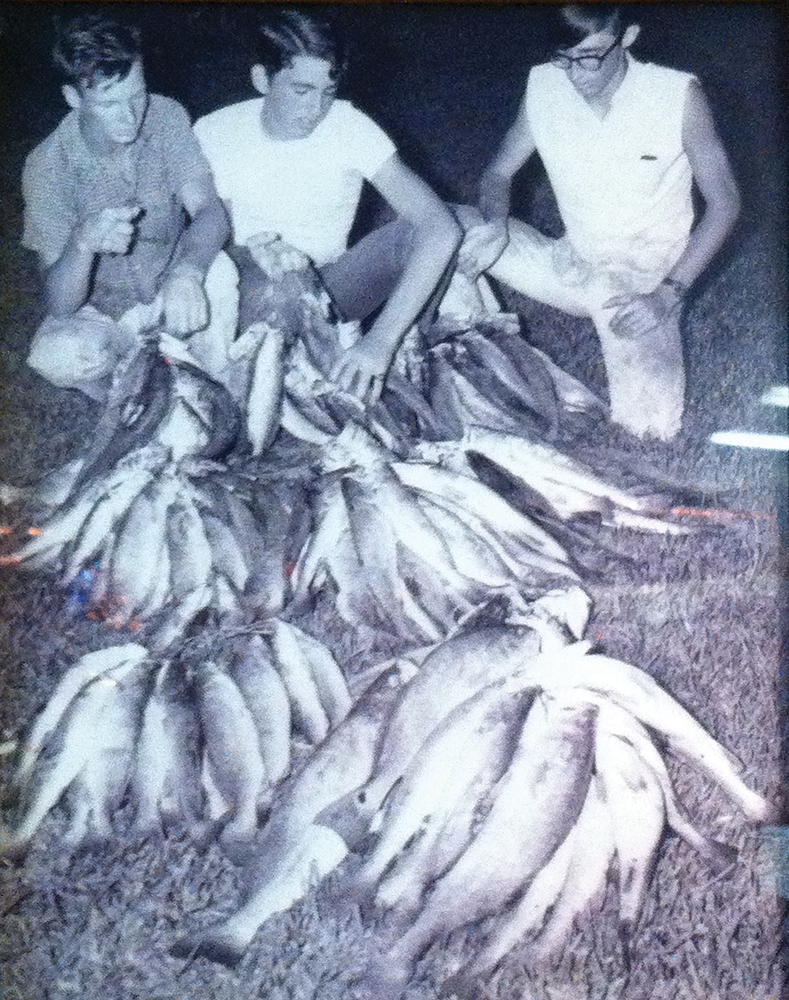
The following year, Brown and Root began building the north and south levies, lopping off about 20 percent of Sabine Lake for ICW dredge fill, while inadvertently trapping trout, redfish, flounder and black drum by the thousands. It was great fishing for a year or more, but way better when Hurricane Camille (in Mississippi) raised our local tides by 3-4 feet, shoving fresh green Gulf water through those 4-foot drain pipes, where fishing action exploded. Three high school buddies, Mike Spencer, Bob Bellows and Clay Smith rode up on their bikes, lugging 191 trout on massive stringers draped all over handlebars and themselves. (No bag limits in those days). Their shocking picture ran in the Port Arthur News that following Thursday. My eight upper slot redfish that same day by comparison looked a pittance; turns out I was a quarter mile away from the real action.
I realized we would need a better means of transportation. A new friend, Dan Ferguson, had just moved to Port Arthur and had access to a family car, a Ford Torino, which offered a fast ride to the honeyhole. Next day was Labor Day so we put the hammer down, drove through Louisiana back roads around to Pleasure Island and parked at the second pipehouse structure on the south levy. The tide was still high, the fish hungry and we nailed the trout and a few drum. Our Tout Tails were shredded so we switched to 7-inch purple Fliptail bass worms (used while camping at new reservoirs called Sam Rayburn and Toledo Bend) and those worms worked just as well on trout.
Back home next day, our local fish market guy on Dallas Avenue, an American/Sicilian named Vic Pavia, told me to leave the trout with him, they were semi-frozen in a big plastic bag, he wanted to thaw them out for a closer look. Next day he said he didn’t want them. Back home the bag was a little light; 30 fish were missing. It wasn’t the first or last time he ripped us off. Back then, fishermen in town sold their catches; even Dr. Couch, who owned an awesome 23-foot Formula boat and was known for his offshore exploits. There were few fish rules and regs and no size or bag limits.
Our freedom was such that waiting out each Friday in high school was torture. We’d rush home, load the car, grab a case of cheap soda, canned tamales, Wolf Brand Chili, and Mrs. Baird’s cinnamon rolls, and hit the road. We fished every weekend for six months on the north levy, which always contained clear green water, camping without a tent. If it rained we slept in the truck. (I didn’t have a driver’s license until the following summer.) Back in town you could rent a cotton beach seine and head for nearby Louisiana beaches where the water was always chocolate brown, but plenty of trout that jumped over the line of corks like salmon. Or tail-walked in a flurry of whitewater.
The year before, we drove the length of the foggy island at night, three 10th graders on the roof rack of a Plymouth Belvedere station wagon, firing away with .410 shotguns, once bagging eight rabbits. Borrowed a Brown and Root truck at midnight when our car got stuck on Johnny Barlow’s island golf course. (Rabbits love golf courses). During the day we learned to shoot ducks, too.
No cell phones in those days, so our folks had only a vague notion where we were, trusting we'd return each Sunday night with a box full of mostly flounder, a few upper-slot redfish and maybe a few ducks. Twice I swam the ICW to the Port Arthur side without a life jacket when a ship wasn’t approaching, to shorten the walk home or because the car broke down. On the second swim during June (at night), there was no place to climb out of the deep water, as the seawall towered above us. A thin drain pipe protruded from the vertical seawall and we grabbed hold in an outgoing tide, chinning ourselves out of the water. When you’re 18, anything is possible.
There is no doubt that American youth before us had even more freedom. Back then most folks lived in rural areas with much stronger connections to the outdoors, where young men grew up fast and were often expected to help feed or support the family. (Three million of them worked in the Civilian Conservation Corps leading up to WWII). I was reminded of this recently while reading Shifty’s War, a biography about Darrell Powers, who came from humble beginnings. Lacking shoes until he was 12, he was responsible for helping feed a family of seven. Running traplines by the time he was eight, his family ate muskrats, possum, lots of bullfrogs and also flathead catfish caught with limb lines. If dad gave him a .22 bullet, he’d better return with a rabbit.
By the time he was 16, he’d been guiding river float trips for years and was highly recommended. When the war began he still couldn’t read or write, much less become a pilot like he wanted, but they gave him his wings on a paratrooper’s uniform with the 101st Airborne. He soon became a sharpshooter with a Garand rifle and wound up in Normandy, the Netherlands (a bridge too far), and the Battle of the Bulge. His platoon was featured in the Band of Brothers TV series. Wounded several times, he was finally shipped home and then it was back to guiding for bass up to ten pounds on Arkansas rivers or increasingly, the state’s new reservoirs. He grew up with more outdoor freedom than most people today can dream of, but I can certainly relate. Except his family was dirt poor, he jumped out of airplanes targeted by German flak guns, and he was wounded several times.
While it's fun to opine about today's youth being deprived of unfiltered experiences in nature, the truth is that there is probably a happy medium between the forced interaction (hunting to feed a family) and 24-7 helicopter parents. It is indeed a different world from the 1959 narrative of Stand by Me and knowing where your kids are is probably a good idea. Truth be told, those lads in the movie could have benefited from a little more quality parental guidance and the same was true with me.
With so many memorable experiences from my youth—and a few learning curves—my hope is that this next generation and their parents will find a way to unplug and make it a goal to catch their own dinner from time to time. There's nothing like serving up a meal of grilled redfish or fried flounder, a gift from the outdoors, and knowing it will be enjoyed.