


Self-Aware Cleaner Fish
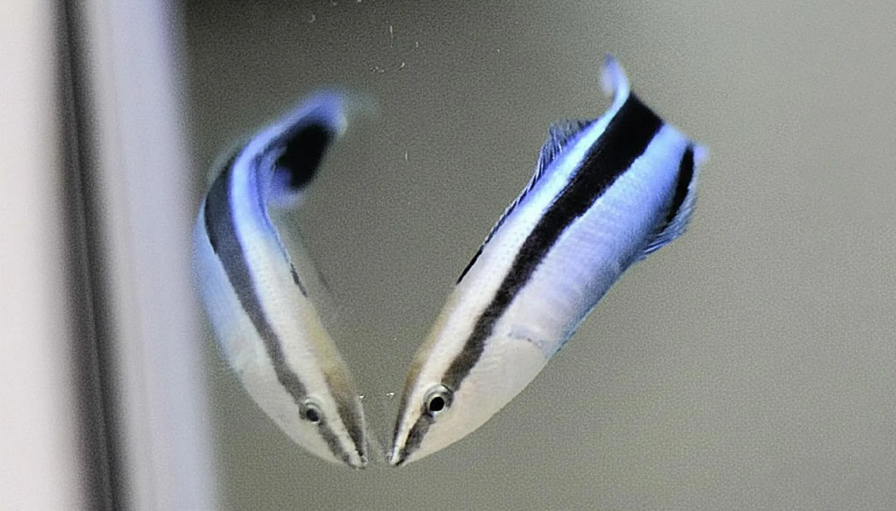
Cleaner wrasses can recognize themselves in mirrors
and use them to track the movement of objects
around them. Credit: Osaka Metropolitan University
People use mirrors for grooming activities like shaving, washing their
face, and applying makeup. Under the sea, though, hundreds of marine
fish rely on cleaner wrasses to groom them. These little fish eat parasites
and dead tissue from the skin of larger fish at “cleaning stations.” Now it
turns out those cleaner fish understand how to use mirrors too, when
given the opportunity!
A few years ago, scientists in Japan demonstrated that cleaner wrasses can recognize themselves in photos and mirrors. In those experiments, the fish did not attack photos showing their own face (even with their face edited onto an unfamiliar body), but they did attack photos of a cleaner wrasse that had an unfamiliar face—even when that face was photoshopped onto their own body. Those experiments also confirmed that the fish knew the photo was of themselves. When the photo included a mark on their throat that looked like a parasite, the fish tried to rub their throat to get rid of the parasite. They didn’t do that when shown an unfamiliar fish’s face having a parasite mark.
In a new study, the same scientists continued testing how cleaner wrasses interact with mirrors. They gave the fish a mark that looked like a parasite and then put a mirror in the tank. Within an hour, the fish used the mirror to find and rub off the fake parasite. But after several days with the mirror, they did something more surprising: the fish picked up a piece of shrimp from the tank floor and dropped it in front of the mirror, tracking its movement in the reflection as it fell to test how the mirror worked. This kind of behavior, which has been observed in manta rays and bottlenose dolphins, shows a level of self-awareness that people didn’t know cleaner wrasses had. It also suggests that many more animals have self-awareness than people realized!
A few years ago, scientists in Japan demonstrated that cleaner wrasses can recognize themselves in photos and mirrors. In those experiments, the fish did not attack photos showing their own face (even with their face edited onto an unfamiliar body), but they did attack photos of a cleaner wrasse that had an unfamiliar face—even when that face was photoshopped onto their own body. Those experiments also confirmed that the fish knew the photo was of themselves. When the photo included a mark on their throat that looked like a parasite, the fish tried to rub their throat to get rid of the parasite. They didn’t do that when shown an unfamiliar fish’s face having a parasite mark.
In a new study, the same scientists continued testing how cleaner wrasses interact with mirrors. They gave the fish a mark that looked like a parasite and then put a mirror in the tank. Within an hour, the fish used the mirror to find and rub off the fake parasite. But after several days with the mirror, they did something more surprising: the fish picked up a piece of shrimp from the tank floor and dropped it in front of the mirror, tracking its movement in the reflection as it fell to test how the mirror worked. This kind of behavior, which has been observed in manta rays and bottlenose dolphins, shows a level of self-awareness that people didn’t know cleaner wrasses had. It also suggests that many more animals have self-awareness than people realized!