
Situational Awareness

The term “situational awareness” wasn’t necessarily coined by a single individual but apparently evolved from military aviation concepts in World War I, then years later was formally defined and popularized in human factors psychology by Dr. Mica Endsley in 1988. In World War I, German fighter ace Oswald Boelcke first identified the core concept. He realized the importance of tracking the enemy before the enemy spotted you (“Situational Awareness and Safety” N.A. Stanton et al., 2001). In the Korean and Vietnam Wars, U.S. Air Force fighter pilots used the informal idea of “ace factor” which meant that the superior awareness of the combat area decided wins and survival (Wikipedia). According to Lt. Gen. KT Parnaik, PVSM, UYSM, YSM (Retired), Joint Managing Director, Rolta India Ltd, the concept of Situation Awareness in combat can be equated with Observe and Orient Phases of OODA (Observe, Orient, Decide & Act) Loop which was developed by Air Force Colonel John Boyd in the 1970s. In today’s context, quick decision making based on enhanced situational awareness is the key to achieving predominance over the enemy (“Importance of Situational Awareness in Combat” Shimonti Paul, 2018).
The 4 steps of the OODA Loop –
Observe – Gather information and real-time data from your surrounding environment.
Orient – Analyze and filter data by combining it with your culture, past experiences and new information to understand what the data means.
Decide – Choose a strategy based upon your orientation phase.
Act – Execute the chosen decision.
(“The OODA Loop: A Practical Guide to Boyd’s Decision-making Framework” Paul Millard, 2026)
Now getting back to Dr. Mica Endsley’s “modern day” formal definition of the term, it’s easy to see how her model follows similar steps to those of years past. Dr. Endsley’s model is broken down into perception, comprehension, and projection.
- Perceive what’s happening
- Understand what it means
- Anticipate what will happen next
- React accordingly
The situational awareness model can be applied to many real-life scenarios. I love football and we see it all of the time when players and coaches have to recognize specific game situations such as time remaining, field position, opponent alignment and down and distance then call the right play. In a nutshell, it’s all about effective decision making.
So, let’s talk about how situational awareness can be applied to fishing. I can easily relate to the OODA Loop since it follows a decision-making set of steps that I believe can help us take our fish catching abilities to a level never before seen or even discussed for that matter. Here’s a real-life example:
On a recent trip to Trinity Bay, I had two of my longtime clients. The conditions were ice cream with a light southeast wind and slightly overcast skies. I had already looked at what the tides, solunar feeding periods, wind predictions and everything else was supposed to be – on paper anyway. As I backed off the throttle to ease into my fishing area, I observed more boats than I had seen there in a long time. One of my clients watched as I killed the big motor and asked, “What are you thinking captain?’ That’s when I told my guys to just sit back and observe what all of the other boats were doing. “You see that boat over there at 10 O’clock? He’s drifting from left to right. Now look over here at 2 O’clock. Those guys are anchored on that Christmas tree wellhead I like to fish. Both of those boats are basically on each end of the area where we’ve been catching our fish but if we try to squeeze in there we’ll be in their way and we’re not going to do that.”
I told my clients that there were some fish in a different area not far from there, so we made a short run. As we arrived I noticed small slicks emerging in about 10 feet of water over some shell and structure. This time there were no boats around, so this allowed us to assess the situation before making our approach. I kept my boat in neutral about 75 yards from where the slicks were popping. Not a single cast was made yet. As we drifted I paid close attention to which direction my boat was drifting in relation to the slicks. Everything was drifting northwest to southeast, so I set up my drift about 100 yards up current and upwind of where the slicks had originated within the alignment of what I had observed. I did all of this taking into consideration that the fish producing the slicks were most likely near the bottom because of the high barometric pressure. In 10 feet of water the regurgitation from the trout won’t just pop up and form a slick directly above said fish given the tide and wind conditions. This is common sense, but it’s surprising how many folks don’t piece it together.
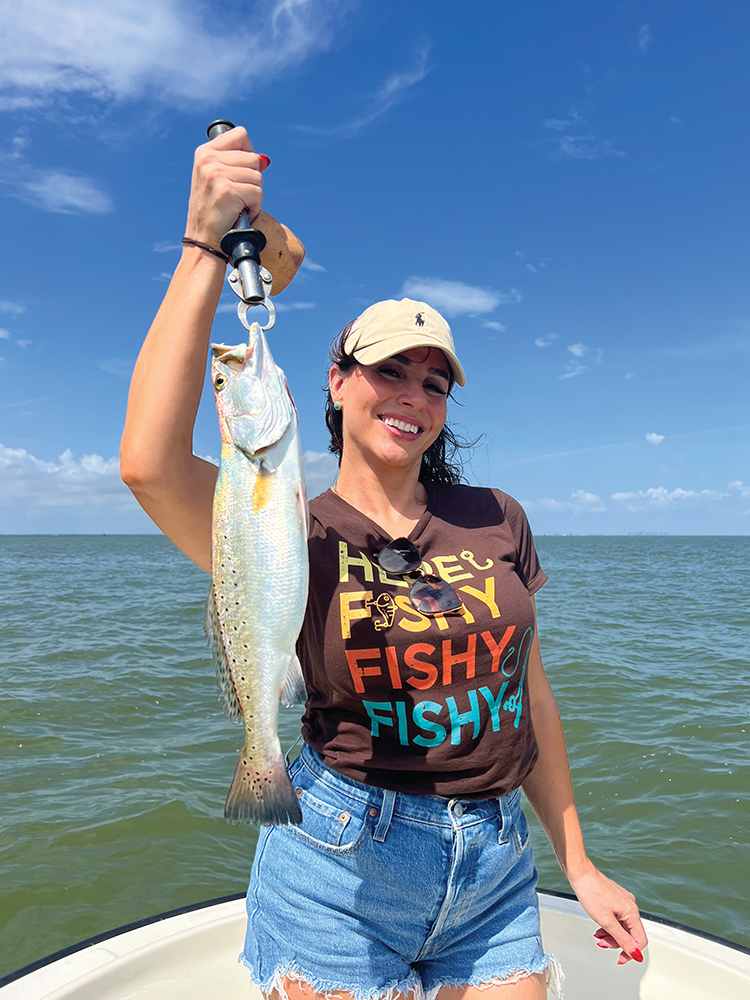
It was now time to decide what strategy we would use based upon all the information we’d gathered to this point. Based on what has worked for us before when presented with similar scenarios, I chose to set my clients up with MirroLure Lil Johns rigged on 1/8-ounce conventional jig heads. I chose this particular bait because it has a faster sink rate than larger-sized soft plastics. This would help get down lower in the water column where I believed the fish were hanging out due to the high barometric pressure. In addition, a high pressure stunned trout should be more inclined to commit to a smaller profile Lil John (3.75 inches) as opposed to a larger bait. The fact that it’s scented I felt would give us an added advantage as well. The color I chose was Glow w/Chartreuse tail because not only is it a great color in “trout green” water, but we were in the midst of our fall white shrimp migration.
So now that we’ve assessed the situation and decided what approach we would use, it was time to go to work. Our first drift only yielded a few bites with one undersized speck caught. It took us three drifts before realizing that we were overworking our baits. Full disclosure – I figured it out kind of by accident. I had stopped reeling momentarily to point to a group of birds working off in a distance when my Lil John got thumped by an 18-inch trout. We all slowed our retrieves and the rest is history. Some may ask why we weren’t using heavier jig heads in the deeper water knowing that the fish were near the bottom. We were between feeding periods and also between tide changes, so there was nothing to necessarily trigger a feeding frenzy, so a lighter weight jig head allowed us to stay in the strike zone longer. Heavier lead heads would’ve sunk straight to the bottom looking less natural and spending less time in their face. In addition, a high barometric pressure typically causes trout to be more docile with less urgency to feed.
Every phase of situational awareness is important, but I feel that it’s especially important to get the Observe and Orient steps correct in order for us to employ the appropriate strategy before acting upon it. Below I’ve listed some of what I believe are key variables (in no particular order) to consider before we head into combat:
- Other boats (Which direction are they drifting? Where are the anglers lined up if they’re wading, and what direction are they wading?
- Proper etiquette (Don’t just motor into a fishing area like a bull in a China cabinet. Instead, take a minute to hang out a fair distance to assess the situation before making your approach.
- Slicks
- Bird activity (may consist of just one tern hovering and circling the same small patch of water)
- Nervous bait (Jumping or fleeing mullet, shrimp hopping, balled up shad, etc.)
- Current speed and direction
- Wind speed and direction
- Barometric pressure (and understanding pre front and post front effects)
- Water clarity (Know which colors work better in clear water and vice versa.)
- Water temperature (Understand how it affects fish locations and feeding habits.)
- Habitat & Structure
- Depth changes
- Cloud cover (or the lack thereof)
A fighter ace is a military pilot credited with shooting down five or more enemy aircraft in aerial combat. The “ace factor” refers to the combat skills, survival traits and mechanics that determine how an ace performs. Historically, a successful ace relies heavily on superior flying ability, exceptional eyesight, situational awareness and the discipline to close in safely before firing rather than wasting shots at extreme distances. Historically, aces made up only about 5% of all combat pilots yet were responsible for a large share of total aerial victories (WW2AIRCRAFT.NET).
As anglers, situational awareness consists of constantly monitoring changing weather, tides, water conditions, and human activity, then deciding what approach we should take and what strategy we should use to achieve the desired result. It should be all of our goals to achieve the highest level of situational awareness possible. We should all aspire to be aces.