
South Padre: August 2025
Based on my experience over the years, I would say August is a transitional month. Actually, I lump August and September together, given that they are both challenging months for me to catch good numbers of fish on a consistent basis. Reasons for this are several – air and water temperatures are still high and the tide level depends greatly on tropical weather. If the Gulf is clear the tides will run mostly to the low side of average. However, during stretches of low atmospheric pressure we can expect tides to run higher than usual. Add to this the fact that fish, especially trout, will tend to stage in deeper, cooler water that is sometimes too deep to wade.
If you study the tide tables you will see, among other things, there are what we call two tide and four tide days. Historically and scientifically speaking, the two tide days are better for fishing than four tide days. Here’s why…
A two tide day consists of one incoming flow and one outgoing flow. They therefore carry stronger currents and flow for longer durations than those of a four tide day. Four tide days have two incoming and two outgoing flows, which are shorter and tend to be weaker. The stronger currents of two tide days will flush out and transport more bait fish and crustaceans from their hiding places, triggering more feeding activity from game fish.
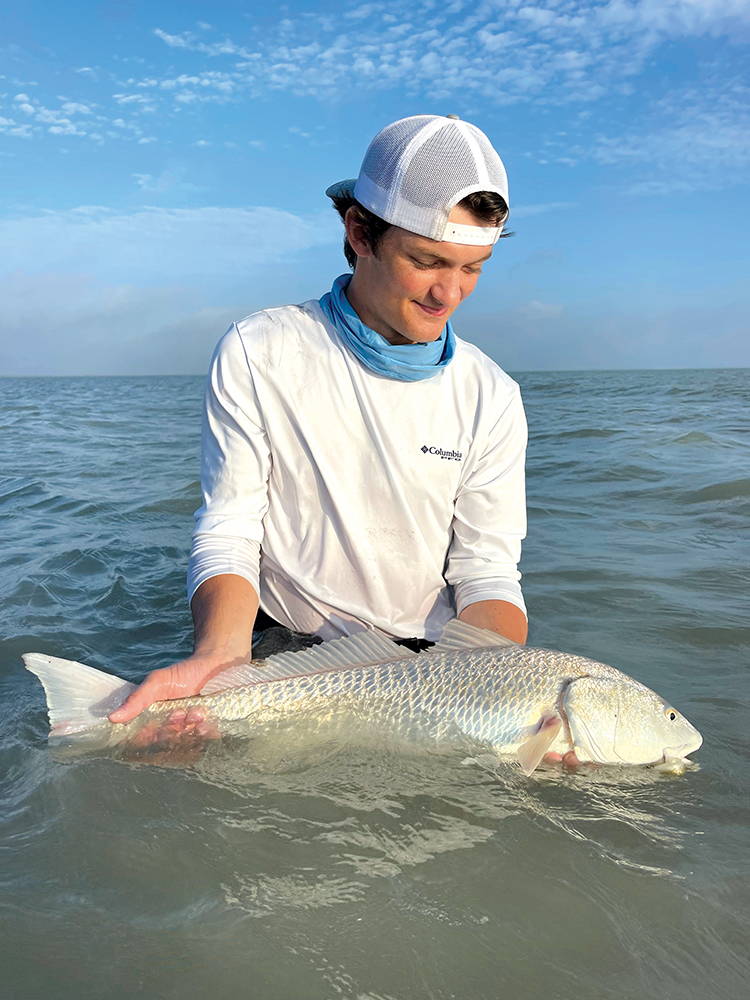
Our recent success with redfish has been below normal, which I contribute mostly to elevated water temperatures. We are catching some here and there, but the numbers aren't as high as they were when the water temperature was cooler. I haven't experienced or seen any large schools of redfish lately, but that will change this month as the bull reds are expected to show up at the Brazos Santiago Pass and Port Mansfield’s East Cut jetties.
Generally speaking, August is when we begin to see redfish beginning to gather in schools. However, if unusually high tides persist due to tropical weather this pattern can be altered or delayed. If the tides remain low as they typically do in summer, the redfish schools will be easier to locate. Lately, our most consistent catching has occurred along ICW spoil islands, a pattern we hope will continue in August.
The trout fishery has saved us on quite a few days lately. When the bite has been slow in other areas we head to the ICW and wade along the drop-off, throwing soft plastics on heavier jigs – the Eye Strike series from ZMan weighing 3/8 and even 1/2 ounce at times to keep the baits bouncing bottom on the deeper ledges. Trout have been easiest to target on the ledges and this trend should continue during August.
Here are a few more pointers when targeting late-summer trout. Target flats that lie adjacent to the ICW during early morning. Soft plastics have been the best producers; I recommend ZMan's StreakZ in Space Guppy, their PaddlerZ in Sexy Penny, and the Big BallerZ in Beer Run, Plum/Chart, and Gold Fire. Another recommendation, whenever floating and suspending grass becomes a problem, I like to rig my plastics in weedless fashion using ZMan’s Texas Eye or Texas Eye Finesse jig heads. This setup catches less grass than any I’ve ever tried.
Flounder catches have been increasing, even when not targeting them specifically. If you might decide to target flounder, focus on points in the ICW, especially at the intersections with smaller channels. Other good locations have been at the base of pier pilings and the drains and cuts that lead to back-bays.
Over the last four years, August and September have become the best months for targeting snook on the flats. I attribute this to reduced boat traffic. Once school starts and dove season opens, we begin to see fewer boats as many outdoorspeople turn to other pastimes. Unlike trout and redfish, snook thrive during the hotter months, especially on days with strongest tidal currents. I suggest fishing around the new and full moon periods, being on the water during periods of maximum water flows, and always during the solunar feeding periods.
Schools of tarpon will begin to show in the August surf. Bull redfish can be found along the rocks of the Brazos Santiago Pass and Port Mansfield jetties. Further offshore, anglers can expect to encounter delicious red snapper and occasional ling. Fishing success will soon begin to hinge on tropical weather in the Gulf. Always consult the weather forecast when planning fishing trips.