
South Padre: August 2026
Just recently, I was traveling through the countryside of Ecuador, up in the Andes Mountains. The slopes were steep, but you could see the trails of livestock where they used particular trails to go up and down the side of the mountain, and the grass was trampled after who knows how many years of use.
If you are a deer hunter, you have probably seen game trails that include well-worn places where animals crouch and scoot under fences. These are but two examples, there are many more that show wildlife can be quite predictable in their movements.
The point I am trying to make is that fish behave similarly; and if you pay close attention to their movements, you will see that they frequently use the same pathways, both coming and going.
I am aware that fish will sometimes lie on bottom, appearing dormant. But when they’re on a tidal exchange or during a feeding period, I always try to discover which direction they’re traveling. Drifting multiple passes through an area; I also take note where we’re getting the most bites. I also try to take note of the direction mullet are moving. Knowing how the fish are moving can keep you in the strike zone for longer periods of time.
We all know that fish tend not to remain in the same area all day. There are factors that will cause them to move – boat traffic, bait movement, rising or falling of tides, etc. I often explain it to my clients via this analogy: If you were at the mall at noon, where would the most people be? Of course, they reply,
“The food court,” and they are absolutely right. Likewise, find the bait, and you will find the fish. This works best during the feeding periods, whether a major or minor feed. I hope this gives you some insight into the value of knowing the direction or pattern the fish are heading.
Many animals are prone to their usual habits and can be predictable with careful observation. The more you see and piece together, the more consistent you become in catching fish. But don’t make the mistake of thinking or being all confident that you've got them completely figured out; that will be your biggest mistake. Make every day a learning experience and grow in knowledge by observing as you fish, and in due time, all that experience will help you locate more fish on a consistent basis.
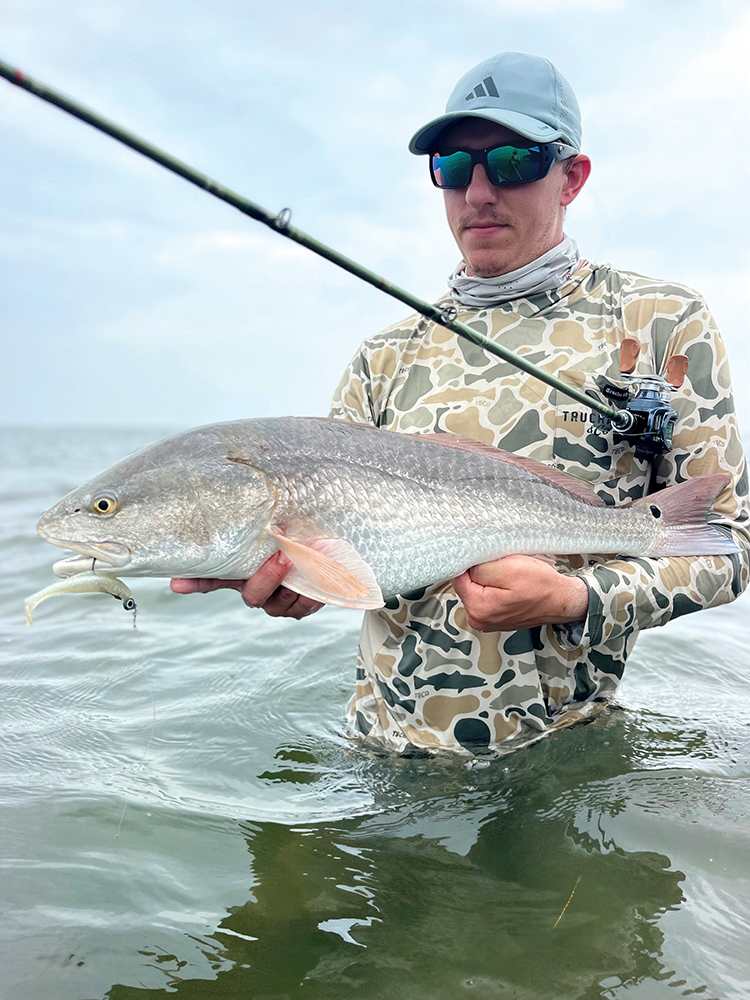
Despite heavy fishing pressure our redfish continue to thrive. We see this daily in the number of undersize redfish we are releasing. We will catch plenty of slot reds during August but in my experience it is not a prime month for them. The reason for this is elevated water temperatures and anglers will do well to focus efforts early in the morning, and again in late afternoon and evening.
One of the most productive redfish lures for August will be the trusty 1/4-ounce Weedless Gold Spoon. Another solid choice will be the ZMan Scented Paddlerz in Sexy Penny, Pearl, or Bleeding Banana.
Our trout fishery continues to rebound nicely; not only in greater numbers but also with respect to larger size. During these hottest weeks of the year the best trout action can be found in and along
the edges of the ICW. Fishing these deeper areas, I suggest you tie on at least a 1/4-ounce jighead as the fish are often staged deep in the cooler depths.
Lately, the upper-slot trout have been harder to find, but this is not unusual at this time of year. Keep an eye on bait and also slicks popping on the surface. Keep in mind that the smaller the slick the fresher, and also the better indicator of trout feeding in the immediate vicinity.
Here's how I explain my choice of trout lures to clients. If the water is off-colored or stained, I will use a paddletail as the vibration they create will help attract the fish. A couple you might try are the ZMan Scented Paddlerz, or the DieZel Kickerz.
If the water is clear and visibility is good, I will likely choose either a ZMan Streakz, Big Ballerz, or Trout Trick, in natural colors. I like to rig these on a Texas Eye or Texas Eye Finesse weedless jighead.
Part of the fun is figuring them out. Make careful observations, do your homework, and try to keep a log throughout your outings. And last, try to think like a fish. It’s always the simplest and most common-sense things we tend to overlook.