
South Padre: January 2026
I’m kicking off 2026 by sharing my approach to prepping for a day of fishing. It begins by checking three weather apps, and then calling the local meteorologist for greater clarification, if warranted. Winter weather changes quickly, so reliable data keeps me safe and boosts my chances. Next is tide predictions—how many, how high, how low, and which areas may or may not be accessible based on those tides. I already have an idea of wind direction and velocity from the night before. With all these inputs, and years of experience, I choose which spots will likely be most fishable. My goal is to be prepared so I can make the most of every trip.
When morning arrives, I check the major and minor feed times and the position of the moon in the sky. One of my core beliefs is that the best bite happens when the moon is forty-five degrees above or below the horizon. For me, fishing success means blending science with instinct.
Arriving at the dock, I reference the features I use to assess the tide level. These can be boards on bulkheads, marks on seawalls—anything that tells me exactly how much water I’m working with. Knowing the precise water level tells me where I can navigate safely and which areas to avoid.
Leaving the launch ramp, I know whether the tide is incoming or outgoing. This leads to another theory I’ve developed through years of observation. In my area, the tide travels an average of six miles per hour. This helps me determine when the incoming flow will reach an area I intend to fish.
With all the prep done, it’s time to search for fish. I look for bait on the surface, subsurface flashes and swirls, and feeding birds—all signs of where fish might be holding.
I’m often asked, “How long do you fish an area before moving on?” My answer: “It depends on the angler’s patience.” For me, personally, it’s 30–40 minutes, unless I know the fish are there but simply not feeding. I mainly wade, so I move forward steadily. If my wade turns into a 30–40-minute session with no bites, I start thinking about my next area and will soon move on.
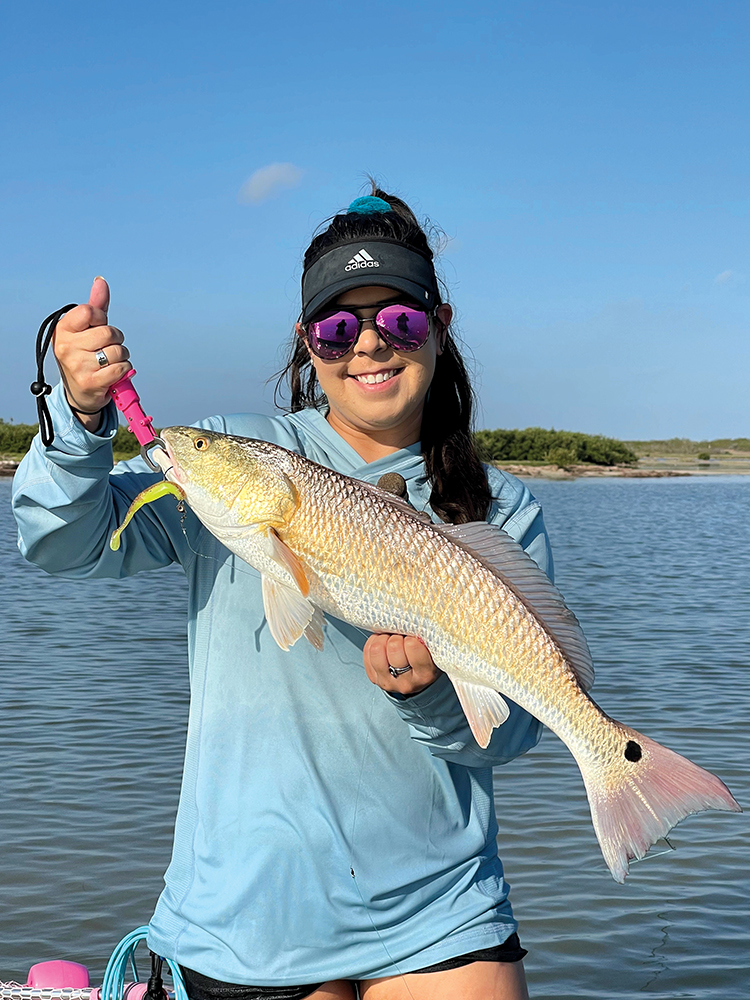
Currently, our redfish are staged in shallow water, but that will change soon. January’s chill cools the bay enough that redfish begin seeking warmer depths… but only until a warming trend pulls them back shallow again. When reds return to skinny water, they’re usually hungry and willing to take almost anything you throw at them.
So, where should you be looking for them? Flats along the ICW are a great place to start, especially if bait is plentiful. Spoil islands attract lots of reds and plenty of bait this time of year.
We’ll begin to experience lower tides now, and deeper areas on flats will become redfish magnets—manmade and natural holes, old oilfield channels, and the ICW are all excellent winter spots. I suggest using Google Maps to identify deeper areas within your region.
We’re beginning to see larger trout showing up more regularly. The colder it gets, the better the big-trout season becomes. By mid-January, after a good number of cold fronts have passed, things really kick off, and from then on, it only gets better through winter.
Trout are more vulnerable to cold than redfish, so their migrations from shallow to deep and back again are more frequent. Trout also have a strong affinity for lying in potholes to ambush baitfish. These two facts help greatly when forming strategies to stay in touch with mature trout as they move with changing temperatures.
Much of summer’s bottom grass is now depleted, but weedless setups are still extremely useful for keeping baits in the strike zone without fouling. Hooks like Eye Strike’s Texas Eye and the Texas Eye Finesse are tops in this category.
This time of year, I’m throwing Z-Man’s five-inch PaddlerZ in Sexy Penny, Pearl, and Beer Run. The Big BallerZ straight tail becomes another of my winter favorites. My preferred colors there are Sexy Penny, Gold Fire, Troutcicle, and Plum-Chartreuse.
The Brownsville Ship Channel becomes a winter home to many species, including snook, jack crevalle, mangrove snapper, redfish, flounder, trout, and others. If you don’t mind the colder weather—or get lucky and catch a warm stretch—January will not disappoint.
Apps and websites: In addition to the Solunar and Tide Charts in this magazine, I use Windfinder.com, Forecast.Weather.gov, tides4fishing.com, and saltwatertides.com.