

Spatial Distribution of Juvenile Penaeid Shrimp in the Mission-Aransas Estuary

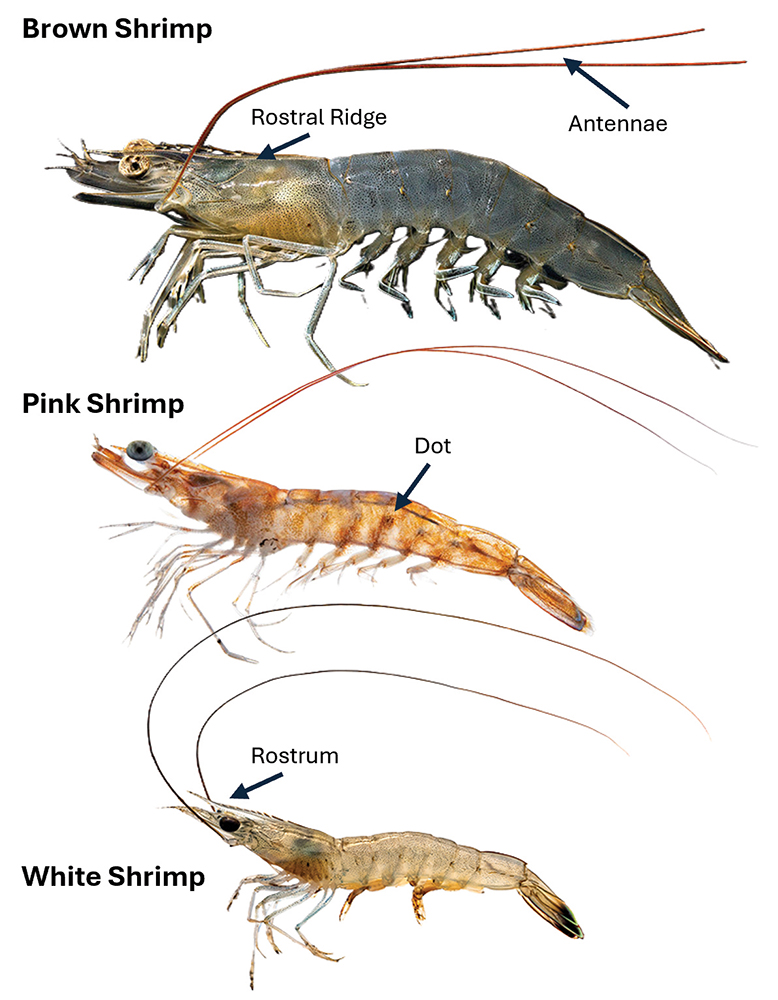
Figure. 1: Images of the three primary penaeid shrimp in the Gulf of America with identifying characteristics: brown shrimp (top), pink shrimp (middle), white shrimp (bottom). Photo Source: North Carolina Department of Environmental Quality.
Have you ever wondered what kind of shrimp you’re putting on your hook or in a pot over the stove? There is so much more to these small invertebrates than most people realize. Along the Texas Coast, shrimping is the largest commercial fishing industry, with its importance extending across the Gulf of America. In fact, according to the National Oceanic and Atmospheric Administration (NOAA), Texas commercial shrimping annual landings from 2015 to 2024 average 61 million pounds of penaeid shrimp which on average added $140 million to the Texas economy. Beyond their economic value, shrimp play an essential ecological role by supporting the food chain of most inshore and offshore finfish species such as red drum, spotted seatrout, sheepshead, red snapper, and many more. Of the subset of finfish mentioned above that rely on penaeid shrimp as prey, each species supports large commercial and/or recreational fisheries which greatly influence the economy of small coastal communities.
The Texas penaeid shrimp industry is composed of three species: brown shrimp (Farfantepenaeus aztecus), pink shrimp (Farfantepenaeus duorarum), and white shrimp (Litopenaeus setiferus). While most shrimp harvest occurs offshore, each of these penaeid shrimp species rely on Texas estuaries as critical nursery habitats during their early life stages.
Identifying shrimp in the field can be challenging if you’re not familiar with their physical differences (Figure 1). Brown shrimp have a dusty brown body with more of a green tail and a distinct groove on the side of the rostrum (rostral ridge). Pink shrimp may appear similar at first glance but have a light gray-pink body, and often a small reddish spot on their abdomen. Out of all three, white shrimp can be the easiest to distinguish, with a light gray body, a smooth (no groove) rostrum, and noticeably longer antennae.
The Texas Parks and Wildlife Department – Coastal Fisheries Division (TPWD-CF) monitors these shrimp populations coastwide and year-round through fisheries-independent sampling programs that can gauge long term trends and spatial distributions. TPWD-CF Bay Trawl data from 2000-2025 helps us understand how juvenile penaeid shrimp are distributed within the Mission-Aransas Estuary. Coastal Fisheries staff use standardized bay trawling methods throughout the Mission-Aransas estuary, which includes two Gulf passes (Port Aransas Pass and Cedar Bayou Fish Pass) and several primary, secondary, and tertiary bays. Standardized trawl nets are towed behind vessels operated by biologists in a circular path for ten minutes at roughly three miles per hour in randomly selected locations across the Mission-Aransas Estuary to eliminate sampling bias. Although many species are captured during each tow, this article focuses specifically on the three penaeid shrimp species seen in Figure 1.
Using this 25-year dataset, heat maps of relative abundance reveal clear spatial patterns among the three penaeid shrimp species illustrated in Figures 2-4. Each figure visualizes catch rates across the estuary using a light-to-dark color gradient, where increasing saturation corresponds to higher abundance.
Figure 2 presents white shrimp distribution, with black indicating higher catch rates and a clear preference for the upper estuary in Copano and Port Bay. Figure 3 depicts brown shrimp distribution, where darker brown reflects higher catch rates and demonstrates a broader presence throughout the entire Mission-Aransas Estuary. Lastly, Figure 4 displays pink shrimp distribution, with darker pink indicating higher catch rates and highlighting a clear preference for the lower estuary near gulf passes, particularly around Redfish Bay, Lower Aransas Bay, and the southern portion of the Intracoastal Waterway.
Since the Aransas River and the Mission River tributaries serve as the ecosystem’s main source of freshwater, Copano Bay is the most freshwater influenced portion of the Mission-Aransas Estuary. Depending on rainfall, salinities in the upper estuary can fluctuate to significantly lower levels than that of the lower estuary. These conditions make Copano Bay a favorable habitat for juvenile white shrimp as shown in Figure 2.
Out of the three penaeid species, brown shrimp show the most scattered distribution in the Mission-Aransas Estuary. Aransas Bay lies in the mid estuary zone, with salinity levels remaining moderate compared to the more freshwater impacted upper estuary and the saltier lower estuary. As shown in Figure 3, brown shrimp tolerate a broad range of salinity conditions and habitats, which result in a scattered pattern of abundance throughout the estuary, unlike the noticeable habitat preferences seen in the pink and white shrimp.
Pink shrimp show a preference for lower-estuary habitats such as Redfish Bay and the lower Aransas Bay. These areas are more influenced by gulf waters, which provide higher salinities and deeper estuarine habitats that pink shrimp tend to favor. Our heatmaps have illustrated this pattern as seen in Figure 4, showing that pink shrimp are most abundant near the southern end of the Mission-Aransas Estuary and gulf passes such as the Port Aransas Pass.
These differences highlight how each species has distinct habitat preferences within the estuarine system during the juvenile life stage. Despite all three sharing a common life cycle of offshore spawning, estuarine nursery habitat, and offshore adulthood, habitat preferences reduce direct competition and help maintain healthy shrimp populations. Ultimately, this distribution supports not only a robust and economically important fishery, but also a key component of the ecological food web within Texas estuaries.