
Stepping into 2026
CCA Texas wrapped up another outstanding year in 2025. As we close out the year and look ahead to 2026, we reflect on a season filled with meaningful achievements in fundraising, habitat work, advocacy, and education. In total, CCA Texas funded more than $6.9 million toward habitat restoration, scientific research, game wardens, and coastal education in 2025. This level of support is unprecedented and only possible through the unmatched dedication of volunteer chapters across the state. Our continued growth and impact are a direct reflection of those volunteers.
Although Oyster License Buyback and Certificates of Location were highlighted in recent issues of Texas Saltwater Fishing Magazine and elsewhere, they are worth revisiting. Oysters are the bedrock of Texas coastal resources, and as a conservation community—alongside responsible partners in industry—we must continue educating the public about the critical importance of mindful oyster management.
The Value of Oyster Reefs
Oyster reefs are far more than a seafood resource. They are a foundation of Texas’ coastal ecosystems. Reefs act as natural breakwaters, slowing storm surge and reducing shoreline erosion, while providing structured habitat for more than 300 species— including blue crabs, sheepshead, red drum, and spotted seatrout.
Oysters are also exceptional filter feeders. A single oyster can filter more than 50 gallons per day, removing excess nutrients like chlorophyll and phytoplankton, improving water clarity, and even helping with carbon sequestration. Their complex, three-dimensional structures support greater biomass than many other coastal habitats, including seagrass and marsh.
Economically, restored oyster reefs provide ecosystem services valued far beyond the market price of harvested oysters. Depending on reef health, annual ecosystem service values range from $2,000 to $40,000 per acre. Recreational angling benefits alone are estimated at $23,000 per acre. In contrast, the commercial harvest value of oysters on public reefs is only about $800 per acre.
Oyster License Buyback Program
Reducing pressure on overworked reefs remains essential. Texas will likely need to reduce the number of oyster licenses from 546 to around 175–200 for long-term sustainability.
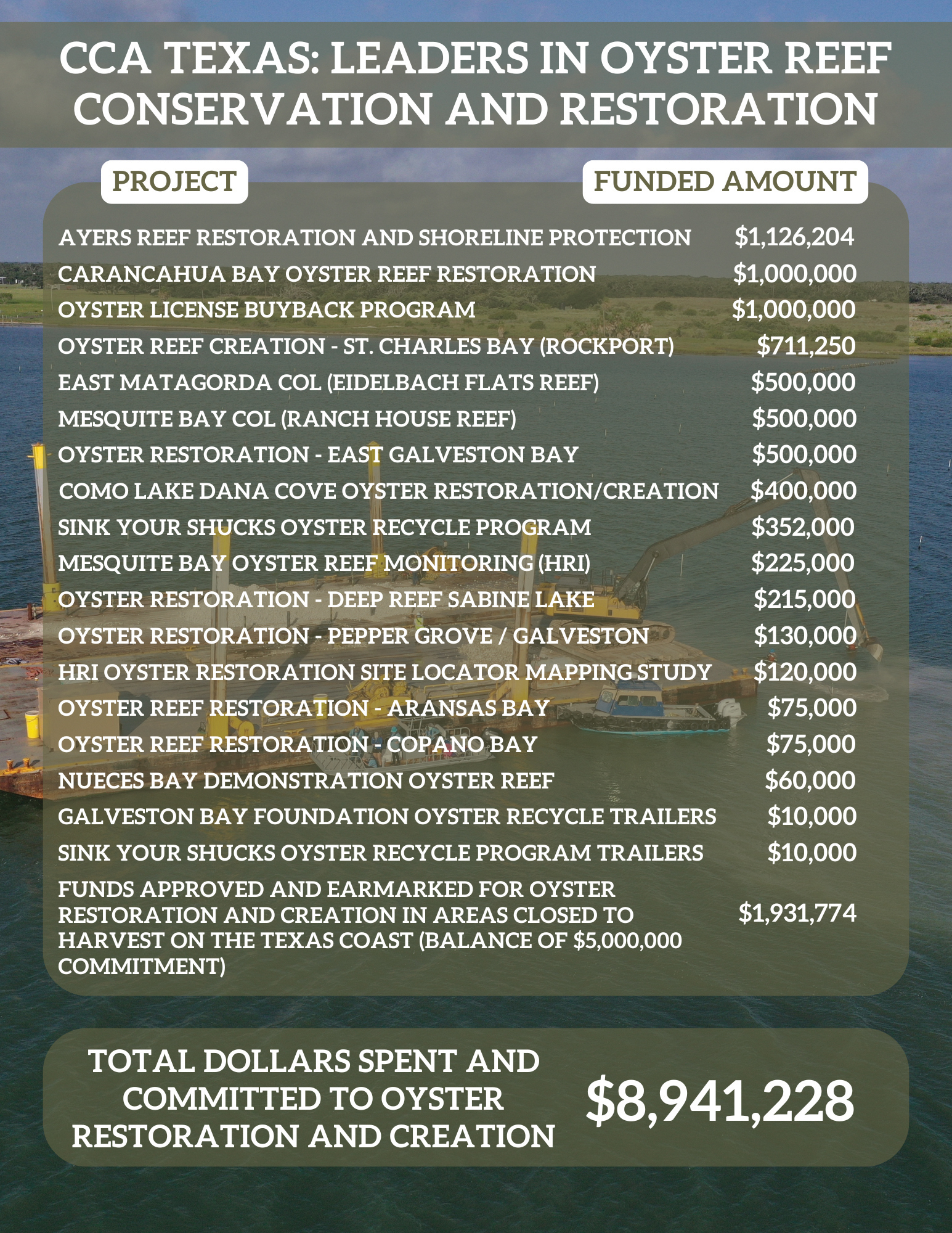
In 2025, license holders were offered $30,000 to voluntarily retire their licenses. Of 115 initial inquiries, 112 licenses were retired, eliminating more than 20% of the total licenses in a single year. Another round is planned for 2026, and CCA Texas—along with donors, Texas Parks and Wildlife Department, and conservation-minded industry partners—anticipates another strong response. CCA Texas proudly contributed $1 million to the 2025 effort.
Bay-Bottom Lease Expansion
Expanding state-managed bay-bottom leases gives commercial oystermen the ability to invest in, build, and sustain their own reefs, reducing reliance on public grounds. Today, roughly 22% of Texas’ annual oyster landings come from 43 Certificate of Location sites in Galveston Bay, totaling about 2,300 acres. Efforts to further expand this program continue, and more than 100 new applications were submitted during the most recent application period, which closed November 30, 2025.
CCA Texas has long advocated for this program and is encouraged to see strong participation from conservation-minded members of industry.
Non-Harvestable Conservation Leases
In addition to commercial lease expansion, conservation groups and research institutions will now be able to secure bay-bottom leases designated strictly for reef creation and restoration—permanently closed to commercial harvest.
CCA Texas, in partnership with Gulf Trust and Matagorda Bay Foundation, has submitted applications for 10-acre and 15-acre conservation sites in Mesquite Bay and East Matagorda Bay. CCA Texas has committed $500,000 to each project, and looks forward to working with our partners through the approval process and eventual cultch placement.
Looking Forward
The year 2025 was truly rewarding for CCA Texas, our volunteer chapters, and the thousands of members who make our work possible. Your continued support fuels our mission, and we look forward to making even greater strides in 2026.
Thank you—and here’s to another year of conservation, stewardship, and success on the Texas coast.