
Swimming with the Fish
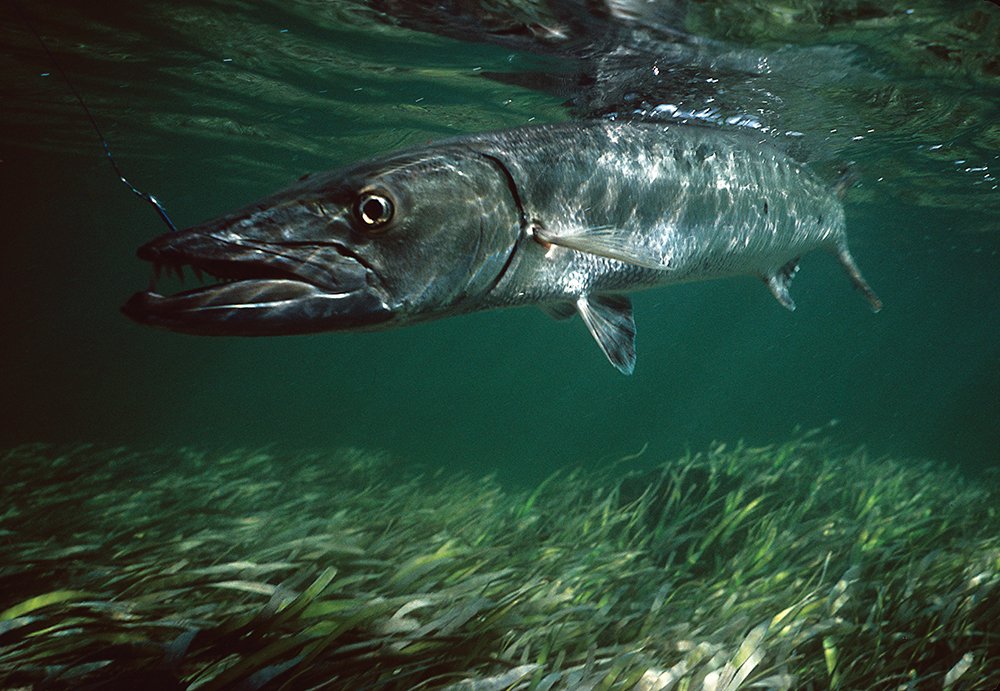
There have been plenty of fishermen out there with the proverbial wet butt and a hungry gut, but some of us were often soaked from head to toe even when it wasn’t raining. We photographed fish underwater.
Tired of spearing fish, I began photographing them with a new Nikonos III camera in 1979, scoring closeups of a tarpon and barracuda on a single roll of film while snorkeling inside a platform eight miles off the Port Mansfield jetties in a 14-foot jonboat. (A calm day in August). For a dozen years after, I jumped overboard with a number of game fish species. I quickly learned that holding my breath while using a snorkel, carried an advantage in that bubbles from a scuba tank could spook the fish. The photos were handy for illustrating articles on favorite fish species, although it was a thankless and rather expensive task.
Back then, each roll of slide film cost $20 to buy and develop, and this was in late 1980s dollars, the equivalent of almost $60 in today’s currency. About one third of every film roll was thrown away, due to poor exposure, focus, distance, or the wrong angle. (At least the fish didn’t have their eyes closed). And then there was the cost of fishing off the coast and actually catching something in water clear enough to photograph. You had to have a boat, too.
So, there were years of making these underwater photos, often clambering back aboard at the end of each session without even a dive ladder. Lots of adventures, but as the years went by, I gradually became weary of soggy clothes and by then, I’d achieved my goal of photographing most of the popular gamefish species in the Gulf. Aside from building up my personal collection for freelance articles, there was limited financial incentive from employers and increased risk, which dawned on me one day when another employee wondered aloud why I didn’t jump overboard to photograph a hooked wahoo in the Atlantic during February—in the same area where big, satellite-tagged white sharks spend the winter, tracked by biologists on a weekly basis.
A few months prior I'd jumped overboard at the jetties, where bull sharks were common, to get a cover photo of an angler lifting a 20-pound snook into his boat. The photo was captured while treading water with a land camera (and wearing a life jacket. Off to the press. It was around then that I began to question my enthusiasm. I could picture the parent company’s reaction to a mishap: “Missing a leg? No problem, put that man on disability.”
Years before that In the Houston office they nicknamed me after the Charles Bronson movies, assuming my jumping overboard equaled a desire for a short lease on life.
My equipment back then was simple and had no flash until my brother bought one at the PX on Guantanamo Bay. Duct tape kept the battery compartment better sealed when underwater. Mostly I used available light, and that meant a sunny sky near midday. I never got hurt while in the water, although a jumping kingfish hit me in the back of the neck with its mouth closed. Out in the Pacific, Buddy Shultz paid a young spear fisherman named Amado to hover close by, watching for sharks, while I took closeup pictures of a big, hooked sailfish alongside the boat.
My camera had a 30-inch minimum focus, so it was better to film bigger fish that filled the viewfinder. You have to move slowly around these fish in a non-threatening manner. My deepest dive was 155 feet at the deepwater rigs off Galveston, which was full of fish, including rare grouper that had never seen a diver.
There were other guys jumping overboard to capture fish on film. In January 1986 a young artist from Jamaica appeared in my doorway at the CCA office, carrying a collection of pen and ink drawings he'd made, inspired by Hemingway's classic novella, The Old Man and the Sea. The drawings depicted a Cuban fisherman hand-lining an epic blue marlin from his small skiff, as well as other scenes of him fighting off sharks with a harpoon, with his half-eaten marlin tied to the boat. The young artist was hoping to sell his paintings at CCA banquets. Problem was, they already had a stable of Texas coastal artists such as Jack Cowan, Herb Booth, Al Barnes and Sam Caldwell. Nobody seemed interested in this well-spoken young stranger with the hint of a British accent.
So, I invited him to lunch. We talked about diving and illustrating fish, and he examined the latest issue of Tide magazine, which showed my recent encounter with a blue marlin 20 miles off Mazatlán. He was curious why the big fish didn’t attack, and how it passed right by me while I clicked off 36 color slides. I told him the big fish only eyeballed me up and down as it passed by, like I’d seen many ling (cobia) do. He then asked how I was able to get such a rich blue background, instead of a dull blue/gray. As I described how I fooled the camera by using a different ASA setting (now called ISO).
His name was Guy Harvey, and needless to say he found his way into a phenomenal career with his fish photography, underwater art and founder of one of the world's leading marine conservation organizations. A true class act, he never forgot me in later years, sending his latest painting when I came out with another fishing book, four times now, each with his distinctive autograph. He’s certainly one of the most admirable people I’ve ever known. Twenty years later we fished on the same boat in a marlin tournament out of San Juan, PR and it was great to see him. By then he had a twelve-year-old son on the boat, and they practiced boxing with each other when the fishing was slow. He also has a daughter; both are now grown, and they help manage his business. He's even painted a marlin on the bow of a 1,000-foot Norwegian cruise ship.
Sidebar
Today, Guy donates his work to many marine conservation causes, including CCA. In 1999, he partnered with the Oceanographic Center at Nova Southeastern University to create the Guy Harvey Research Institute (GHRI) in Dania Beach, Florida, for the purpose of providing “the scientific information necessary to understand, conserve and effectively manage the world’s marine fishes and their ecosystems.” The GHRI provides global-level leadership in the generation of scientific data necessary to conserve the world’s fish resources.”
For more information: guyharveyfoundation.org