

Texas Snook: The Lone Star State’s Hidden Gamefish
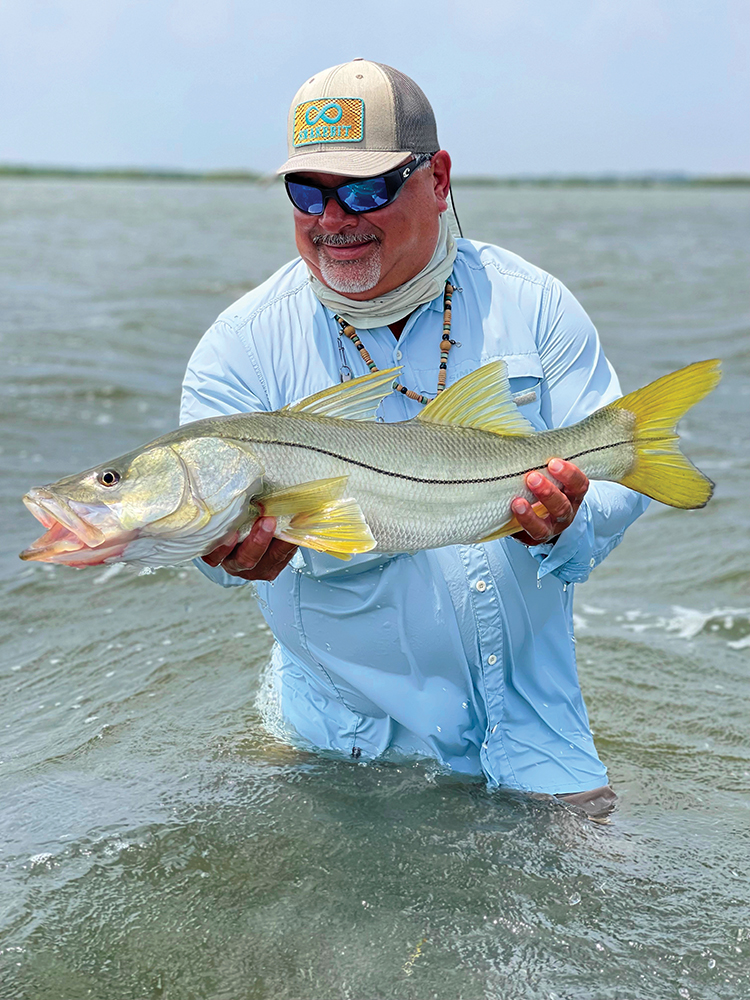
Capt. Ernest Cisneros is passionate about snook. Ernest practices a strict conservation ethic; all snook landed on his charters are quickly photographed and released.
One of the great things about coastal fishing in Texas is that the state represents a natural confluence of two different ecological settings: temperate river bays in the north, and semi-tropical lagoons in the south. The relatively deep, cool, brackish waters in places like Galveston and Matagorda Bays in the north give way to relatively shallow, warm, and salty waters in the Laguna Madre, with a broad diversity of habitats throughout. The result is an incredible diversity of predators that can be targeted throughout the state. Snook are a group of predatory game fish species that have historically been associated with the tropics, but they are increasing in both abundance and geographic range in Texas, and they present an excellent challenge for anglers that want to venture from the coastal fisheries “usual suspects.”
One thing many anglers might not know about snook is that there are several different species. To understand which snook species reside in Texas, it is worthwhile to track their diversity back through ancient time. Snook have an incredibly interesting evolutionary past that has not always included residency here in Texas. Based on DNA evidence, it is believed that the snook family originated in the Pacific Ocean and then branched out into the Atlantic prior to the rise of the isthmus of Panama, when fish were able to move freely between oceanic basins through a now extinct body of water called the “Central American Seaway.” During this time, a great deal of differentiation between different populations of snook resulted in a number of different snook species, all of which used different habitats and had different behaviors. When the isthmus of Panama formed about three million years ago, populations of snook in the Pacific and Atlantic were cut off from one another. To this day, “sister” species of Pacific and Atlantic types continue to exist in both oceans. In other words, many of the species of snook that reside in the Atlantic have mirror image species in the Pacific.
There are at least seven recognized species of snook currently in the Atlantic basin, many of which have at least some presence in the Gulf. Perhaps the most common and abundant of these species is unironically referred to as the common snook. This species is found throughout the known range of snook species in the Atlantic, from North Carolina to Brazil, and is prized as a sportfish throughout that range. If you’ve hooked up on a lunker snook in Texas, there is a good chance it was a common snook. In addition to being the most abundant species in Texas, it also grows to a larger size than any of the other species found in the state.
Beyond the common snook, the question as to what other species reside in Texas has remained a mystery for biologists. Because snook are a relatively young group of species in a historical sense, they all look very similar and can be very challenging to tell apart. In the past 10 years, collaborative research between the Texas Parks and Wildlife Department (TPWD) and the Florida Fish and Wildlife Conservation Commission has set out to answer the question of what “other” species of snook reside in the greater Gulf. To answer this question, researchers in both states collected hundreds of fin tissues from snook using agency-collected as well as angler-collected samples. The DNA from fin clips in both states were then compared to DNA from known specimens of all of the different Atlantic snook species. What these researchers found was an amazing diversity of snook species in the Gulf. In Texas, the species known by anglers as “fat snook” was identified as being a completely different species from the one in Florida that has the exact same name. Additionally, they were able to identify the presence of a third rare species in Texas, the Mexican snook. This species had never before been observed in the state but was observed twice in the Laguna Madre, and once in Aransas Bay.
While most snook species have been confined to tropical and semi-tropical parts of the southern Gulf due to its relatively warm waters, the common snook is a species on the move. In Texas, it wasn’t very long ago that anglers had to venture to the southern coast to have a chance at landing a snook. Now, it’s not uncommon to hear reports of anglers as far north as Galveston Bay hooking into one. Common snook were first observed in a TPWD gill net in Galveston in 2012, and then in Sabine Lake in 2017. Last year, authors in Mississippi documented several catches of juvenile common snook in that state, in a paper published in the journal Gulf and Caribbean Research. The presence of these individuals in the far northern reaches of the Gulf suggests that the common snook now resides in nearshore waters throughout the Gulf basin.
Fishing regulations for snook in Texas are fairly conservative (daily bag of one snook; 24 to 28 inches slot), in deference to the fact that all snook species are still relatively rare compared to other predatory fishes in the state. These species are also fairly sensitive to cold winter temperatures. For instance, a great deal of mortality of all snook species is typically observed during times of extreme cold weather like winter storm Uri in 2021. With that said, the finding of common snook in the northern Gulf just a few years after the winter storm indicates that the species might be more resilient to these events than once thought. Perhaps this once tropical species will become a more common catch for anglers throughout the Gulf, adding another classic catch to the portfolio of predatory targets available to coastal anglers in Texas.