

The Future of the Silver King
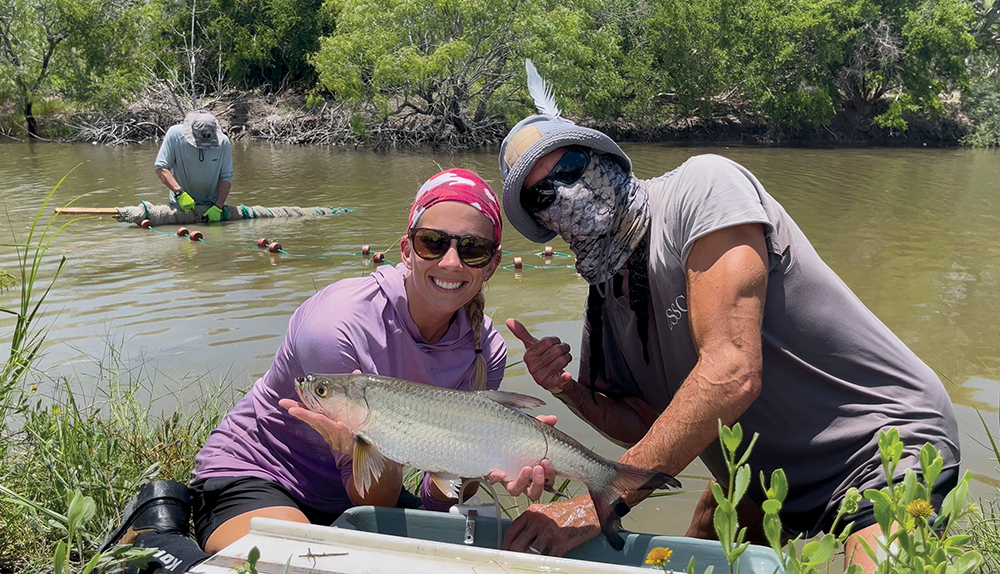
When I learned about the opportunity to study tarpon in Texas, I was all in. As a budding fisheries scientist and amateur fly fisher, the history and mystery of Texas tarpon was captivating, like a puzzle waiting to be solved. I envisioned long yet rewarding trips on the bay, sight-casting and fighting migratory monsters in the south Texas heat. I imagined myself scrambling across the slick jetty rocks and fishing my heart out until dark for the mid-sized sub-adults, carrying a box of fish tagging equipment in one hand and my rod and tackle bag in the other. What I didn’t see coming was the reality of my master’s research: wading neck deep in wastewater, thigh high in sulfur-reeking muck, praying that a little six-inch tarpon wasn’t about to leap over the seine that my team and I had so strenuously pulled through a trash-filled, roadside ditch.
Now it’s true that you’ll find tarpon in all of these places and then some, as tarpon have complex life cycles that require different habitats as they develop, grow, and mature. For the first few years of their lives, juvenile tarpon seek inland, protected, backwater nursery habitats with abundant prey resources and protection from predators. Then, after growing large enough to survive in more exposed environments, the now sub-adult tarpon move into riverine, brackish, or estuarine habitats to continue development before moving further into deeper, saltier waters as reproductively mature adults. Tarpon reach maturity at around 8-10 years old and will periodically migrate offshore to broadcast spawn throughout the rest of their 80-year-long lifespan. After spawning in these deep, offshore waters, the eggs may fertilize and hatch into thousands of tiny, long, clear, eel-like larvae, called leptocephali, that somehow swim their way back to the inland nursery habitats hundreds of miles away, where they transform into tiny tarpon and begin developing. Few survive, and those that do are long-lived, late to mature, and need access to all of these habitats to persist – a life history strategy that’s been steady and true for 18 million years. A life history strategy that can be detrimental in today’s world.
While the recorded history of tarpon in Texas isn’t as extensive as their evolutionary record, tarpon have historically played key roles economically, socially, and culturally along the Texas coast since the 1800s. Anglers travelled far and wide to places like Port Aransas, Texas for a chance to fight and weigh-in a massive “Silver King.” That is, until the tarpon fishery collapsed in the 1950s. Since then, scientists have sought to understand why this happened and have narrowed it down to two primary reasons: adult overfishing and the loss of juvenile nursery habitat. It’s no secret that the tarpon fishery was world-class back in the day, and if you’ve seen the many, many weigh-in photos from the “Tarpon Era” or observed the massive scales covering the walls of the legendary Tarpon Inn in Port Aransas, you’ll understand why adult overfishing contributed to the collapse. Though since the 1990s, tarpon fishing in Texas has been primarily catch-and-release (with minimum size set to allow potential state records; currently 85 inches minimum total length), and anglers have happily embraced safe handling practices to minimize post-release mortality (like keeping any larger tarpon in the water, making sure the fish is fully recovered before releasing, and minimizing handling time). With these laws and practices in place during recent history, why aren’t we seeing the legendary schools of tarpon that our grandparents and great-grandparents witnessed more than seventy-five years ago? Hasn’t it been enough time for the Texas tarpon fishery to recover by now? This is where the puzzle becomes a bit more complex, and that brings us to the second point: the loss of juvenile nursery habitat.
Nursery habitats are specific areas within a larger ecosystem that provide juvenile fish with optimal conditions for growth, survival, and recruitment into the adult population. Nursery habitats come in many shapes and sizes depending on the species, but they all have three things in common: shelter, fewer predators, and abundant prey resources, and they are absolutely essential for sustaining healthy fish populations. For juvenile tarpon, these nursery habitats look like backwater creeks with abundant freshwater inflow and good connectivity to the surrounding bays and estuaries, in addition to those three key factors. Without these nurseries, juvenile tarpon have reduced growth and lower recruitment into the adult population to sustain the fishery. This statement is simple, and perhaps a bit obvious, but important to understand because several studies along the Gulf Coast have determined that minor negative impacts on juvenile tarpon survival will result in major reductions in adult abundance, in part due to their life history strategy. Essentially, an isolated impact on juvenile tarpon survival that occurred two to three decades ago is just now starting to be seen, and it would take at least a few decades for the tarpon population to rebuild itself after such disturbance. Unfortunately, vital nursery habitat has constantly been degraded, destroyed, or both since coastal development began in Texas. Freshwater has been diverted and rediverted, and these backwater creeks have been routinely altered to accommodate the growing human population and industrial demands. So, while yes, adult overfishing in the early 1900s quickly reduced the size of the tarpon population, the loss of juvenile tarpon nursery habitat has prevented full recovery of the population for nearly a century.
Though hope is not lost. While small negative impacts on juvenile survival have detrimental impacts on adult abundance, the opposite is also true: a study by Kirk Winemiller and Bill Dailey found that a 1% increase in juvenile tarpon survival can lead to an increase in adult abundance by ten times. Therefore, identifying and understanding juvenile tarpon nursery habitat is crucial to the conservation, restoration, and management of the Texas tarpon fishery. If we can understand what types of habitats juvenile tarpon need to survive and their current population status, then we can create and implement well-informed protective measures to rebuild the fishery. Now, it would take a few decades to start seeing those positive results because of their life history strategy, so patience and consistency will be key. Unfortunately, little is known about the early life ecology of tarpon in Texas in general, precluding our ability to properly manage the fishery.
To fill this knowledge gap, the Center for Sportfish Science and Conservation at the Harte Research Institute at Texas A&M University-Corpus Christi is conducting a juvenile tarpon habitat study to identify key nursery habitats, describe their physical, biological, and environmental characteristics, and determine seasonal residency, habitat use, abundance, and survival of tarpon within the identified nurseries. Since April 2024, a trusty team of three scientists and I (we call ourselves the “Poon Patrol”) pull a 60-foot center bag seine through five identified nursery sites (with the gracious help of many anglers who contributed to our confidential juvenile tarpon habitat survey) to capture juvenile tarpon every week. The sites range from ditch-like cuts to pond-like systems, varying in water quality, physical attributes, and connectivity to the surrounding bays to provide a better idea of what “prime” nursery habitat specifically looks like for juvenile tarpon in Texas.
Upon capture, each tarpon is measured, tagged with a small, uniquely numbered PIT tag (which is very similar to your pet’s microchip), and a small piece of its pelvic fin is clipped and preserved for future genetic analyses. If a tarpon has already been tagged with a PIT tag, we record its unique tag number as a “recapture” to estimate population abundance and remeasure the tarpon to calculate growth rates. All other fish and crustaceans captured in the seine are identified and recorded to describe the biological community within the nursery habitat. On a monthly basis at each site, a smaller center bag seine is pulled to capture potential prey resources and further describe community assemblage at the lower levels. Prior to each seine haul, we measure salinity, temperature, dissolved oxygen, pH, turbidity, and depth levels to understand the water quality of the nursery habitats and any seasonal fluctuations they undergo. At each site, the physical components of the habitat are described in detail, such as substrate type and the presence or absence of submerged structure and overhanging vegetation. Lastly, a subset of juvenile tarpon are tagged with an acoustic tag to passively track its movement in and out of the nursery habitat to determine habitat use and seasonal residence. This study is currently underway and projected to conclude in 2026.
And that brings us back to the last year of my life: the ditches. I say ditches because… that’s what they are. So far, we have found leptocephali in the late spring, and age one-, two, and three-year-old tarpon year-round in places like stormwater drainage ditches and wastewater outflows that empty into the surrounding bays, small cuts we drive over every single day without giving it a second glance. These ditches are urban and wild all at the same time: shorelines covered in invasive Brazilian peppertrees and razor-sharp mesquites, thick muck that bubbles up and reeks of sulfur when waded through, rusted pipes and concrete culverts funneling runoff and wastewater, cars flying by on the highways that cross over the ditches, and shopping carts and trash littered throughout. While that may not seem like “clean and pristine” nursery habitat for such a prized sportfish, these ditches are covert sanctuaries, an oasis in disguise. Key prey resources, like small mullet and shrimp, are readily abundant, and the ditches are often only connected to the bays during high water events, keeping aquatic predators out for much of the year. Plus, tarpon are specifically adapted to tolerate regular changes in salinity and can breathe air through their vascularized swim bladder, allowing them to live in areas with fluctuating salinities and low oxygen levels that are too variable or uninhabitable for many other aquatic species. And perhaps most importantly, the thick muck and warm wastewater seems to keep these ditches warmer during the cold winter months, greatly increasing survival during freeze events. At least, that’s what we know so far.
As you read this, I’m probably wading through another ditch, searching for another six-inch tarpon, striving to add another piece to the puzzle that is Texas tarpon. While I never imagined myself wading through trash and muck and wastewater in search of such a prized sportfish, every day I am left in awe, not just because I now intimately know the inner workings of a roadside ditch, but because of the respect the ditch demands. These places are truly covert sanctuaries, and tarpon have capitalized on the places we overlook and disregard, just to fight for another day in a rapidly changing world. Through it all, my respect and admiration for their resilience has only grown, and it’s been an incredible opportunity to contribute to these research efforts and help tell the story of Texas tarpon. While our study is still ongoing, this much is clear: by better understanding and protecting juvenile tarpon nursery habitat, the future of the Silver King is promising. It just may take a few decades before we see it.