
TPWD Science-Based Gill Net Program Remains On Hold
For nearly five decades, the Texas Parks and Wildlife Department’s (TPWD) gill-net sampling program has provided an unparalleled, science-based view of coastal fisheries and estuarine health. This continuous dataset—one of the largest and longest-running marine resource databases in the world—has driven major management decisions, supported academic research, and underpinned the economic value and sustainability of Texas’s coastal fisheries.
Today, however, that program remains suspended while a federal investigation into rare, incidental interactions with protected species threatens to dismantle a flagship monitoring system at the heart of Gulf Coast fisheries science.
What the program does and why it matters
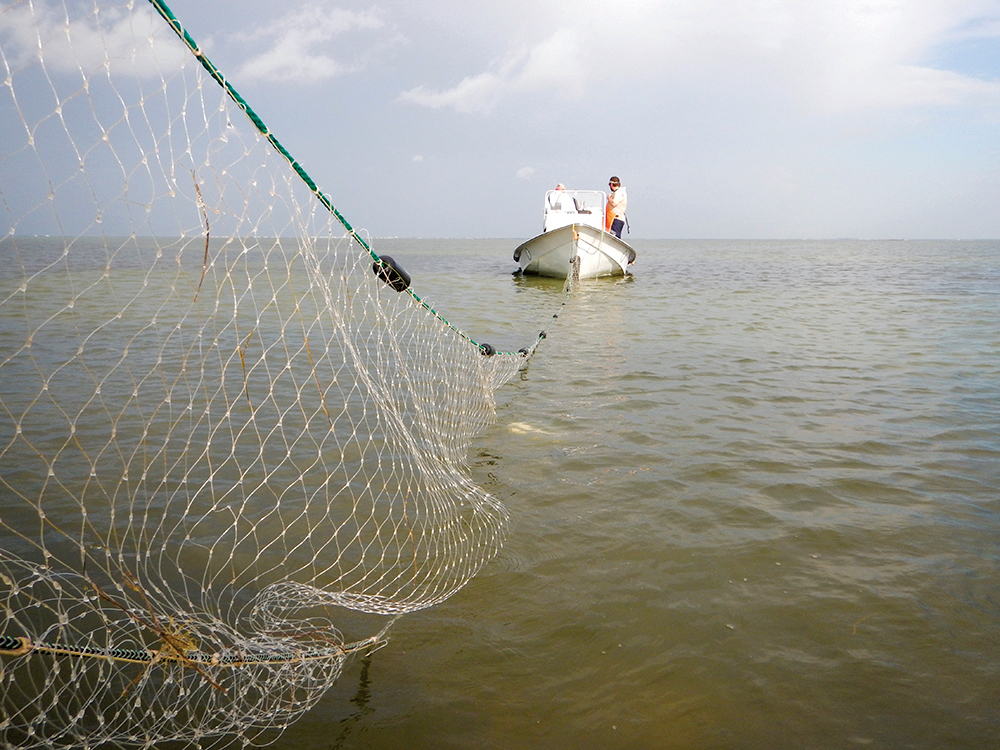
TPWD’s standardized gill-net sampling, in place since 1975, provides spatially unbiased, repeatable measurements of key species such as red drum, southern flounder, and spotted seatrout. Nets are deployed on randomized shorelines across eight major bays each spring and fall, with strict limits on how many nets can be set in a given bay or at one time.
That random-design, repeated sampling is uniquely effective at detecting trends in adult and sub-adult fish that other gear types miss. It complements angler survey data and additional sampling methods to give fisheries managers a comprehensive picture of fish population status and ecosystem conditions.
The program’s data has driven difficult—and at times controversial—management actions, including designating red drum and spotted seatrout as gamefish, banning commercial bay gill nets, adopting formal fishery management plans, and implementing limited-entry programs and commercial license buybacks. While these policy choices were often contentious at the time, the long-term scientific record repeatedly validated the need for regulation and demonstrated positive biological outcomes.
Beyond regulation, this dataset has formed the backbone of hundreds of peer-reviewed studies, graduate theses, and agency reports documenting shifting baselines, habitat change, and responses to restoration and freshwater inflow decisions. Economically, TPWD fisheries science has helped sustain a coastal recreational fishery that supports local businesses and communities—commonly cited estimates place annual economic impacts in the $4–5 billion range, illustrating the program’s real-world value.
Incidental takes: rare, recorded, and largely nonlethal
Over more than forty years of sampling, interactions with protected species have been extremely infrequent. From 1983–2023, TPWD recorded 41 bottlenose dolphin encounters across more than 30,000 gill-net sets—an average of about one encounter per year, and in roughly 41 percent of years, none occurred at all.
Sea turtle encounters have likewise been uncommon and typically nonlethal. Observed increases in some turtle interactions reflect the success of long-term conservation measures that have helped populations rebound, not an escalation in risk associated with the sampling program itself.
Regulatory impasse and inconsistent permitting
Despite the program’s long track record and the documented rarity of protected-species interactions, NOAA Fisheries has declined to issue TPWD the incidental take authorizations the agency has requested five times since 2011 (applications submitted in 2013, 2015, 2017, 2022, and 2023).
In May 2024, NOAA Fisheries’ Offices of Law Enforcement and Protected Resources opened a formal inquiry into alleged Marine Mammal Protection Act and Endangered Species Act violations related to those rare encounters. As a result, TPWD suspended gill-net sampling while the matter proceeds.
The permitting history raises troubling questions about consistency. NOAA has granted incidental take authorizations to various private and public entities for activities with potential impacts on marine mammals and listed species. Yet TPWD’s requests—supported by decades of monitoring data, mitigation measures, and transparent reporting—remain unapproved.
That regulatory delay has immediate consequences. Without a permit, TPWD cannot resume routine sampling, and the continuous, structurally unbiased time series that managers, researchers, and stakeholders rely upon has been interrupted.
Consequences of a data gap
Suspending gill-net sampling does more than pause a government program—it fractures an irreplaceable dataset. In the last decade alone, TPWD gill-net data supported dozens of peer-reviewed publications, numerous graduate theses and dissertations, and countless management actions.
Losing consistent sampling degrades the ability to detect population shifts, evaluate regulation effectiveness (including recent speckled trout harvest changes), and identify emerging threats from desalination projects, ship channel expansion, industrial development, or altered freshwater inflows.
A fragmented monitoring approach reduces analytical confidence and increases management uncertainty. Decisions made without timely, unbiased data can lead to premature relaxations or unnecessary restrictions—each carrying real social and economic consequences for coastal communities and industries. Alternatively, managers may be forced to delay decisions entirely due to insufficient information. Either outcome handicaps fisheries management while the nets remain out of the water.
A practical path forward
Protecting endangered species and conserving marine ecosystems must remain priorities for all agencies involved. Those protections, however, can and should coexist with sound, science-based monitoring when agencies collaborate and apply regulations consistently.
TPWD has actively supported conservation-aligned research, including updated bottlenose dolphin assessments indicating population increases in some areas, and regularly provides response support during cold-stun events and strandings that directly benefit species recovery.
To prevent bureaucratic delay from eroding a 50-year scientific legacy, NOAA should act with urgency, resolve the investigation, and issue TPWD the necessary permits to continue its program.
The stakes are clear. Without science-based gill-net sampling, fisheries management loses a critical tool, public transparency erodes, and academic and agency research stalls. Reinstating a permitted, responsibly managed gill-net program is not only consistent with conservation goals—it is essential to preserving the long-term health and value of Texas’s coastal fisheries.