

TPWD Set to Resume One of the Largest, Longest-Running Marine Resource Databases in the World

The Science-Based Gillnet Program is Back
We have some great news! The Texas Parks and Wildlife Department (TPWD) has received the federal authorizations needed to resume its long-running science-based gillnet survey in Texas bays!
The approvals cover incidental interactions with protected bottlenose dolphins and federally protected sea turtles, resolving the permitting issue that forced TPWD to suspend sampling in May 2024. After nearly two years without routine spring and fall surveys, this fall crews will once again collect standardized information that helps managers understand the condition of Texas’ coastal fisheries.
You may recall that we have been covering this subject in previous editions of CURRENTS. Here is a quick review of the program and why it is consistent with conservation goals and essential to preserving the long‑term health, economic value, and scientific integrity of Texas’ coastal fisheries.
Established in 1975, the program uses a consistent, scientifically designed approach to monitor important recreational species such as red drum, spotted seatrout, and southern flounder. Crews sample designated locations across 10 major bay systems, from Sabine Lake to the Lower Laguna Madre. The resulting data helps TPWD identify population trends, evaluate the effects of regulations and habitat changes, and make informed decisions affecting the state’s roughly 900,000 saltwater anglers.
The federal authorizations include strict safeguards intended to minimize risks to dolphins and sea turtles, including restrictions on where nets may be placed, shorter soak times in higher-risk areas, pre-deployment wildlife observations, improved gear requirements, and rapid reporting of protected-species interactions. Certain sampling locations will be removed from future surveys after protected-species entanglements, and TPWD must follow detailed handling, release, and monitoring procedures.
For recreational fishermen, the survey’s return means fisheries managers will once again have access to the consistent, long-term information needed to support sound decisions about Texas’ inshore fish populations. The restart does not change current bag limits, size limits, or license requirements; any future regulatory changes would follow the state’s normal public rulemaking process. However, restoring the survey helps close a significant gap in a five-decade record and strengthens the scientific foundation for managing the coastal fisheries that anglers and coastal communities depend on.
Thank you to all CCA Texas members who provided comments to NOAA while the permit applications were under review. Your engagement on this issue helped to highlight the importance of this program and the unfortunate delays by the federal government in issuing these permits.
TCEQ Temporarily Suspends Essential Freshwater Releases to Nueces Bay
Despite objections from numerous conservation organizations – and in stark defiance of established scientific evidence, published research, and best practices for healthy estuarine ecology – the Texas Commission on Environmental Quality (TCEQ) unanimously approved an emergency order temporarily suspending required pass-through freshwater releases from Choke Canyon Reservoir and Lake Corpus Christi into the Nueces Bay Estuary.
Requested by the cities of Corpus Christi and Three Rivers and the Nueces River Authority, the emergency order allows water that would otherwise be released to meet required estuary inflows to remain in regional reservoirs. The temporary [AH1] suspension applies whenever combined storage in Choke Canyon Reservoir and Lake Corpus Christi is at or below 50 percent. It will remain in effect for 120 days—through December 23, 2026—with the possibility of a 60-day extension.
The irony of the timing of the application is difficult to ignore: while asking TCEQ to suspend pass-through flows, which are critical to an estuary widely recognized as being on life-support, the City of Corpus Christi simultaneously eased water usage restrictions for its customers, moving from Stage 2 to Stage 1. In other words, Corpus Christi asked the state to withhold water from an already stressed estuary while loosening restrictions on water use by its own customers.
CCA Texas opposed the request and submitted comments urging TCEQ to deny the emergency suspension. We also asked to reconvene the Nueces Estuary Advisory Council {NEAC[AH2]}, the collaborative forum historically used to bring scientists, state agencies, water users, conservation organizations, and other stakeholders together to identify collaborative solutions that support both reliable water supplies for the region and a healthy, sustainable estuary.
The 2001 Agreed Order already includes a drought-responsive framework. As reservoir levels decline, “target” environmental-flow volumes are reduced. Additional measures are also included to further protect regional water supplies. As soon as the rain stops, and water flowing into the reservoirs decreases, the “required” environmental-flow volumes are further reduced, regardless of reservoir level. The Order was designed to balance human and environmental needs without eliminating the freshwater inflows necessary to sustain the Nueces Estuary. [AH3]
Those inflows are essential. Freshwater helps maintain the salinity conditions required by fish, crabs, shrimp, oysters, and other estuarine species. It also transports nutrients and sediments that support wetlands and marshes, maintaining the Nueces Delta. We cannot ignore the importance of freshwater inflows into our estuaries because prolonged reductions have significant consequences.
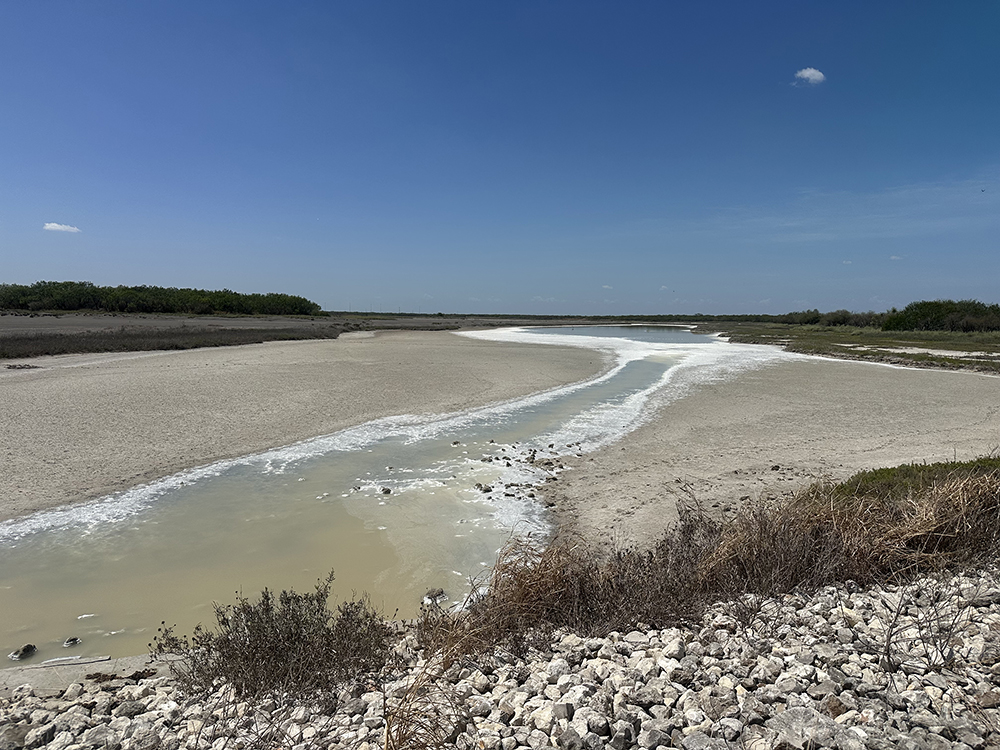
Since releases were suspended in March 2024, in compliance with the 2001 Agreed Order, salinities in Nueces Bay reached approximately 40 parts per thousand, compared with a historical average of roughly 22–26 parts per thousand. Salinity in the Nueces Delta exceeded 55 parts per thousand, despite the delta typically being one of the freshest areas in the estuary. These hypersaline conditions can significantly reduce the survival of larval and juvenile fish, crabs, and shrimp, harm oyster reefs, reduce biological productivity, and delay recovery even after normal inflows return. TCEQ was aware of this information yet decided to grant the emergency order.
Recent surveys conducted in late September 2026, showed mass juvenile crab mortality and salinities above 100ppt at the less-tidally influenced areas of the delta. These conditions effectively create a reverse estuary, with salt-encrusted shorelines and no vegetation or habitat to support fisheries. Ecological impacts in other areas of the delta can be delayed and may become apparent over time. As such, a thorough assessment of fisheries and habitat impacts should have been completed before suspending potential future pass-through releases, and one is certainly warranted moving forward.
CCA Texas is especially concerned about the precedent this decision sets. If long-standing science-based water management frameworks can be bypassed without meaningful stakeholder participation, similar requests could follow in other coastal basins. Emergency decisions affecting shared water resources should not become a substitute for collaboration, transparency, and independent scientific review. They should be made through processes that include all affected interests—not solely by those seeking additional water storage.
Healthy estuaries support commercial and recreational fisheries, tourism, boating, hunting, birding, water quality, storm protection, and the broader economy of the Coastal Bend. CCA Texas will remain engaged and prepared to respond to future actions, including any effort to make this suspension permanent.
We will continue advocating for the reconvening of the NEAC, protection of essential freshwater inputs, and collaborative water management decisions that safeguard both regional water supplies and the long-term health of Texas’ coastal ecosystems.
[AH1]Adding temporary. Under the Order, releases are suspended when levels drop below 30% and you say further down that releases have been suspended since 2024. Just trying to make the distinction between built in suspensions, and this new development.
[AH2]A slight nuance, but the NEAC group specifically seeks inform the environmental/estuary component and strike a balance between the regional needs and the environmental needs.
The Region N Water Planning Group is the group that meets specifically to inform and plan for regional water needs
[AH3]This paragraph has been the most difficult to communicate to the public succinctly, but I believe its the most important aspect to get across to the public because the publicly stated volumes of water that are released have been significantly overstated. I took a stab at it..
To explain how it works in a little more detail:
The order sets out a series of “target” environmental flow volumes that are based on the combined reservoir level. There are annual target volumes, which are broken down into a monthly schedule. These “targets” are what everyone points to as “required” volumes, and are the only round numbers stated in the Order. HOWEVER, they really represent an “up to” or “maximum” amount and not a requirement.
There are additional conditions that further reduce how much water comes from the reservoir, independent of reservoir level. To include everything is too nuanced for the article. The most important additional condition is that “required” environmental flows can never be greater than the inflow into the reservoir. So even if the reservoir is full, and the “target” environmental flow volume is high, if there is no rain and no water is flowing into the reservoir, no environmental flows are “required”.
This has resulted in “required” environmental flows being less than 50% of the “target” environmental flows over the past 25 years.