
Watch for Tagged Ling and Tripletail
Beginning this May, offshore anglers are asked to keep an eye out for newly tagged cobia (ling) and also tripletail, part of a new Gulf-wide study. The goal is to more accurately assess the movements of these offshore fish, whose numbers are clearly down in some areas, in some cases drastically so, especially cobia. As a result Florida’s Gulf Coast, decades-old, high-stakes cobia tournaments have been cancelled for several years now, for lack of fish.
Were they almost wiped out locally, or moved away? Biologists are trying to determine if cobia are more localized than earlier believed. While some migrate south every winter to southern latitudes, others may be waiting offshore for spring and summer to return; they are definitely not a cold water fish.
This new Gulf-wide project is led by the University of South Alabama’s Dr. Shawn Powers and will involve 100 fish tagged in each Gulf state. The project is funded by the Gulf States Marine Fisheries Commission. In Texas, Matt Streich is director for the Center for Sportfish Science and Conservation, part of the Harte Research Institute in Corpus Christi. They will be responsible for tagging cobia and tripletail from Port O’Connor south to at least Port Mansfield. Dr. Dave Wells and Dr. Jay Rooker at Texas A&M at Galveston will be responsible for tagging on the upper half of the Texas coast.
Each of the state teams involved will be carrying the easily-visible shoulder dart “spaghetti” tags, and anglers reporting the tag’s number and size of fish will earn a nice reward. Some of these fish may also carry an internal, cylinder-shaped sonic tag surgically placed inside the body cavity (not the gut), found only if the fish is cleaned and examined. Cobia carry the bigger, 3-inch models, while tripletail will carry the smaller, 2-inch variety. These acoustic tags cost a few hundred dollars each and last for up to three years, and will hopefully be mailed back to the appropriate address, where it can be installed in a new fish.
In addition, scientists are going to plant about 50 external satellite tags across the Gulf in these fish. Easily tracked by downloading the data from a satellite onto a laptop computer.
At this writing, Streich said the color of the tags had not been decided, though they’ve used yellow before. The tags will be a bright color and fairly easy to notice. While tagging the fish, they will also collect available fin clips, which have proven useful for genetic studies and hopefully provide more information on Gulf and Atlantic fish, which are thought to be slightly different genetically. “Cobia are found all over the world and remain the same species, but genetically they’re different enough not to breed together,” says Dr. Streich.
New technology makes it easier to determine DNA and it will be welcome information, providing more insights on these mysterious fish which at times, seem to come out of nowhere when fishing. In my 2002 book The Cobia Bible, a map illustration shows populations found in warm waters stretching from Japan to North Australia, and also across the Indian Ocean before wrapping around Africa (except for the chilly Med). That covers what must be a million or more square miles. Cobia also prowl from New York to Brazil, including our own Gulf.
We’ve been tagging cobia since 2020, mainly studying connectivity with [migrations into] Mexican waters,” says Streich. “Most of the fish we tagged were not going way down into Mexico. They were kind of stopping near the border. I think many of the fish we’ve recovered are somewhat localized, not going through a full migration to other regions. We don’t know what proportion of these fish carry those behaviors. We’re hoping this new tagging effort will help figure out those questions.”
“Our recent years of tagging have also seen a study on catch-and-release mortality. So far the numbers are very low, which is what we expected. They seem very hardy. There were no mortality estimates in the past, so we’re doing that now. There are still lots of questions about fish movement however,” says Streich.
“Our sonic tags have a high retention rate; they’re placed inside the fish, with the incision sewn up. We have receivers that listen for these fish swimming in the area. The receivers are placed on offshore gas and oil platforms and PVC pipes in the estuaries and have to be retrieved every 4-6 months and their data downloaded. Each sonic tag has its own unique ID. In offshore waters, a receiver can detect fish 200-600 meters away. Inshore, it’s 200-400 meters. Gulf-wide there are close to 800 receivers. There are other fish-tagging groups in the Gulf such as ITag and if we detect their fish, they’re notified.”
As for tripletail, they seem to be getting more scarce. There was no bag limit on these fish until in recent years, and sometimes they were slaughtered, including one episode in upper Matagorda Bay where they covered the deck of one boat in hot weather. As often happens, a bag limit on these fish arrived late and is now three fish per angler. The big ones have become more scarce, and some days the only tripletail spotted are all undersized, the classic sign of overfishing. Back in the 1970s they were plentiful enough each summer, and the many we saw off Port Arthur averaged about 12 pounds, with my top fish weighing 22 and 24 pounds. The long-standing Texas state record was caught in 1984 in Matagorda Bay, and it weighed 33.5 pounds, a powerful fish. Yet, there are still big tripletail out there. The new record, weighing 33.8 pounds, was caught a year ago last April, “in Texas coastal waters.” Odds are 5-1 the new record came from Matagorda Bay once again.
Okay folks, now you know the program this summer, it’s time to head offshore when the wind quits blowing and find these fish. As for myself, I haven’t seen a cobia in three years except for an occasional short fish. I’m done harvesting them, having caught more than my fair share. Even began tagging and releasing these fish back in 1987. But if I catch another, I will certainly be watching for tagged individuals that can be recorded and released. And my luck with tripletail apparently ran out. If I turn the boat around to cast at a floating tripletail, my boat’s wave-slap under the bow spooks them into diving out of sight almost immediately. Another time, two dolphins showed up and harassed a surfaced tripletail into diving. What are the odds on that.
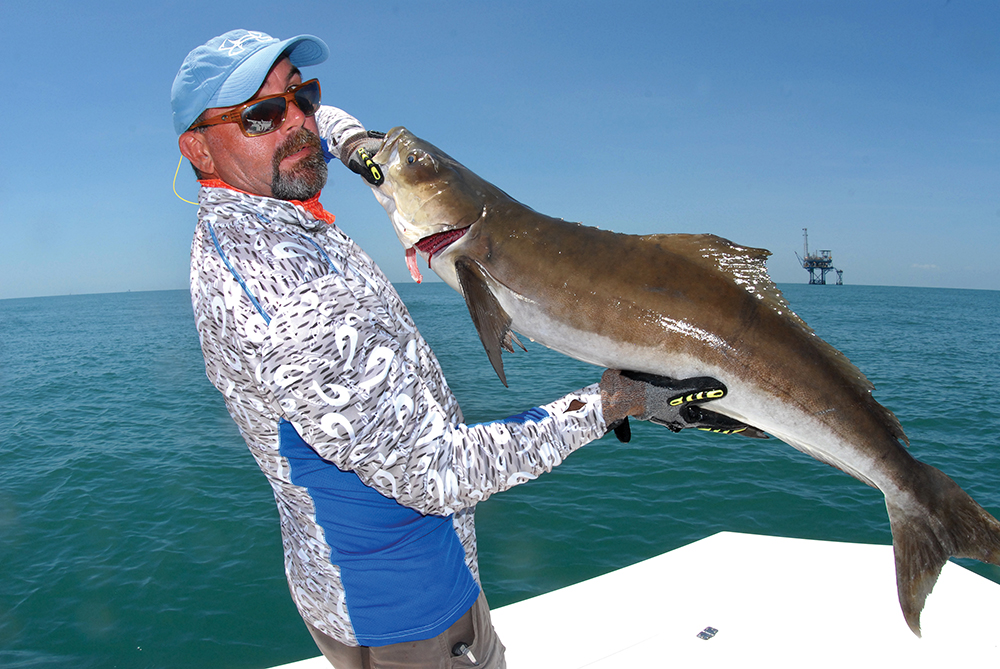
If you do catch a cobia or tripletail of legal size this summer be sure to watch for a black sonic tag in the body cavity and keep it and the accompanying, colored dart tag in a safe place. They are easy to lose, which I have done. If I catch another algae-covered tag, I will be sure to scribble the tag number on the nearest piece of paper or (as I have done in the past), with a lead weight on the dash of the boat. As I learned the hard way, a tag is too easy to lose in the laundry. I took a picture of the tag but that was no guarantee either; the tags are thin as spaghetti and difficult to focus the camera lens on, where the number can be later read. That fuzzy yellow tag in the picture, still attached to a cobia, came from Mississippi and was caught off Port O’Connor, but the tag’s number is unreadable.