


We Have the Meats: Sizing Up Texas Oyster Fisheries
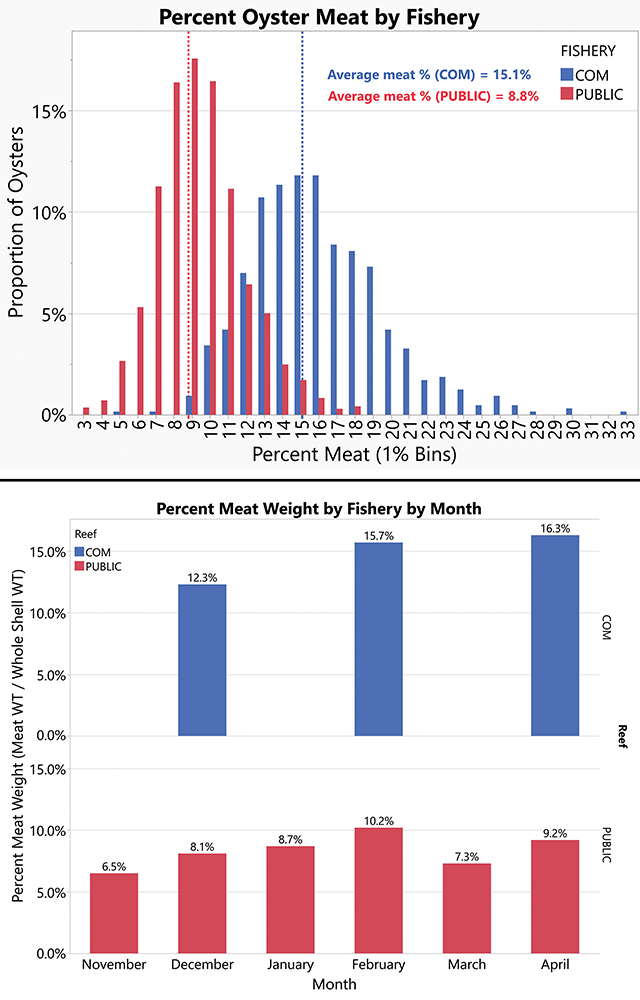
Figure 1. Distribution of oyster meat percentages (meat weight/whole shell weight) comparing oysters from Texas’ public reef (wild-caught) fisheries and Commercial Oyster Mariculture (COM) farms. The average meat percentage for COM oysters (15.1%) is significantly higher than for public reef oysters (8.8%), indicating a consistently higher yield of meat from COM-grown oysters.
Figure 2. Monthly comparison of oyster meat weight percentages (meat weight/whole shell weight) from Texas' public reef fishery and Commercial Oyster Mariculture (COM) farms. Public reef oysters exhibit noticeable seasonal fluctuations in meat weight, peaking in February at 10.2%.
When Texans think of oysters, thoughts typically drift towards grilled or fried delicacies, or perhaps a fresh, briny bite straight from the shell. Yet behind each succulent oyster lies a fascinating journey from bay to table, beginning with their sustainable management based on scientific research conducted by the Texas Parks and Wildlife Department (TPWD). Recent findings from the TPWD Trip Ticket (commercial fisheries landings) Program’s study on oyster meat weight provide valuable insights into the differences between Texas’ traditional wild-caught oyster fishery and the emerging Cultivated Oyster Mariculture (COM) or Oyster Farming industry.
Texas oysters are harvested primarily from public reefs scattered from Galveston Bay to Aransas Bay, contributing significantly to the local economy and culture. In Galveston Bay, there are also Certificates of Location (or CoLs), which are areas where oysters are privately maintained and exclusively harvested by the CoL holder, much like wild-caught public reef oysters. These wild oysters are typically shucked for their meat but some of the harvest is selected to supply to the half-shell market for raw consumption. In contrast, the relatively new COM program focuses specifically on cultivating oysters tailored for premium half-shell consumption. The oysters cultivated are the same species as the wild harvested oysters. These COM farms utilize off-bottom cage culture that can maximize growth and shape of oysters (the rotation and swaying of cages promotes a deep-cup shape). This divergence in production strategies leads to noticeable differences in oyster size, meat yield, and overall market positioning.
Aiming to better understand differences in oyster meat weight between farmed oysters and those harvested from public and private reefs, TPWD recently conducted a conversion factor study that examined 2,502 oysters collected from public reefs (n=1,679), private reefs under Certificates of Location (n=179), and cultivated off-bottom farms (n=644) along the Texas coast. These oysters were weighed whole, measured (length, width, depth), shucked, and their meat weight precisely measured. Results showed significant differences between oysters from different sources. Public reef oysters exhibited an average meat yield of about 8.8%, which is 8.8 pounds per 100-pound sack. For CoLs, a small sample size of 179 oysters from a single 97-lb sack resulted in 7.6 pounds of meat (or 7.8% meat yield). COM oysters, however, demonstrated considerably higher meat-to-whole shell ratios, averaging 15.1% per oyster! Half-shell markets prefer smaller oysters and the COM oysters sampled in this project averaged 3”, while the public reef and CoL oyster samples averaged 3.7”. The current legal minimum size limit for COM oysters is 2” and wild-caught oysters must be 3”. So, it is not surprising that an average wild-caught oyster had more total meat with an average of 12.3 g of meat, while the COM oyster only contained 8.7 g of meat, despite the having a higher proportion of meat. However, a 100-pound sack of COM oysters would yield more total meat than a 100-pound sack of wild-caught oysters.
Two important graphs from this study help to visualize these distinctions. The first (Figure 1) clearly illustrates the stark contrast in meat yield distribution, with COM oysters consistently providing higher and more predictable meat content compared to their wild counterparts. The second graph (Figure 2) highlights seasonal fluctuations, pinpointing February as the optimal month for harvesting wild oysters, achieving peak meat ratios of approximately 10.2%. Conversely, COM oyster yields remained remarkably consistent across months sampled, underscoring their reliability and market potential.
COM oysters currently contribute far less to Texas’ overall oyster production. In 2024, the Texas wild-caught oyster fishery harvested approximately 184,893 sacks of oysters from public reefs, equating to roughly 1,627,428 pounds of oyster meat from an estimated 48 million individual oysters (~260 oysters/sack). In contrast, COM farms produced about 1.4 million individual oysters in 2024, which is an estimated 26,716 pounds of meat. An important factor in the lower total harvest volume from COM operations is that the COM program is still relatively new with less area covered than the wild harvest of either public or private reefs, and its output is expected to grow as more farms begin production along the Texas coast. In 2025, the harvest from COM farms is projected to double as only seven farms were producing in 2024 and there are now 15 fully permitted farms. Another factor that will likely come into play in the future for total COM harvest volume is their specialized niche market rather than competing directly with wild caught oysters.
Indeed, the economics of the two fisheries differ notably. Wild-caught oysters (including private CoLs) remain essential for large-scale meat production, serving broader consumer markets. Conversely, the higher operational costs and specialized cultivation practices required for COM oysters make it economically impractical to compete in shucked oyster meat focused markets. Instead, COM operations capitalize on premium, high-value markets, particularly targeting restaurants and consumers seeking quality half-shell oysters and can be harvested year-round.
The private oyster reefs (CoLs) add another dynamic component to Texas’ oyster fisheries. These privately managed, on-bottom reefs in areas like Galveston Bay significantly supplement public reef harvests, especially during periods when public reefs face regulatory closures due to declining stocks. They also provide a reliable source of oysters outside the traditional season, as they can be harvested year-round. Over the past five years, CoLs have contributed roughly 20% of the wild-caught oyster harvest, occasionally reaching up to 36%, underscoring their strategic importance in maintaining the state's oyster supply.
In conclusion, TPWD’s detailed research provides critical data for understanding and optimizing Texas’ oyster fisheries. Wild-caught oysters continue to anchor the market, particularly for traditional shucked oyster meat products, while COM oysters offer consistent, high-quality half-shell options. Supported by sound resource management and the strategic use of private reefs, these complementary fisheries work together to sustain a robust, resilient, and economically viable oyster industry, helping safeguard Texas’ rich maritime heritage for generations to come.