


When a Survival Strategy Backfires
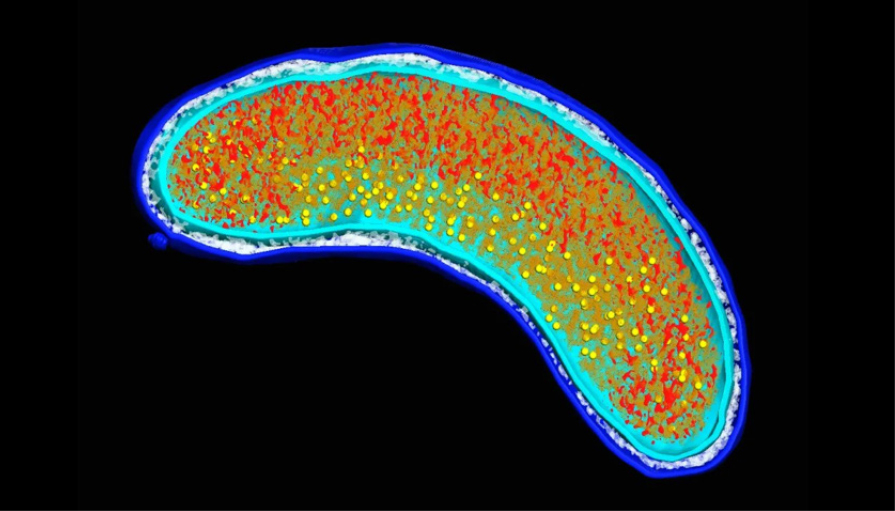
SAR11 bacteria, like this model of one, are among the
most abundant organisms in the oceans. Image courtesy
of Xiaowei Zhao and Nicastro Lab, UT Southwestern
It’s easy to take bacteria for granted when these single-celled creatures
are too small to see with the naked eye. Yet bacteria are the most
plentiful living organisms on earth and play a huge role in maintaining
ecosystems. The population of one group, called SAR11, in the world’s
oceans is estimated to be around 24,000,000,000,000,000,000,000,
000,000! (That’s 27 zeros.) SAR11 bacteria make up about 20% to 40% of
plankton cells in upper layers of the ocean.
Scientists have learned that the very characteristic that’s helped these bacteria survive so well also makes them extra sensitive to unexpected changes in the world’s oceans. So far, the secret to SAR11’s evolutionary success has been their ability to adapt to environments with very few nutrients. They do this by getting rid of genes they don’t need. This helps them conserve energy when food is scarce. When scientists recently looked at the genes of hundreds of these bacteria, they learned which genes tended to be lost. The missing genes were the ones that regulate the cell cycle and ensure that cell division and replication of DNA occurs normally. The strategy of losing those genes is effective if the surrounding environment remains fairly stable. But oceans have been in a state of ongoing flux in recent years due to effects of shifts in the global climate on ocean temperature and pH levels.
Under that stress, these bacteria are replicating DNA without dividing properly. They end up with extra chromosomes and then grow too big and die—even when nutrients become more abundant. That’s bad news for more than just SAR11. These bacteria are important in regulating marine food webs, so environmental instability affecting them could have far-reaching consequences for many other creatures. Learning more about this vulnerability can help scientists understand what to expect as conditions in the oceans change.
Scientists have learned that the very characteristic that’s helped these bacteria survive so well also makes them extra sensitive to unexpected changes in the world’s oceans. So far, the secret to SAR11’s evolutionary success has been their ability to adapt to environments with very few nutrients. They do this by getting rid of genes they don’t need. This helps them conserve energy when food is scarce. When scientists recently looked at the genes of hundreds of these bacteria, they learned which genes tended to be lost. The missing genes were the ones that regulate the cell cycle and ensure that cell division and replication of DNA occurs normally. The strategy of losing those genes is effective if the surrounding environment remains fairly stable. But oceans have been in a state of ongoing flux in recent years due to effects of shifts in the global climate on ocean temperature and pH levels.
Under that stress, these bacteria are replicating DNA without dividing properly. They end up with extra chromosomes and then grow too big and die—even when nutrients become more abundant. That’s bad news for more than just SAR11. These bacteria are important in regulating marine food webs, so environmental instability affecting them could have far-reaching consequences for many other creatures. Learning more about this vulnerability can help scientists understand what to expect as conditions in the oceans change.