


Why Crabs Scuttle Sideways
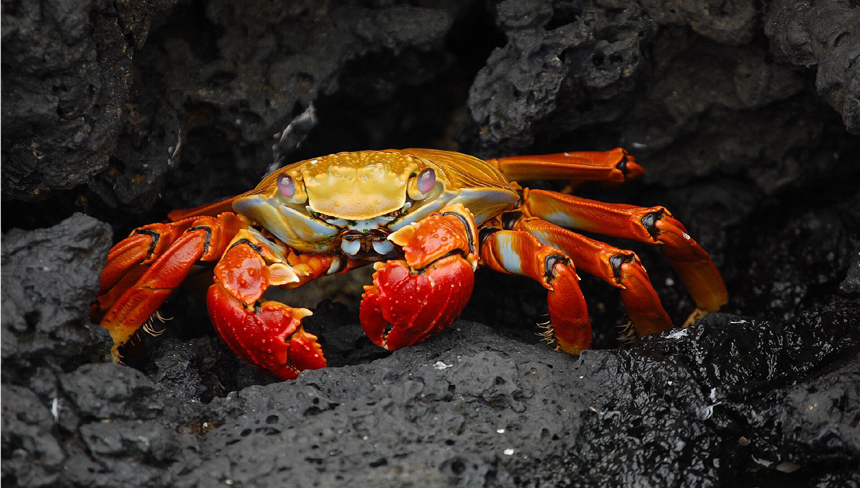
A crab’s sideways movement is an adaptation that evolved from a
common ancestor and helped crabs thrive in oceans around the
world. Credit: NOAA Photo Library.
Nearly all animals with legs move mostly forward and backward to get
around. But one marine creature tends to move a bit differently — crabs.
Among more than 7,900 species of true crabs, which are those with four
pairs of walking legs, a pair of claws and a tiny tail, the vast majority
move sideways. A few other animals may move sideways, but true crabs
are the only group where it’s the dominant form of locomotion. But what
is especially unique about this adaptation is that it evolved just once, in a
single ancestor about 200 million years ago.
To understand how remarkable that is, it helps to remember that evolution is random and disorganized, even as it’s responding to what helps a creature survive and reproduce in a particular environment. Mutations are always happening during reproduction. Most of these minor changes to genes have little effect, so they don’t alter a species’ evolution. Every so often, however, a mutation gives an organism an advantage over its peers. When that kind of mutation gives a creature a big enough survival or mating benefit, that individual and its descendants, who also have the same mutated gene, are more successful. Over generations, the mutated gene and the new trait it created gradually become a dominant feature of the species. As new species evolve from the species with the beneficial gene, they too carry the trait created by that gene.
Researchers from Japan watched how 50 species of true crabs move, and they combined their observations with existing data on the evolutionary relationships of true crabs from 344 species’ genes. They learned that the sideways locomotion evolved just one time during the early Jurassic period in an early ancestor of crabs. It likely gave crabs quite an edge in survival, letting them more quickly and easily escape predators during the Jurassic’s rapid expansion of marine habitats. Sometimes, it seems, one really happy accident is all it takes to change the course of a critter’s history and its gait.
To understand how remarkable that is, it helps to remember that evolution is random and disorganized, even as it’s responding to what helps a creature survive and reproduce in a particular environment. Mutations are always happening during reproduction. Most of these minor changes to genes have little effect, so they don’t alter a species’ evolution. Every so often, however, a mutation gives an organism an advantage over its peers. When that kind of mutation gives a creature a big enough survival or mating benefit, that individual and its descendants, who also have the same mutated gene, are more successful. Over generations, the mutated gene and the new trait it created gradually become a dominant feature of the species. As new species evolve from the species with the beneficial gene, they too carry the trait created by that gene.
Researchers from Japan watched how 50 species of true crabs move, and they combined their observations with existing data on the evolutionary relationships of true crabs from 344 species’ genes. They learned that the sideways locomotion evolved just one time during the early Jurassic period in an early ancestor of crabs. It likely gave crabs quite an edge in survival, letting them more quickly and easily escape predators during the Jurassic’s rapid expansion of marine habitats. Sometimes, it seems, one really happy accident is all it takes to change the course of a critter’s history and its gait.