
A Big Switch
People who participate in an activity for a long period of time often go through phases, as their methods and interests evolve. Preferences for specific tools and other objects related to the favored endeavor predictably change. I definitely work through phases in my life as an angler dedicated to fishing mostly on the beachfront.
One of the primary forces placing pressure on me to evolve is the environment of the surf itself. The Texas coast is home to some of the harshest environments one might encounter. In the area of the Padre Island National Seashore, numerous hazards to our vehicles exist. Copious amounts of salt in the air lead to devastating corrosion, and brutal driving conditions also take their toll on our vehicles.
As of June 2026, I've acquired my fourth vehicle (3rd purchased new) in the past fifteen years. With each change in vehicles, I've taken what I learned from the previous and applied it to the next. My last two were Toyota Tundras. Overall, I've been exceptionally pleased with these simple, reliable, and desirable tucks. The 5.7L iForce V8 motors are among the best on the planet.
All that being said, I'll surely miss them, because my new sled bears the logo of a different brand. I'm hopeful the Ford F150 will perform well enough to justify the switch. Many factors caused me to make this change, including some issues I have with the new Tundra's design. Some of the subtle changes have generated horror stories from the users of these vehicles.
I also wanted to give the F150 a try because it has an aluminum body. While the undercoating methods I used to apply protective material to my Tundras did work well, parts of the bodies of both those trucks did not fare well in the ultra-corrosive environment, over time. Within about five years, the beds practically rusted out, and the roofs had numerous rusty spots too.
Coastal corrosion is the ultimate menacing force for metal vehicles. I've learned it's not really possible to go too far in the effort to protect them, also that no matter what we do, it will never be enough. The best and only strategy is to remain vigilant, stay on top of things, and keep the vehicle as dry as possible, free from salt.
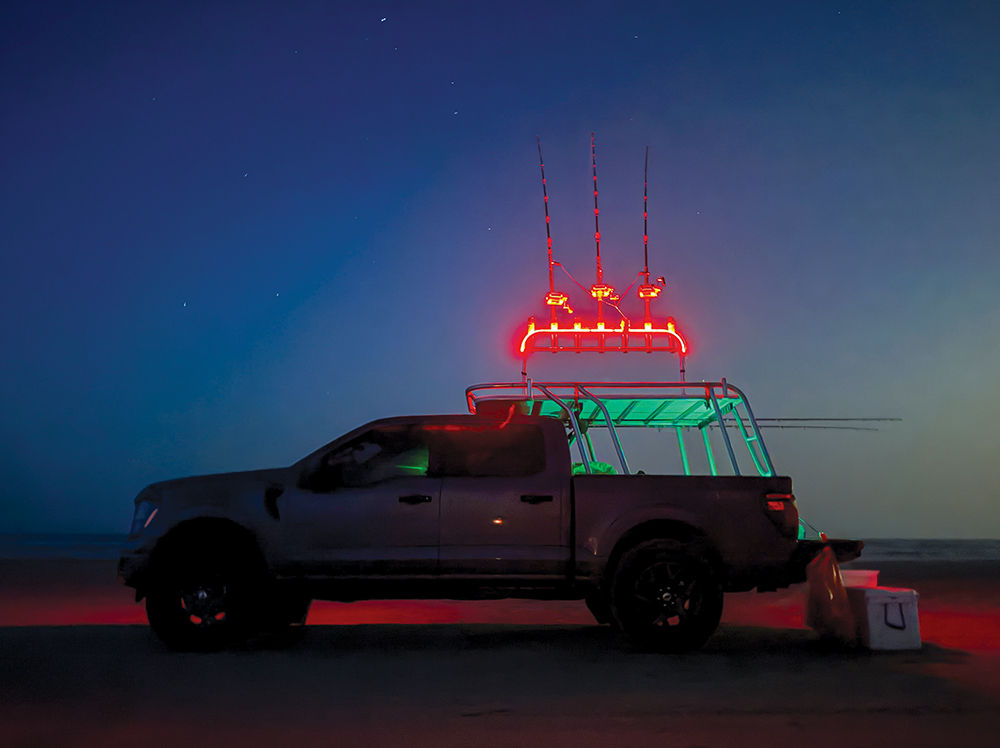
I had an entirely new shark rack designed for my new truck. As with my two previous custom shark platforms I designed, I had the incredible team at Blue Streak Fabrication build the new rack. Like the previous platforms, the frame on this one is made entirely of aluminum. It has a seven-rod holder setup on top as did the previous ones, with a minor tweak to the design. This time, I utilized Marine Grade Starboard material for decking. On my previous racks, I used plywood, which held up pretty well because I kept it coated in fresh paint, but I wanted to skip the whole painting and preserving process in favor of trying this textured material.
So far, I've been pleased with the starboard deck, and am also liking another minor innovation I added to this deck. I attached a 12 to 18-inch rubber reducer coupling to each rod holder. This prevents the large two-inch tubing from rubbing the spools on my largest reels.
In addition to the improvements I made to the rod holders, I've come up with a new method of undercoating the Ford. I used boiled linseed oil on the Tundra, and while it worked well, it didn't hold up as well as I'd like over time. With this new truck, I decided to go a more conventional route, and had a Ziebart undercoating applied. After the company finished their work, I went back with multiple spray cans and meticulously touched up areas that were light or missed. I let the undercoating dry for a couple days, then applied an additional layer of protection, in the form of a product called Surface Shield, by Blaster. This seemingly magic stuff offers a creeping coverage that spreads out and adheres to surfaces, staying on even after many washes.
I also applied high-heat paint to certain parts of the truck for additional protection, primarily areas around the exhaust such as brackets and other stainless-steel parts would potentially get hot. The main area where I applied the heat-resistant paint was on the driveshaft. Both my Toyotas were notorious for having severely rusted drive-shafts. In fact, I had to replace both shafts on my first Tundra, after the 4WD one actually broke in half. Anything used on a driveshaft for protection has to be light, clean, and evenly distributed to avoid disrupting balance. Time will tell how well this new paint holds up, but after a few trips, the coating still looks clean and new.
I decided to add more protection to another normally exposed area―the brakes. Of all the mechanical parts on a vehicle, the brakes suffer the most in a salty world. The entire system, from the rotors to the calipers, takes relentless abuse from the corrosive effects of salty air. This is exacerbated by the way we sharkers use our trucks, parking them right next to the water, where they're constantly blasted by salt-infused mists.
The water-facing wheels take a beating. To help mitigate these effects, I've started a new practice, something I've been wanting to do for a while. When I get down the beach to set up for the trip (usually 2 days), I take the time to spray some Salts Gone product on the caliper/rotor region. After I lightly spray, I cover the two water-facing tires. This completely blocks the salt air from blowing onto the brakes and other fragile components. Before I began using this procedure, on a typical overnight trip, a visible rusted dust layer appeared on the rotors. Now, when I remove the wheel covers, the brakes shine.
The beach can be a cruel and relentless mistress. Despite the love we share for surf fishing and everything associated with it, we pay a high price in the form of our weathered gear. This thing called corrosion is a beast; we should all come up with every creative idea we can to fight against its effects. We should also share our ideas with others, especially when a new plan works out well. We all know how much we rely on our trucks on these long, sometimes treacherous missions, so we should do everything we can to take good care of them. Acknowledging that, a tweak on a famous adage makes perfect sense to me―happy truck/happy life.