


Angling is a Game
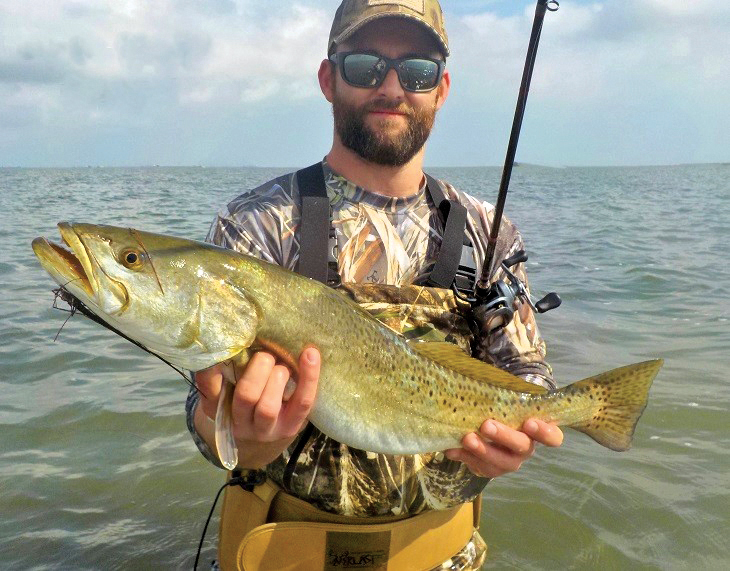
Justin Morris caught this nice trout in Baffin during a warm spell in November while fishing with the captain.
We often think of the terms sport and game as interchangeable. I often do, but I also acknowledge the differences between these two things. When defining a particular activity as either a game or a sport, I use a basic standard. If a woman can be the best in the world at an activity, it's a game. If a woman cannot be the best in the world, it's a sport. This works with almost all well-known activities within these two realms.
Track and field is clearly a sport, more accurately, a collection of sports. Because all its events require competitors to display ample strength and power, and because precise times and distances determine the winners, a man will be the best at each and every event. I don't make this statement to denigrate the performances of splendid female track athletes, some of whom I rightly admire.
Sydney McClaughlin-Magrone is simply amazing. The event she runs requires a combination of speed, strength, agility and stamina, and she dominates it like few other athletes in any sport. Much faster than any other woman who's ever laced up the spikes and cleared all the hurdles over 400 meters, she resembles a cheetah and stakes her claim as a female GOAT, but she can't complete the lap faster than the fastest man on the planet.
Similarly, female sprinters run faster than almost all the men in the world, but they can't keep up with the fastest man, nor can they threaten the lightning-fast historic times of Usain Bolt. The same can be said of female champion throwers, jumpers and pole-vaulters. They're great, for women, but they cannot outperform the best men in the world in these events.
This same truth applies in most of the other major sports played by both men and women, including soccer, basketball, volleyball, swimming, skiing, cycling and many more. Because all these activities involve so much athleticism, specifically strength, speed and power, men will always rise to the top in them. The reason is crystal clear; men are bigger and stronger, on average, also in the extremes.
If success in an activity relies heavily enough on physical prowess, it's a sport. If mental aspects play more important roles, it's probably not, at least according to the standard by which I define these things. This means billiards is a game. Though it requires acute hand-eye coordination, moving the balls around deftly requires little strength and power, so it's entirely possible a woman could become the best billiards player in the world. Perhaps she already has. I don't know; I'm not a billiards historian.
I do know modern statisticians have proven one thing about golf, an avocation I find harder than most to label as either a sport or a game. According to the number crunchers, the best putters on the LPGA Tour make a higher percentage of short putts than the best male PGA players. This doesn't surprise me at all. Putting closely resembles billiards. Good putters rely on hand-eye coordination, grace under pressure, confidence and feel. The activity requires minimal athleticism.
The same cannot be said for the other components comprising golf. The best male golfers drive the ball much farther than the best females, and their superior power also allows them to wrench the ball out of tall grass easier than the women. While an iconic female player like Annika Sörenstam could likely have survived and made a living playing the PGA Tour, maybe even winning an event or two over the course of her career, she had no way of becoming the best golfer in the world. So golf is a sport, not a game.
Putting, then, is a game embedded within the sport of golf. This confuses what at first seems like a simple concept. Furthermore, because golf requires so many different types of skills, it becomes more than just a sport containing a game. In some way, it's an art-form, built on a foundation of athleticism, enhanced by creativity, imagination and grace.
The same might be said about another famous activity, one bearing a broad label – gymnastics. Like track and field, gymnastics includes several different activities, and the lists of events differ for men and women. Surely, the men can do many things the women can't, but the opposite is also true. Completing an exercise on the rings requires impressive upper-body strength. Men do things on the apparatus that make them appear almost super-human. The best female gymnasts in the world can't begin to compete with them in this specific event.
Nor can the men tumble and flip on the balance beam like the women. Apparently, the best female gymnasts have better balance than their male counterparts; perhaps they have steadier nerves, as well. Few things in the world of sport require participants to show such bravery while performing. While the feats performed by the best gymnasts on the narrow beam clearly require ample athleticism, the performers look like hybrids while they tumble, part athlete, part artist.
In the form of dance, artistry plays a lead role in another of gymnastics' feature events. Debating whether men or women perform better floor routines is difficult, always bringing in biases and subjective beliefs. No man can do some of the things Simone Biles can do, nor can she do some of the things the top men can. Most observers would assert the women look more graceful and elegant doing their floor routines, and most would agree the men look more powerful in parts of theirs. Since all events in gymnastics require judges to assign numbers to performances, eliminating all subjectivity from the events is impossible.
I'd say gymnastics as a whole is something of a unicorn. Because some of the events place such emphasis on balance and graceful agility, women perform better than men, despite the fact the events do require plenty of athleticism. Each event comprising gymnastics is more a sport than a game, so some don't fit my basic definition of the term sport. These events also include plenty of artistic components, as does diving, another activity which stretches the validity of my method of defining these kinds of things.
In addition to athleticism, gymnasts, golfers and divers display grace under pressure, creativity and imagination. The same can be said about people who fish with serious purposes. Fishing resembles two of the aforementioned activities in a basic way. Like track and field or gymnastics, the thing we call fishing includes many distinctly different activities, requiring different types of skills, elevating different types of participants to the top. Certainly, catching panfish on flies requires different skills than winning a battle with a grander marlin from a fighting chair.
The various activities we lump together under the term fishing differ in many ways other than just the size of the fish targeted. For example, some are indisputably singular endeavors, while others require teams to achieve their stated goals. Teams target billfish; individuals target bass.
I refer here specifically to fishing with artificial lures. I'd argue fishing with natural baits, whether alive or dead, falls into the realm of leisure activities, and is not truly a sport. Surely, we can call that kind of fishing a game, since a woman could certainly rise to the top of the ranks of all who participate.
Assigning the title of angling to the act of fishing exclusively with artificial lures helps differentiate it from fishing, which includes any attempt to catch fish, using any kind of legal method. More like putting and billiards, less like sprinting and jumping, angling is a game, not a sport. This statement rings louder for some types of angling than for others.
The bigger the fish, the stouter the gear, the more strength a form of angling requires, the more likely it's a sport, not a game. Of course, consistently catching fish requires much more than just reeling them in and landing them after they're hooked. In all cases, anglers can only win fights against fish after they succeed in locating them and making them bite. Consistency in angling requires anglers to make productive decisions about where they fish, what they throw and how they present lures to the fish. Master anglers must develop a strong acumen specifically related to the species of fish they target.
On average, men show a higher propensity to develop this kind of acumen than women. Generally, boys spend more time playing in the woods, trying to tug crawdads out of the ditch, shooting at birds with BB guns and participating in other forms of interaction with creatures in the great outdoors. Because this is so, more boys reach adulthood with extensive knowledge and a set of accumulated experiences related to the natural world. This hedges the bet in favor of a man becoming the best in the world at a given type of angling.
But this general truth cannot prevent a specific woman, perhaps one who grew up surrounded by brothers or male friends, or one who naturally possesses every bit as much curiosity and interest in the great outdoors as any boy could, from becoming the best in the world at catching a bass, a rainbow trout or a bonefish. The more strategy, guile, finesse and artistry a form of angling requires, the more likely a female will become the best at it. Surely, all forms of angling which target fish of modest size and require minimal levels of athleticism fall into the category of types of angling which might allow a woman to evolve into a GOAT.