
Are We There Yet?
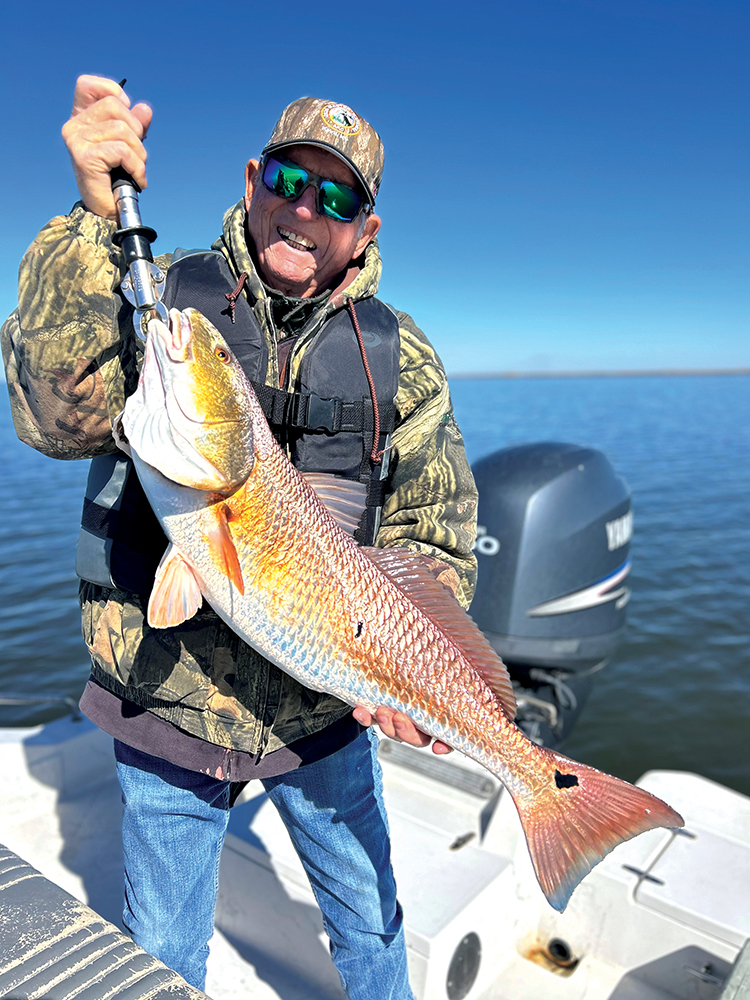
Dow Gene Anderson with another oversize Sabine Lake redfish.
There are very few sure things in life, but I would be willing to bet you something shiny that we have all heard that patience is a virtue or that good things come to those who wait. Another one I’ve always liked that might register with you is it’s a marathon, not a sprint. In today’s world of instant gratification, the thought of having to actually wait on anything seems to be a foreign concept—unless you are a kid waiting on Christmas morning. And even that’s a longshot in most cases, because parents usually give in and say, “Okay, you can open one.”
For Sabine Lake anglers, it has seemed like an eternity plus a week since conditions and fish were able to live up to expectations—but that has changed. Over the last year, many anglers, like anxious youngsters, have begun to wonder…are we there yet?
The downward spiral of Sabine Lake’s fisheries started back around 2016, with a major flooding event in March of that year. In 2017, Hurricane Harvey dumped another 60 inches of rain on the Sabine watershed, absolutely washing everything out to the Gulf—and beyond. Yes, those numbers are correct. And as if enough damage hadn’t already been done, other major flooding events followed in 2018, 2019, 2020, and 2021, magnifying the problems Sabine Lake faced while trying to rebound.
The floods were bad, no doubt, but the timing of when they occurred made things even worse. Almost all of the aforementioned floods happened during colder months when fish were concentrated in deeper water and much more vulnerable to weather events. As if the floods weren’t bad enough, you can sprinkle in a few freezes for good measure during the same time frame. Oh, and let’s not forget—during this same period Texas Parks and Wildlife thought it would be a great idea to reduce limits on speckled trout to match those of the Lower Coast, while neglecting to consider that Sabine shares a border with Louisiana. That shared border allows anglers to harvest much more liberal limits, increasing pressure on an already very fragile fishery that somehow always seems to receive stepchild treatment from the powers that be in Austin.
However, despite having so many factors stacked against it, Sabine has somehow begun to thrive, and all signs point to stable conditions for close to a year now.
If you have ever read any of my columns, you know I often reference runoff from both the Sabine and Neches rivers, along with lake levels for Toledo Bend and Sam Rayburn reservoirs. Now, by some miracle, for the last eight months both Toledo Bend and Sam Rayburn have been at or below normal pool levels and have been discharging water at very low rates, which translates into minimal—if any—significant runoff flowing into Sabine Lake.
With the reduced runoff, saltwater concentrations have been much higher than in years past, rejuvenating much of the ecosystem and stabilizing conditions. Without the threat of constant changes in salt content, clarity, and water levels, many fishermen were able to pattern fish for longer periods of time and experience greater overall success.
The fall and early winter bite was phenomenal for both speckled trout and redfish, as shrimp continued to pour from the marshes all the way into February.
The quality of keeper-sized fish was as good as we’ve seen in many years, and there are even a few trophy-class trout making an appearance. The hope is that this trend will continue and Sabine will do nothing but improve as the year goes on.
Hopefully, as you read this column, we have made it past the coldest weather of the year and have begun warming up to a more normal forecast. During this time of year, I personally get torn between options and techniques because we have so many variables affecting those decisions. Unlike other venues along the coast, we have a few more choices to make before heading out to fish. It would be nice from time to time if we could just do the same thing day after day—grab your wading gear and go—because that’s the only game in town.
Fortunately—or unfortunately, depending on how you look at it—we have to decide on things such as deep water versus shallow, or wade versus drift, among others. I am hopeful that we can really get on a good wading program this year because we are way overdue for that to happen. With conditions being favorable, the wade program may surprise a few people this spring, and I wouldn’t be shocked to see a few really good trout caught. I fully expect the redfish to keep doing their thing, as they show no sign of slowing down.
Looking ahead, I am anxious to try some new approaches this spring that proved successful during late fall and early winter. I have proclaimed my affinity for jerkbaits and crankbaits for both trout and redfish on several occasions, and that pattern will continue to be one of my go-to choices. I will also add some larger swimbaits to my arsenal this year, thanks to the great results I’ve had with the new Swag LT by Z-Man.
The Swag LT incorporates two different rigging methods with a unique system that allows the angler to fish either a single hook from the top of the bait or a treble hook from the belly. Once a fish is hooked with either setup, the lure is designed to separate itself from the hook and slide freely up the main line. This increases hookup ratios and makes the bait much easier to remove from the fish when landed—especially nice when oversized redfish get it down near the crushers.
The Swag LT is incredibly durable, like all Z-Man products, and has excellent action produced by its paddletail. I like the 5-inch version, which weighs 3/4 ounce, though there is also a 6-inch model weighing 1.25 ounces. I believe this bait will be a great choice for days when you want the option to cover water or slow down for reaction strikes. I’ve already had solid results with the Swag LT on open-water redfish, along with some trout, and believe it has excellent potential to earn a spot in my everyday rotation.
As we approach the warmer months, there will be plenty of optimism coming from Sabine Lake anglers—but be careful not to overlook seasonal boat prep and maintenance chores after winter storage. Take the time to go through everything and make sure your equipment is seaworthy. Nothing spoils a trip faster than getting to the ramp and finding the motor won’t start or the trolling motor malfunctions.
While the weather is still rough, take a couple of evenings to thoroughly check everything over, especially your safety gear. Late winter and early spring are famous for sudden winds and storms, so being safe and prepared should always be priority number one.
Take care and enjoy the upcoming spring fishing—and if you get a chance to bring a kid or someone new to the sport, please take that opportunity and share it with the next generation.