
August Addictions: Chasing Tarpon and Snook on the Lower Coast
There’s something about August on the lower Texas coast that pulls me toward two fish in particular – tarpon and snook. Maybe it’s the heat. Maybe it’s the still mornings and the aggressive tides. Or maybe it’s just the way both species seem to show up and move in all the right ways this time of year. Either way, once we hit mid-summer, my mindset shifts. Don’t get me wrong I love chasing redfish and trout like anyone else, but when these two begin to show up I can’t help myself to go looking for them.
This time of year, chasing tarpon and snook turns into a full-on mission to understand them better every day. And, the thing is, I don’t discriminate when it comes to how we target them. If I’ve got to throw live bait, I’ll do it. If they’ll eat a lure, even better. The goal is simple – Get tight on two of the most elusive, explosive, and addicting species we’ve got swimming in the Lower Laguna Madre.
When it comes to chasing tarpon, I spend most of my time working structure and the beachfront. Those rolling, silver-backed giants are usually on the move, and some days they’ll test your patience. But once you see that first one roll or eat a bait on the surface, everything else fades. The beachfront is a special place when it’s on. You’ll get mornings with hardly any chop, and you can actually see them cruising, rolling, free-jumping, or daisy chaining like ghosts, just under the surface. Other days, they’re laid up near structure or the jetties, pilings, or deep drop-offs where they wait to ambush bait.
Live mullet or piggy perch will always be a go-to, but I also keep a Waterloo rod ready, rigged with a KWiggler 4” Paddletail in Bart’s Sand Ninja or something very bright. Some of my best bites come when I least expect it, and having the right setup ready can make or break the moment. Hooking a tarpon is one thing; landing one is quite another story. They’ll go airborne, cartwheel, shake hooks, or dump your spool before you even know what happened. It’s pure chaos, but the best kind.
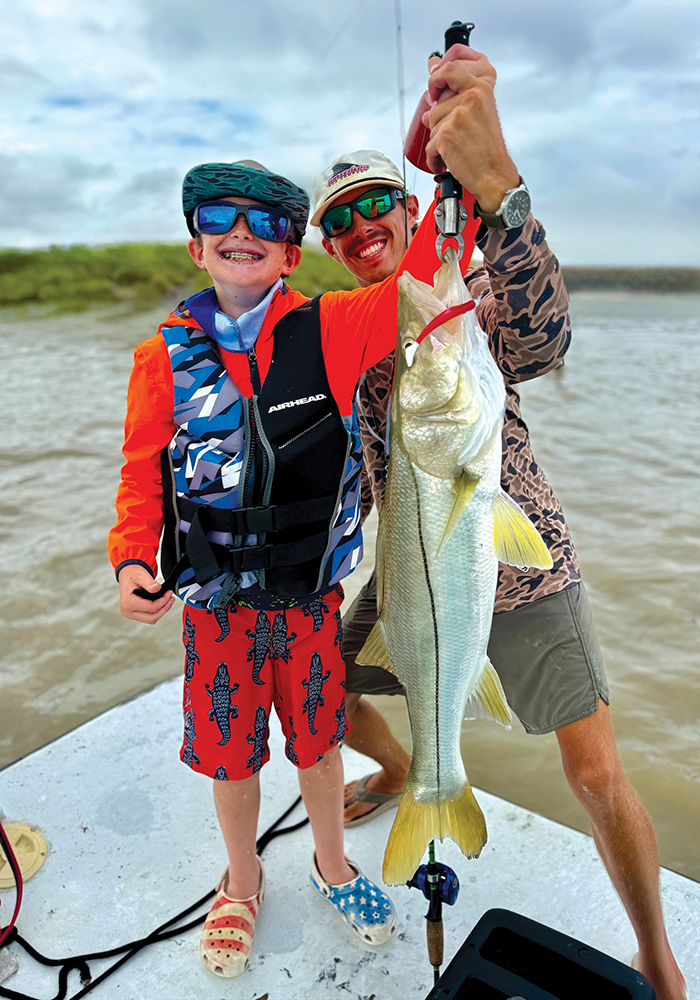
Now, snook, these guys are a completely different kind of hunt. Definitely more calculated. I’m usually targeting structure – bridge pilings, rocky seawalls, docks, piers, and jetties. If there’s good current and bait stacked up, chances are there’s a snook tucked in somewhere nearby. They’re ambush predators through and through, and they like to stay tight to cover. Sometimes the bites come fast. Other times, you’ve got to work every inch of a spot and get that lure or bait just right before they’ll take it.
Snook have a bad habit of making you work for it, but they’ll also absolutely wreck a bait in short order when they’re fired up. I like throwing paddletails and topwaters on structure, the Mansfield Knockers draw lots of strikes with their obnoxious rattles; but again, if the bite’s slow and the fish are there, I’ve got no shame in free-lining a live shrimp or mullet to get it done.
The cool thing about focusing on both of these species is how much it pushes me to be a better angler. You can’t just wing it with tarpon or snook. You’ve got to pay attention. Watch the tides, read the current, follow the bait, and make every cast count. They’re unforgiving fish. You can fish the right spot for hours and never get a sniff. Or you can show up at the right time and have a day you’ll never forget.
What I love most is that these fish teach you something every time. Whether it’s learning how to position the boat better, what lure retrieve cadence works, or simply when to move on – every trip chasing tarpon or snook adds a little more to the tool kit.
August might not be everyone’s favorite time to be on the water. It’s hot, it’s humid, and you’re likely going to really earn your bites. But for me, this is the stretch where the payoff is worth every drop of sweat. Whether I’m tucked in tight near some mangrove thicket working for redfish, working covered pilings, or drifting the edge of the surf zone looking for silver flashes, I know I’m right where I need to be.