


Big Shark Bliss
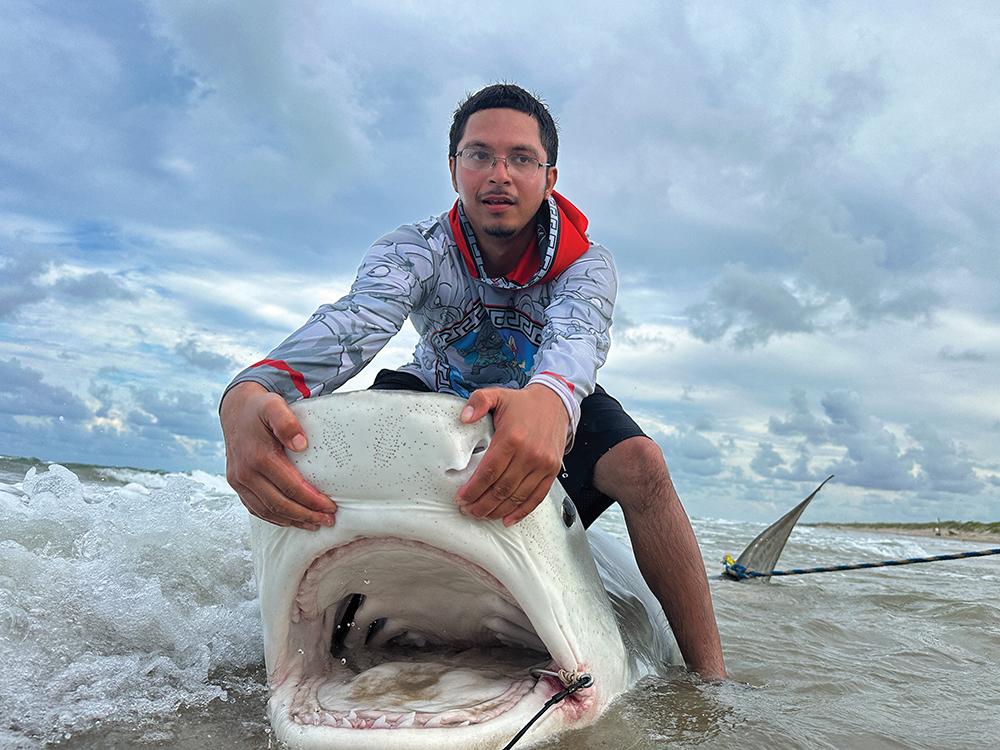
Valen Colunga with a recent tiger shark landing.
Along the Coastal Bend of Texas, where the sea meets the sand, the scorching doldrums of summer can be tough on the human soul. The salt-infused heat takes a toll physically, while the beach sand burns the feet. The extremity of the sun's radiation also beats us down mentally. Despite all these superficially dire facts, hordes of anglers head to the surf this time of year to take their chances at big fish in the warm, often clear, ocean water.
When summer settles in and the surf runs calm, our nearshore waters look much like those in the Caribbean Sea, and speckled trout roam around in the beachfront guts, feeding on a variety of prey species. These thick, brawny trout seem bulked up from the struggles they face in the open ocean, heftier than their cousins we find in our bays and backwaters. Tarpon and mackerel also cruise the inshore waters during summer, within reach of coastal anglers, but for the most hardcore folks who head to the beaches with rods and reels this time of year, catching trophy sharks is the ultimate goal.
The beauty of this unique season is not found in quantity, variety, or the amount of action. Instead, summer beach fishing for many people is all about SIZE. June, July, and August typically produce our biggest fish of the year. The Big 3 species typically present in the surf during summer are the tigers, great hammerheads, and bull sharks. Both dusky and lemon sharks measuring more than ten feet have been caught from the beaches of the Lone Star State during this time-frame as well. Dusky sharks are rare, and the only time we encounter them in the Texas surf is during offshore upwellings, which send cooler water than normal toward our beachfronts. While huge dusky sharks provide thrills to those lucky enough to catch them, in many years we have had no shot at them at all.
Of course, many factors affect our chances of beaching big sharks. Spring weather, with its almost constant barrage of strong winds, certainly does. The big blows generate strong currents close to shore, which large sharks typically avoid, riding out the tumultuous time far offshore, in water of much greater depths. Meanwhile, the strong currents reshape our sandbars, sometimes exposing buried shells. As a result, sandbars are sometimes hazardous early in the summer.
Unfortunately, many of us experience cut-offs when running our big baits out for sharks over the crusty bars. The sharp, exposed edges of newly exposed shells sometimes cut lines. If they aren't immediately severed, lines can be damaged by the shells, then break during fights with fish. As summer rolls on and gentle waves reset the bars, green water returns and begins covering most of the worst stuff again, and our gear is less often damaged.
Green to clear water plays a vital role in increasing our chances for encountering either of the king duo of sharks in our surf, the tigers and hammers. These sharks don't often venture into muddy or even lightly-churned water as the bull sharks are apt to do. When the winds of summer predictably settle to a whisper, a noticeable increase in action with big sharks typically occurs. Big sharks just love clear, shallow water. Both hammers and tigers have large eyes, and they use them actively to feed during daylight hours.
Hammers love chasing down large fish like jacks and drum, even tarpon. Tigers aren't built for speed, so they rely on ambush tactics when taking their prey. And they'll eat most anything big that gets close enough to justify an attack. These sharks have been known to eat turtles, birds, even other sharks. At times, both hammers and tigers will also come up to investigate humans on kayaks. Typically, these inquisitive encounters pose no threats to us, but all anglers aboard kayaks should be aware these impressive predators generally move closer for a better look when they see us.
Tigers, hammers and bulls all have huge appetites. They're present in the summer surf-zone because of the abundance of potential prey. While schools of jackfish, tarpon, drum and sheepshead are all alluring to these sharks, stingrays that inhabit the nearshore waters tend to attract the largest of the monsters. During June, both the southern and roughtail stingrays move into the shallows fronting our beaches; most of the giant females, reaching up to 200 pounds, arrive heavily pregnant.
They move shallow to feed on crustaceans or scavenge small, dead fish. They'll linger and feed in the surf zone until they give birth to a litter of pups. For the sharks, this provides a bountiful buffet. During this time, the big tigers and hammers often feed on the mature rays exclusively at night, when the water is clear, while darkness provides them some cover and enhances the stealth of their attacks. Once these giants succeed in locating a big ray, they often dispatch it by taking multiple big bites, until their appetite becomes temporarily satisfied.
Bull sharks nearing the nine-foot mark usually have massive girth, and are a welcome, though sometimes random catch. The hammerheads present perhaps the greatest angling challenge on earth, but they're fragile, difficult to revive and release after epic battles. Consequently, I almost exclusively target the giant tigers. In terms of weight, tigers are the largest sharks we have, and to battle one to the beach and visually appreciate the creature at close range represents the very essence of sharking adventures.
During the peak of big shark season I'm most often kayaking out really large baits, like whole rays weighing up to 20 pounds, just before dark. In the past, we generally would thread multiple large J-hooks into our baits, but these days, laws restrict us to using only circle hooks. With circle hooks, I run one single 24/0 hook, held in the end of the bait, in the hopes a big shark will engulf the entire offering. I usually deploy a spread of two to four big baits, somewhere between four hundred and six hundred yards from the sand. Many times, just one bait gets picked up, but I've also experienced dreamy, hot August nights on which sharks take all the baits I run.
For decades now, Texas sharkers have focused their efforts primarily on the hottest season when targeting the biggest sharks. As with all kinds of fishing, success depends heavily on the qualities of the conditions. As long as the warm surf waters run relatively calm, with good visibility, chances run high that a few beastly critters are around. Both strong moons enhance anglers chances for encountering big fish. The summer full moons are called tiger moons for a reason, and the dark nights of the new moon also have high potential. Approaching tropical events seem to improve the bite too.
So far this summer we've been tackling plenty of slob hammerheads. As we get into August I expect to encounter mainly large tigers. It's all more than exciting. When I'm awakened late at night in the surf by an 800-pound tiger shark, I realize my way of life is truly an obsession.