
Breaking Down the Badlands
While working on my latest fishing book, Active Tracks—a collection of stories and reflections from a lifetime on the water—I realized something I hadn’t fully appreciated until assembling it all on paper. Much of the action in those narratives unfolds in a legendary stretch of Baffin Bay. The area occupies a permanent place in the mental apartments where I store my most cherished memories.
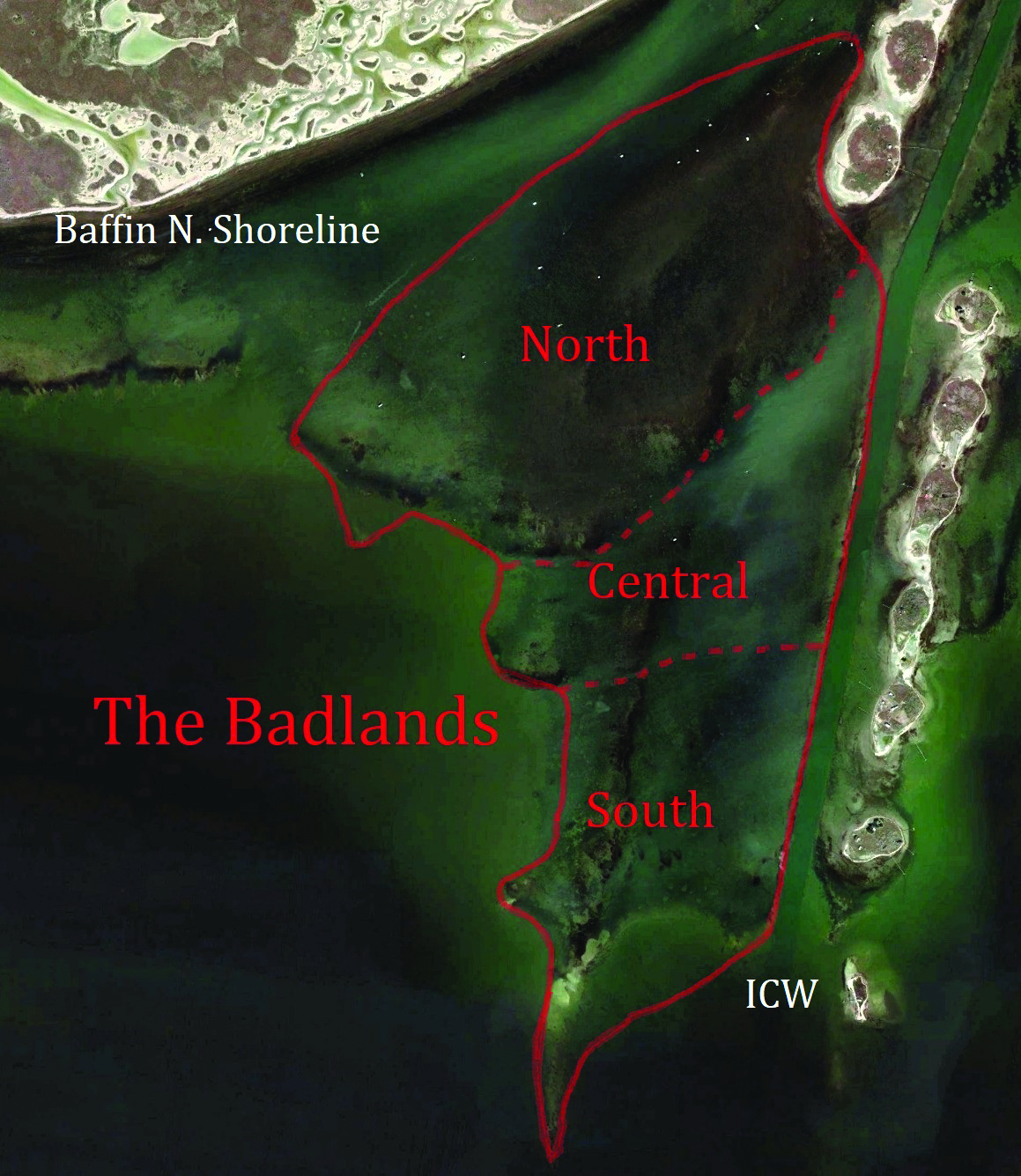
Situated west of the Intracoastal Waterway between the Point of Rocks and Penascal Point, the Badlands is perfectly positioned to produce truly exceptional trout. It checks all the boxes I use to define a high-potential fishery—consistent productivity, year-round opportunity, and resilience to changing weather. It sits near a main-bay point and lies at the junction of two of the most celebrated trophy-trout regions on the Texas coast.
Part of what makes the Badlands so productive is its diversity. The area varies dramatically in depth, with shallow structures lying close to deeper water. Four distinct bottom types—mud, sand, grass, and serpulid rock—create a habitat rich in bait, protection, and ambush opportunity. This mixture produces consistency, even under shifting conditions.
Roughly three miles long and more than a mile wide at its widest point, the Badlands is very much an area, not a spot. Its mix of grass beds, serpulid rocks, and shallow flats provides ideal habitat for growing large trout. The small prey species thriving among the grass and rocks draw in larger fish—exactly the kind mature speckled trout prefer. The result is a place where anglers can legitimately expect to encounter giants.
But the same rocks and structure that nurture big trout also create serious hazards. Many dangerous obstructions lie unmarked beneath the surface. Even the deeper portions can fool boaters into believing they are traveling safely. No map system accurately displays every rock in the Badlands, and several uncharted boulders sit squarely in areas anglers commonly traverse. Anyone fishing this area should do so with extreme caution, and only after supplementing their GPS with detailed, reliable tracks.
The Badlands breaks naturally into three major sections, each with its own characteristics.
To the north lies the Point of Rocks Meadow—a wide flat that many people run across far too casually. Despite its appearance, unmarked obstructions here can wreak havoc, especially when a boat is trying to climb onto plane or settle off it.
South of the Meadow sits the Badlands Crown, a muddy, grassy, rock-strewn hump with significant navigation hazards. Shallow, soft-bottomed water dominates its eastern stretches, while the western section is firmer and slightly deeper. It’s a classic refuge for big trout—protected, complex, and difficult for all but the most determined anglers to fish correctly.
Moving farther south, the Central Badlands presents even more challenges: grassy humps, deep holes littered with unseen rocks, and the famed area near the floating cabin known to many as Hell’s Half Acre. This portion includes gut systems and transitions that funnel fish between shallow and deep water—a dynamic that explains why so many trophy trout have been caught here.
At the southern edge of the region, four PVC pipes mark a safe path across the Spine of the Badlands—a narrow ridge leading into deeper, mixed-bottom water. Farther south, the Badlands becomes a tight sand bar armored with large serpulid rocks and bordered by deep water on both sides.
These serpulid formations differ from rocks found elsewhere, such as those in Rocky Slough near the Land Cut. Scientists tell us the Badlands rocks are the fossilized remains of extinct marine worm colonies. Whatever their origin, they pose serious risks—risks that every angler navigating Baffin or the Upper Laguna Madre must respect.
The purpose of this introduction—and the three features that will follow—is not to teach people how to safely traverse the Badlands. Rather, it is to define the area, outline its major sections, explore the patterns that make them productive, and document the enormous influence this place has had on my fishing career. I’ve logged countless days here, and many of my best catches came from these rocks, grass beds, and mud flats.
Nearly half of all 30-inch trout caught by my clients, friends, and me have come from the Badlands. Five of the top ten trout of my life were caught somewhere within its boundaries. My longest trout to date came from this area, and several other well-known anglers landed their personal bests here too—some their heaviest, some their longest, and a few both.
When I think back, I can still feel the mix of anticipation and fear from my first ventures into the Badlands. I remember pre-fishing for the first Troutmasters tournament held in this bay, riding with my buddies Hector and Jesse as we eased toward Hell’s Half Acre with no GPS, just two landmarks lined up in the distance. The rocks lurking on both sides were easily visible through the clear water, and the danger only amplified the magic. This was my introduction to Baffin Bay—the place most anglers dream of when they dream about giant trout.
Though time and experience eventually allowed me to navigate the area with more confidence, I’ve never lost my respect for its hazards…nor the awe I felt on those early trips. A friend once told me, “A man could make a career out of learning every detail of this place. Someone ought to become the guru of the Badlands.” He wasn’t wrong. This place is vast, diverse, and endlessly fascinating.
I didn’t devote my entire career to mastering only this single area, but I’ve spent enough days here—left enough footprints in the mud, cast to enough potholes, and fought enough big trout—to say the Badlands has shaped my life as an angler more than most places ever could.
It remains one of the most storied and mystifying locales in all of Texas, a place where every cast carries the possibility of meeting the trout of a lifetime.