
Critical Mass
Absolute Number One governs the efforts of anglers with unwavering certainty. In order to catch fish, one must find fish. It would be easier to grab a wet sponge and safely bathe a Bengal tiger or to land a paper airplane on the surface of the sun than to catch a fish in a place where no fish swims. Absolutes establish simple, foundational clarity, but making consistently productive decisions about angling efforts requires reliance on more complex principles.
Ideally, anglers fish in places holding plenty of fish. In the context I've invented here, which focuses specifically on coastal anglers fishing with artificial lures, I use the term Critical Mass (CM) in a specific and limited way. For the purposes of this discussion, Critical Mass represents the amount of fish present in a place necessary to justify a sustained effort. In the previous statement, the term amount has two significant and separate meanings. The amount of fish does mean the raw number of fish, but in a more complex way, the term amount represents the number of targeted fish as a percentage of the total number of fish present.
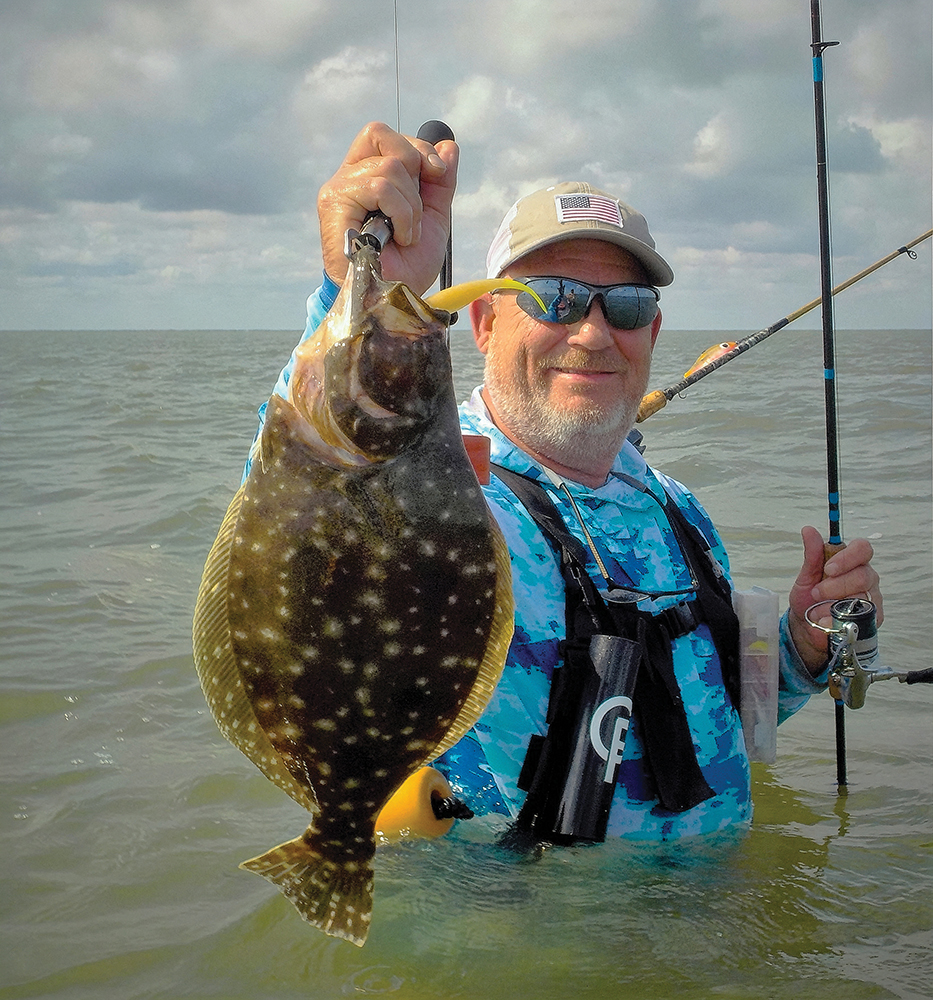
The term fish also has multiple meanings in this context. In the graphic I've included with this piece, I've used the character ƒ to represent the targeted, or desired fish, and a capital F to represent fish, generally. Significantly, I only consider species which might be caught by an angler trying to catch the targeted fish (ƒ) when thinking of fish in general (F).
Anglers' priorities affect the values of Critical Mass. One angler fishing for one trophy fish creates a context for CM which differs from a group of anglers targeting limits of fish. More anglers desiring to catch and/or keep more fish increases not only the value of CM, but also the need for larger areas, where more anglers can cast at spots holding desired fish. The nature of the area, especially whether it's likely to facilitate new fish replacing caught fish, influences the original value of CM, which evolves over time. Certainly, targeting fish roaming around the rocks of a jetty differs significantly from targeting them in a tiny corner of a back-lake, and those differences affect CM.
The specific numeric value(s) of Critical Mass prove difficult or impossible to determine. Obviously, an angler can't catch a speckled trout measuring at least thirty inches in length unless at least one swims within reach. Likewise, four anglers attempting to catch limits of redfish need at least twelve reds measuring at least twenty inches but not more than twenty-eight inches within their reach. However, percentages favor people who fish in places holding more than the minimal number of the right fish. Most likely, the raw number of the right fish must be at least three or four times the minimal amount to justify a sustained effort in a place, and those fish probably must represent at least 33% of the fish (F) present in the place.
Some species of fish significantly affect the value of CM, while others don't. The snapping jaws of hordes of dink trout and/or ladyfish can make catching big trout nearly impossible. On the other hand, sheepshead and black drum don't readily strike conventional lures, so anglers fishing for trout, reds and flounder in places holding large schools of those species can largely ignore them. Trophy trout anglers can't ignore a bunch of reds swimming around in the spot where they hope to land a monster trout. In many cases, the reds show much more willingness to strike lures than big old trout, and they take time to land after they're hooked, so they can pose real problems for folks hoping to catch the trout of a lifetime in places where decent numbers of them swim among a larger number of the bronze bullies.
Unless we can see the fish, we must use our experiences and our ability to earn strikes in a timely manner to make educated guesses about whether the CM is present in a place. Doing this successfully means calculating the expected bite-rate appropriately, considering the timing of the outing and the conditions in play, as well as making smart choices with regard to lure choice and presentation style. Guides and competitive anglers who hope to survive and thrive must become proficient at all these things over time. When I look back on my career to this point, I realize I made many predictions related to CM, though I didn't think of those decisions in the terms stated here. Three poignant anecdotes clearly illustrate what I mean.
On the last day of September 2001, four partners and I caught a bunch of trout weighing at least four pounds, the biggest nearly seven, in a Rockport Troutmasters event. We made this catch on a day when most of our competitors brought light sacks to the scales, either barely able to get three fish big enough to qualify, or failing to do so. Importantly, we caught our fish in a tiny corner of a cove, and we hooked and lost several others while doing so. I knew this would cause trouble for us on the second day of the event.
I told the others, "We just caught over a dozen big trout in this little pocket, and we sore-mouthed at least ten more. I don't see how we have enough fish left for tomorrow." We all needed three more fish on day two, a total of fifteen trout. "If we aren't catching the right fish in numbers by 11 o'clock, I'm bailing out of here to go find three keepers to weigh." When the hour arrived, the five of us had managed to catch just a single four-pound trout between us, landing no smaller trout, no reds, no other fish at all. We did leave the place, all agreeing we'd arrive at the scales wearing the smell of skunk if we didn't.
It's possible a CM of big trout still swam around close in front of us on day two, since those kinds of fish can become tough to catch for a while after they feed vigorously one day, as they did for us on the first day of the event. I doubt it, though. Seems much more likely we reduced the number of fish too much on day one, and the nature of the spot didn't readily facilitate it filling up with new fish overnight. Sometimes, in other types of places, new fish arriving in a place can alter CM negatively, as it did for me at the end of a really productive run catching big trout in 2008.
I'd been fishing at Summer House nearly every day for about a month, at first catching a fairly modest number of trout, but with a healthy percentage of the fish weighing over five pounds, up to nearly eight. On the memorable day, things changed, when I and four clients landed at least 120 trout by lunch time, but the biggest stretched the tape to just 23 inches. "We got to move," I said. "We have too many smaller trout in here now. Even if we still have some of the big ones, the others are beating them to our lures."
We moved and proceeded to catch 15 trout over 25 inches, with the biggest measuring close to 29. In the new location, one with an obvious CM present, we caught no smaller trout at all. In this case, my focus on the priorities of my customers drove me to leave fish to find fish. I knew they wanted to catch a trophy trout, and I strongly believed we would fail to catch big ones if we stayed in a spot holding so many smaller trout. Obviously, a guide with the goal of returning to the dock with limits of trout would have already gone in before I chose to leave so many solid trout biting, in search of bigger ones. This scenario differs significantly from another one in which I successfully made a calculation related to CM.
In 2010, in the midst of the best run of big trout fishing I ever experienced, I and my clients had caught at least one trout weighing at least nine pounds four trips in a row when I stuck the Power Pole in the mud in the North Badlands to begin a new day. "I hope y'all like the scenery here," I told the two guys in my boat. "If we get one bite within the first two hours, we'll be here all day. This spot has been producing monsters for us, but it's getting tougher to catch 'em as the water warms up."
The streak had started in the place after water temperatures bottomed out at 50°F. At first, we caught plenty of trout, including several over seven pounds, with the really big ones serving as icing on the cake. Over the coming days, as the water warmed, we caught fewer and fewer fish, but we still managed to bring at least one giant to hand. On this, the final day of the streak, I caught a four-pound trout about 45 minutes after we stepped into the shallows, and I stayed true to what I had told the guys at the start. Four hours later, I coaxed a fish to strike my Fat Boy with deadly intent; she nearly yanked the rod out of my hand. Right at thirty inches in length, the fat sow trout weighed a shade over ten pounds. Two hours later, one of my clients caught the biggest trout of his life, reinforcing my belief in the decision I'd made.
On that occasion, fishing on an expansive flat with few fish present, we did manage to prove we still had a Critical Mass within our reach. I didn't choose to stand and grind that day thinking of the terms I've used in this piece. But I did base my choice on our priorities and on my perception of how the nature of the place and the evolving conditions exerted influence on how many of the right fish we'd likely encounter if we stayed. The next day, I didn't fish the spot for long, because I believed the number of big trout present in the place had fallen to a point where we'd crash and burn if we stood on it all day.
Anyone interested in establishing a consistent level of productivity must make accurate predictions with regard to the likelihood of CM being present in the places they choose to fish. They must always keep their priorities at top of mind. In places with clear water, where anglers can see the fish they target, these predictions become simplified. But in other places, where anglers can't see fish, they must adeptly apply their skill sets, to assess whether a Critical Mass of the right fish swims within their reach.