
Lessons Gleaned (Part 3)
For some anglers, deciding where to fish is a more reactive than predictive process. Fishing regularly in an area elevates the level of influence recent results exert on the choice. This truth becomes magnified after a recent effort produces especially satisfying results. As mentioned in Part 2 of this series, guides and avid anglers often start a day fishing in the place where they experienced the best catching on the previous outing.
Starting off in a spot which produced a rich recent result really makes sense with stable weather and other environmental conditions in play. Significant changes in weather, tide cycles and similar factors can complicate things, as can the passage of time. The value of relying on recent results to determine where to make a new effort decreases as the time between efforts increases. Within a given day, recent results exert profound influence at the micro level, on a cast-to-cast basis.
Essentially, an elementary fact prevails, especially for anglers who choose to fish by wading―the best place to make the next cast is the last place which produced a bite from the right kind of fish. Digging into the details related to an event I fished in August of 2001 helps reveal more subtle aspects related to this basic mantra. During the event, I chose to start the first day fishing a reef lying right next to the bank near Sand Point, on the north shoreline of West Matagorda Bay.
A person didn't need to rely on sophisticated angling acumen when deciding where to cast in this location back in those days. Standing just offshore of the tiny reef, which stretched no more than thirty yards down the bank and extended just forty or fifty feet out from the shoreline sand, one could easily probe every inch of the feature. Central portions of the reef jutted out slightly, creating a subtle point, visible under the water, with decent clarity prevailing.
I approached the reef slowly and as quietly as I could that Saturday morning, hoping not to spook any fish which might be feeding around it. Within minutes, I noticed something significant. I watched intently as mullet, many of them at least a foot long, swam west to east in the water fronting the shell bank, then suddenly changed their course and leapt free of the brine, jumping away from the subtle point. After this happened five times, I came to an inspiring conclusion; some kind of predator lay on the east side of the point, waiting to ambush its prey.
Once I realized this, I shuffled a bit to my right, so I could cast my Super Spook and make it land near the western end of the shell bank and bring it toward the point. I executed a presentation with some starting and stopping, pausing the lure right near the perceived sweet spot at least twice before reeling it in and starting over again. On the third cast, a whopper trout blew up on the plug while it rested within inches of where the oysters formed a point.
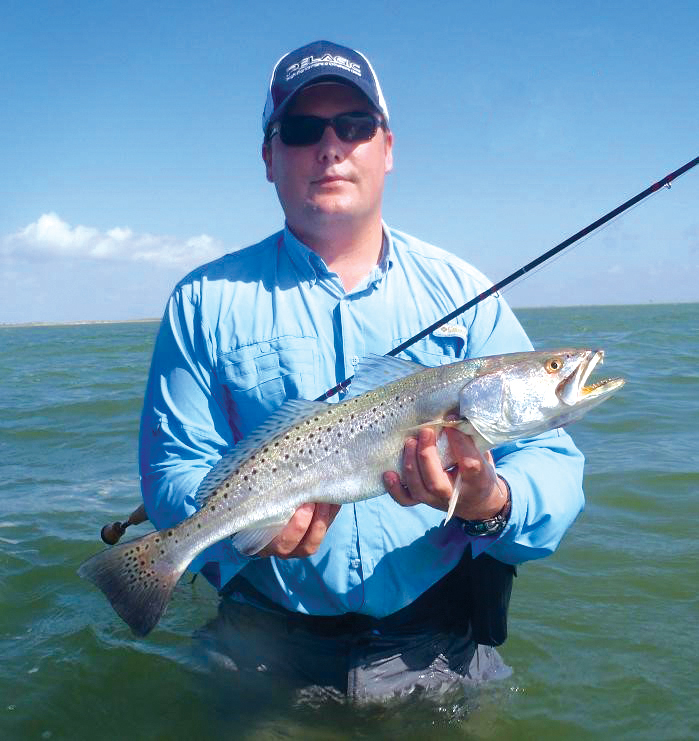
In those days, no one fished with braided line, and I knew I'd be lucky to land the fish as soon as I hooked her and we began our fight in the shallows, where numerous live oyster spikes jutted out of the sand, extending up close to the water's surface. Luck smiled on me though, and I did manage to put my hands around the broad shoulders of a trout which later earned me a check; she weighed more than all but one of the others brought to the scales in the event, falling just an ounce or so shy of the winner.
I walked up on land to handle and string my prize, and once I had her secured, I let out a wail of delight likely heard by dudes working the docks in Port Lavaca. In an August tournament, few trout measuring 28 inches and weighing 7 pounds come to the scales, and this fish looked like a winner. Fortunately, as soon as I regained my game face, I experienced an important epiphany. I knew a trout similar to the one tied to my hip might replace her at the point on the reef.
Champing at the bit, licking my chops like a hungry gator, I slid back into the water and set up to continue casting my lure past the point and working it back into the precise location where I earned the first strike. Nothing happened on the first pass, nor the second, or third...in fact, I made nine empty retrieves into the Promised Land before the second fish blew up on my Spook with the same seemingly deadly vengeance as had her twin. The second monster fought with more intensity and unpredictability than the first, and after about a minute, broke my twelve-pound monofilament main-line on one of the oyster spikes.
I then watched with disgust as she swam right by my feet, carrying my Woody Spook atop her head like some kind of cruel crown. Certainly, she had every bit of the length and weight of the fish I managed to land. For me, these events illuminate several significant truths, ones which drive my operating principles to this day.
Most importantly, I always attempt to find some kind of reason to precisely direct every cast, all day, every day. If signs of life don't dictate something obvious, I rely on my knowledge of the lay of the land, choosing to cast at proven sweet spots within reach. But I would always prefer to cast at some significant sign, like the mullet adjusting their paths over and over again that summer morning on Sand Point.
And, I will always choose to cast back at any spot where I earn the right kind of strike, or catch the right kind of fish, not just once, but at least several times, maybe a dozen or more, depending on the situation. A single empty cast and retrieve can't prove a fish isn't in the place. In some cases, making fish strike requires a persistent, creative effort. So, before I abandon the strategy of casting repeatedly back into the site of a memorable bite, I will adjust presentation, maybe even change my lure, before moving on to look for another likely place to send my plug on a mission.
This strategy has worked for me countless times, including on the day I hooked the biggest trout I've ever seen and on the day I best separated myself from the crowd in a legitimate competition. I recalled some of the events of the 2001 September Rockport Troutmasters event in the last feature. My first-day stringer bettered those of all the other contestants by at least four pounds, if you throw out the guys who fished with me.
Those details remain relevant here for one primary reason. All five of us caught all our fish that day in a circle measuring no more than twenty yards in diameter. In the back corner of a tiny cove, we coaxed about two dozen big trout to bite, likely ruining our chances for success in the place on day two of the event. Significantly, we had chosen to focus our efforts in the tight space for a supremely important reason.
The afternoon before, one of my partners caught a 31-inch, 9.5 pound trout in the location. We had struggled elsewhere, catching only small trout when we did manage to earn a strike. As I admired his trophy and took pictures of him holding it on the deck of the boat, I remember saying, "Well, now we know where we're starting off tomorrow morning." We recognized the significance of catching a trout of such dimensions less than twenty-four hours before the beginning of a tournament, and rightly made the choice to return the next morning to cast in the exact location where she took a bite.
Many times, casting immediately back at the site where one big trout bites produces a second strike, if not on the first cast or two, within a manageable amount of time. But spots have different qualities which affect this truth. Some sites have the capacity to hold plenty of fish, while others do not. Some sites will likely fill up with new fish faster than others. Savvy anglers factor in these truths when deciding how long to continue casting right back into a specific spot or close to the spot after a satisfying result happens.
Importantly, these anglers also consider other factors when attempting to decide whether to continue trying to make a good thing repeat itself, among them whether to change presentation style and/or the lure on the end of the line. Sometimes, by changing the movement pattern of the lure, an angler can earn strikes from other fish in the place, after the original presentation loses its effectiveness. Similarly, a change in depth of presentation, usually involving a change in the type of lure, can help an angler earn more strikes in a place holding a number of quality fish. These elements of the puzzle can profoundly affect the productivity of outcomes. No one can catch a fish in a place where no fish swims. But we all fail to catch fish which swim within our reach some percentage of the time, because we use the wrong strategies or throw the wrong lures for the moment.
So far, this discussion of how competing against others in tournaments helped me refine the concepts by which I make decisions has centered almost entirely on the location part of the puzzle. In next month's feature, I'll focus more on other aspects of the endeavor, ones which either helped me succeed or doomed me to failure, and which helped me grow as an angler, as I honestly evaluated them over time.