
Following Bait to Find Fish Has Worked More Than 45 Years
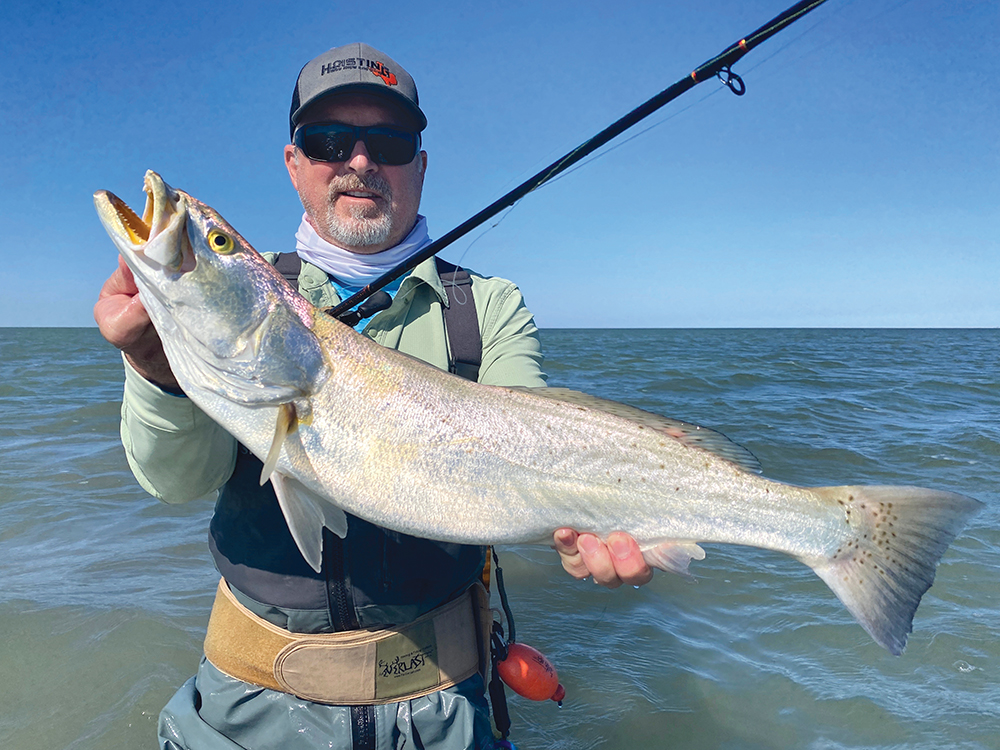
Jay Anderson with a solid 7-plus.
I have returned from Port Mansfield and it is good to be back on my home water here in Rockport. Unseasonably warm so far this month, water temperatures are already running in the upper 70s. “The wind is your friend,” once again applies and is something that I want readers to understand. Waters in the Aransas Bay Complex will remain clear even in 20-plus mph SE or even ESE wind directions. An occasional late-season front will bless us with strong NE winds, and this churns the water up slightly more than the SE wind direction. Early season growth of submerged grass has been promising, and it significantly influences how I develop daily strategies for my clients. Moving water is important all year ’round in Rockport, but it's especially relevant during the spring and summer seasons.
This month I will concentrate on two specific types of structure and both will be somewhat dependent on weather conditions. I often have anglers ask me as we push away from the dock where we are headed for the day. I think many are shocked when I say that I really don’t know for sure. I’m just going to let the conditions and hopefully some signs show us a promising starting point.
Once any submerged grass structure is located, it will (or should) only increase in size throughout the season. Reefs are my secondary structure, but they're just as important as submerged grass beds. Both of these structure types are equally productive. I probably fish grass more in the spring due to easy access and the simple fact that areas in my bay system that hold an abundance of grass allow the water clarity to hold up better during periods of high wind.
San Jose and Matagorda Island shorelines have the majority of the scattered grass beds in my area, while Southern Aransas Bay’s grass flats feature more potholes and isolated grass beds. Our barrier island shorelines also offer excellent structure in the form of parallel guts. Within these guts, we find areas of scattered grass as well as small areas of elongated grass beds that provide distinct grass edges. The key in locating the fish is first locating the water depth with the most submerged grass. Sounds simple enough, but accomplishing it can actually be rather challenging.
Now, to complicate matters, bottlenose dolphins can appear regularly and consistently drive game fish away for a brief period. When you see this happening it is okay to leave and return a while later if needed. This allows time for your area to reload. I would personally rather have a boat run over the area where I am working than a pod of dolphins.
I say this because, to the best of my knowledge, boats do not eat fish. And while it’s true that we very occasionally see prop-chopped trout and reds on the flats, these dolphins will take fish off your line and will also be quick to gobble down every fish you release when they are present and feeding.
Never is there a time when I am not looking for a food source in any area where the bottom structure is consistent with that which I know game fish to be favoring at that time. The amount of bait present can easily increase with the passing of every tidal movement. In the spring we also start seeing slicking in areas where trout and reds alike are feeding. On windward spoils and shorelines, I tend to believe that most of the slicking I am observing comes from trout. I hold this belief based on a lifetime of experience. Shallow slicks usually indicate good trout of better-than-average size. If you see them but get few bites, the trout you're after are likely making those slicks.
My best trout in Rockport typically come from shallow, windward spoils and barrier island shorelines. I prefer to run well offshore of these types of structures, outside the drop-off, when conducting my scouting runs each morning. This allows me to see everything I need to see without spooking the fish, which gives us better odds of catching once I decide to stop and fish an area.
The same is true when scouting reef structures. You want to run well offshore and then approach as quietly as you can. This just gives us better odds. And let’s face it, with fishing pressure on the rise along the entire Texas coast, we need to create our own luck as often as we can.
Try to stay as far away from the targeted area as possible when wading, making long casts to every piece of structure you can identify. Bites of any kind should stop everyone in the group in their tracks. This is when we start working and can learn important details about the fishing area that we can use in other areas that match the characteristics of the current one.
Allowing the bite to develop around us is something it took me a while to practice as a young angler and guide. It is common for individuals, including myself, to encounter times when we feel pressure to produce and should therefore pick up the pace of our wading. While that approach does pay off at times, over the years I have learned that staying power pays larger dividends more often than not.
When fishing reef structures we need to avoid walking on shell as much as possible. When I was a youngster my dad would tell me that I was “crunching them off,” meaning I was pushing the fish I was trying to catch farther ahead than I could cast. I used the same phrase with my boys when they were learning to fish oyster reefs.
Now, speaking of walking on shell, walking amid scattered shell clumps is hard on our wading boots and can even be hard on areas of our legs that are not protected by the high-top lace-up style that I prefer. My boots of choice right now are the new Southerly brand and they are holding up very well to my normal schedule of fishing five days a week, about 40 weeks per year—a great program for testing just about any product used by fishermen who wade Texas bays.
I am often asked what time of the month I recommend for booking a fishing trip and my answer has long been the same. Whenever possible, I recommend scheduling your trips three to four days before the Full and New Moon phases, not only during spring but throughout the entire year. Now, having offered that recommendation doesn’t mean you will not have good days at other times of the month because you certainly can. The question, you see, was aimed at learning my opinion of the best times to book a trip, and I answered honestly.
I use a wide variety of lure styles during spring—probably more so than any other time of the year. The new MirrOlure and Custom Corky Soft-Dine Floaters have proven to be fantastic choices for us. The slower sink ratio allows anglers to work the bait aggressively over shallow grass, drawing aggressive strikes from trout and reds. Jay Ray used them before I did and has certainly gotten into a groove with them.
I also throw the Texas Custom Double D a lot this time of year during solunar feeding periods. I am also a huge fan of soft plastics and have fished most every type and style throughout my career. Bass Assassin, MirrOlure and now the new Texas Custom and 6th Sense series of soft plastics are my current go-to baits.
Chris Bush is really good at the mid-strolling style of fishing for trout and reds. I watched him closely this winter and was very impressed. I am not ready to write anything about this style of fishing because I am not qualified at this point, but stay tuned because I will be. These two companies I mentioned are at the forefront of the industry with these types of lures. I might even have to break down and purchase a bad-to-the-bone spinning rig…we’ll just have to see.
I pretty much stick to a theory on lure color that is fairly simple and goes like this: clear water, clear-bodied lures. Dirty water, darker color patterns. Texas Custom’s Pistachio-colored soft plastics and Double D series are difficult to beat in clear water.
Spring is a terrific time to fish. Warming water temperatures and stronger tidal movements open the floodgates from the Gulf for our baitfish that reside offshore to re-enter the bays. Where the bait goes, we should follow.
There is little science that supports any specific direction that the bait goes once it enters the bay. I think that, in many bays, migration typically occurs from south to north. However, predicting this pattern is challenging because spring weather conditions are often very unpredictable. Some years the bait moves south and the fish follow. Other years it shifts to the north and game fish move with it. I believe trout follow bait no matter what the other conditions might be.
I know this to be somewhat of a gold standard: I follow the bait and it seems to have worked for over 45 years.
May Your Fishing Always Be Catching– Guide Jay Watkins