
Frequently Asked Questions

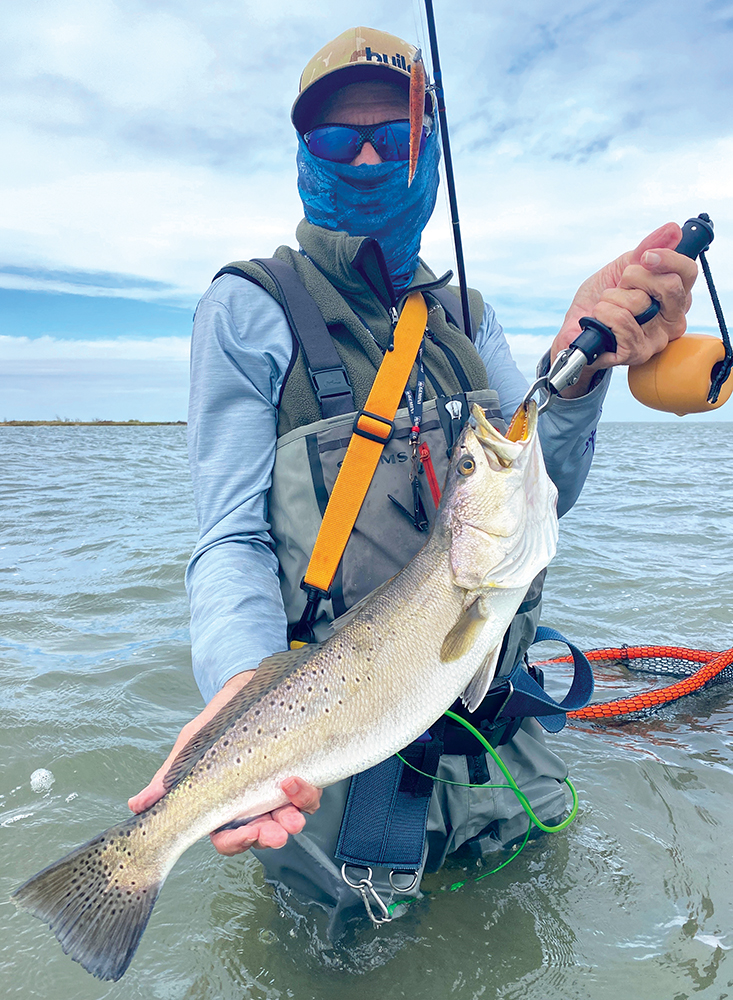
Steve Lessem with one of many good ones that day.
We get deeper into the winter pattern with the passage of each frontal system. Winter is my favorite time of the year to fish for several reasons although the bitter cold at times is no longer one of them. I am thankful to have been able to experience the development of many fine winter clothing products that allow us to stay comfortable in the harshest of conditions. Forty years ago I literally froze my butt off many a day on the water. Today’s wading products are also far superior to what I had in the beginning of my fishing career. I also like the fact that there are fewer forage choices for the trout that I chase during winter, and less boat traffic for the most part. I have the luxury of having a clientele that can adjust their schedules that allow them to fish during the week and avoid much of the boat traffic that we experience on the weekends. I guess this is one of the perks for lasting in this business as long as I have.
I have people asking me frequently how to coordinate their days on the water with the most optimal fishing times; most often with reference to the Solunar Tables. I am always aware of when the Major and Minor feeding periods for the day will occur. I also keep track of the daily moonrise and moonset, and try to make sure that I have my clients in proper areas as these events occur. It is important to remember that no matter what the optimal periods are, there must be fish present to capitalize during these periods. You can’t catch what’s not there and this is where the angler’s awareness and expertise come into play. Water time in every weather condition and season is truly the only way to gain this knowledge. You can read all you want about it; and I am glad you do, but time spent on the water experiencing as much as one can is still the best way to learn.
I was fortunate to be surrounded by people that were always willing to take me fishing as well as teach me, my dad had a master’s in biology so every day on the water and in the field were filled with science and information that I still rely on today. On my guided trips today, many are simply interested in learning why I choose the areas we fish, wanting to know what it is that I see or know that suggests these areas are the best choices for the conditions. It seems that even in some cases, the day’s catch is secondary to these nuggets of information.
I am still old school and relate the success of the day on what I can put people on and what they are able to catch. I find that most fishermen when placed in the proper area with proper coaching can catch some fish. I find it rewarding to be able to get clients on the right bite and help them tweak their skill set in a way that improves their odds. In the early years I just barked and made comments on how dumb it was to not listen to the guide. That was not good for repeat business, earning tips or future recommendations. I left rebooking’s out because nobody wants to pay to be abused. Over my long career I have gotten much better at the way I present the teaching process on the boat each day and it seems to have worked nicely for me as I continue to be booked as much as I can possibly fish at my age. Four to five days per week is still pretty good, I think.
I get a lot of questions in regard to how I know where fish will be depending on the day’s conditions. First thing to remember is that I don’t always know, no one ever truly does, whatever they might want to believe. I try to allow myself to have an awareness of the telltale signs that fish will show us if we are keyed in on what these might be. There is no doubt that my extensive time of the water as a guide has allowed me to establish patterns for multiple bay systems along the Texas coast. I am also aware that I probably sound like a broken record, continuously mentioning the importance of noting where the food sources and bottom structures that all fish need to survive are locating all the time.
It is a given that the food sources are subject to tidal movements and migration patterns. In other words, the bait moves and as this occurs the fish will often move with them. It is also important to remember which types of structures are subject to annual changes – and which are not. Let’s talk about the structures that can possibly change. These would be areas of submerged grass, shoreline guts, and sand bars. Mother Nature controls the growth and development of bottom grass and bottom structures like shoreline guts and sand bars. The lack or abundance of rainfall can cause the absence of grass or excessive grass growth. Hard winters with extremely low tides and temperatures for prolonged periods will also affect growth of our bottom grasses. Sunlight at the proper times is also a key to the growth and development of our seagrasses. I have seen harsh winters with seemingly stronger than normal cold fronts reform normal shoreline gut and bar configurations. This is definitely the case with tropical storms and hurricanes.
Hurricane Harvey destroyed most all our shoreline configurations, especially seagrasses, and even fixed structures such as mid-bay reefs. We had to literally start over at ground zero in much of our north country following that storm. Even today, fully nine years after that storm, there are still significant signs of Harvey’s passage. Some of these were good and some that were not so good. One in particular is the northwest shoreline in Copano Bay where the first and second shoreline guts have been covered with soil from the O’Connor Ranch, which is made up of a large amount of clay, and caused the once hard-packed shoreline to become quite soft and slippery in many areas. The bottom grasses have still not recovered in this area, which has made patterning fish in this area difficult for me. No structure – no bait – no fish!
We still have the annual white shrimp migration that I experienced this year with some success, but this is due to the annual migration of white shrimp out of the bays to the Gulf and not actually structure related. For the most part, oyster reefs don’t move and, given proper management of this resource the reefs will continue to grow. Recent as well as current overharvest of the oyster reefs in the Aransas Bay Complex is a serious problem and gross neglect from our Texas Parks and Wildlife, despite great strides being made recently to better conserve larger reef structures of Carlos, Cedar, Beldon’s, Ayers, and the Second Chain of Islands. These reefs are once again growing and aiding shoreline protection from erosion and water quality in our bays. In summation, reefs don’t move unless moved by Mother Nature or mankind and bottom grass, sandbars and shoreline guts can move annually depending on weather patterns.
Another question that is asked often is how we know what section of a flat holds fish when water depths, water temperatures, bottom structures, and food sources are equally distributed. The truth be told, I don’t. What I do know though, is when these areas are at their seasonal best. Countless wades in these areas have created a knowledge of the corridors that fish seem to prefer during their daily and seasonal movements. Personally, this was the most time-consuming process for me in the beginning of my career, due to the lack of experience and a lack of tools. Tools being GPS, boats with extreme shallow water capability and, of course, top-drive burn boats. I am glad I learned how I learned and believe it made me a more connected angler. I do burn at times, but I don’t depend on this method of locating fish due to knowing that I know what to look for besides just the fish itself. I do use burning for relocating structures from year to year. Burn responsively I guess could be what I am saying. Avoid the practice when it is going to negatively impact your fellow fishermen.
Just this past couple of days I fished a large flat that is relatively the same from one end to the other and bait scattered throughout. Years of wading have shown me the corridor that the fish prefer to travel day in day out. We caught them big time both days. It is important I think to say that I continue to make short wades in other areas of the flat so that I can reconfirm the pattern. It goes without saying that we catch fish in other areas of the flat but do not see the concentration of fish that we do in the area that I believe is the true corridor, the place they spend most of their time. Experimentation is still the main ingredient in proving a pattern in my opinion.
I think we should use everything that is out there to increase our odds of success on the water. I guess the next question and maybe the next article should be - What is success? That term has developed new meaning for me over the years, and I believe for the betterment of myself, clients, and the fishery.
May Your Fishing Always Be Catching! -Guide, Jay Watkins